Glossary
Energy-Based Devices Glossary: RF, MFU, IPL, Lasers
A cross-modality glossary of 60 energy-based device terms — RF families, MFU/HIFU, IPL, every laser family, plasma, EMS — defined in plain English, with the parenthetical caveats I wished a friend had given me.
After three trips through the Gangnam aesthetic-clinic circuit and a fourth where I deliberately consulted across modalities — RF, MFU, IPL, picosecond, ablative laser, plasma — I noticed I was running into a different vocabulary problem than the one my MFU glossary covered. The issue was no longer terms within a category. It was terms across categories. A picosecond laser practitioner uses "fluence" the way a Thermage practitioner uses "energy density," except the numbers reference different physics. An IPL provider talks about "target chromophore." An EMS provider talks about "motor unit recruitment." None of these are interchangeable, and none of them are explained in patient-facing brochures. This glossary is the cleaned-up version of the second notebook I started keeping — sixty terms organized A to Z that span RF, MFU, IPL, laser, plasma, and EMS modalities, plus the underlying physics vocabulary (selective photothermolysis, target chromophore, thermal relaxation time) that makes the whole field cohere. Plain English, with parenthetical Rachel-tone notes on patient outcomes where they actually matter. None of it is medical advice. It is the working vocabulary that lets you read a multi-modality consultation without nodding along.
A — Ablative, Alexandrite, AccuREP, Applicator
Section A covers four foundational terms that show up early in cross-modality consultations.
Ablative laser
A laser that vaporizes the outer skin layer (epidermis) and a controlled portion of the upper dermis to trigger a wound-healing and remodeling response. CO2 (10,600 nm) and Er:YAG (2,940 nm) are the two main ablative wavelengths in aesthetic use. Fully ablative resurfacing produces the strongest texture and laxity result of any laser approach but requires seven to fourteen days of meaningful downtime. Modern protocols are mostly fractional ablative — same depth, fraction of the surface area, much faster recovery. (Tip: "ablative" and "fractional" describe two independent axes — a fractional CO2 is still ablative, just delivered in a fraction-pattern.) See also: CO2 laser, Er:YAG, fractional.
Alexandrite laser (755 nm)
A laser at 755 nanometers, well-absorbed by melanin and to a lesser extent by hemoglobin. Used for hair removal on lighter skin tones (Fitzpatrick I–III) and for treating melanin-based pigmentation like sun spots and lentigines. Picosecond Alexandrite (PicoSure, PicoWay 755) extends the wavelength into pigment-shattering territory for tattoo removal and pigmentation. (Tip: Alexandrite is generally not the right wavelength for darker skin types — the absorption spectrum overlaps too much with epidermal melanin and risks hypopigmentation.) See also: melanin, hair-removal IPL, picosecond.
AccuREP
Thermage FLX's automatic energy calibration feature — short for "accurate repair." The device measures tissue impedance and adjusts RF energy delivery to each treatment zone in real time, so the same machine can deliver different energy levels depending on what the skin reads back. The reason a Thermage FLX session feels more uniform than older Thermage generations. (Patient-side: AccuREP is what makes FLX more comfortable than the original Thermage — ask whether your clinic operates the FLX generation.) See also: Thermage FLX, monopolar RF.
Applicator
The handheld piece a practitioner moves across your skin during an energy-based treatment. "Applicator" is the generic cross-modality term; depending on the device it may be called a handpiece, transducer (ultrasound), tip (Thermage), cartridge (MFU), or wand (IPL). Different applicators on the same platform usually deliver different depths or energy patterns. (Tip: ask which applicators are included in your specific package — "light" packages sometimes skip the deepest one.) See also: handpiece, transducer, cartridge.
B — BBL, Bipolar RF, Broadband light, Bulk heating
Section B covers four terms split between the IPL family and RF basics.
BBL (BroadBand Light)
Sciton's branded version of intense pulsed light, using filtered broadband visible-to-near-infrared wavelengths roughly 400-1400 nm with selectable cutoff filters. Targets pigment, vascular structures, and surface texture in the same session by changing the filter. Heavily used in Korean clinics for photofacial protocols and pigment management. (Tip: BBL and IPL are categorically the same modality — BBL is Sciton's specific platform, with refinements like SmartCool and Forever Young settings. "BBL" is brand, "IPL" is category.) See also: IPL, photofacial, broadband light.
Bipolar RF
A radiofrequency configuration where the current travels between two electrodes placed close together on the same handpiece, producing a shallower, more localized heating zone — typically 1 to 2mm deep. Compared to monopolar RF, bipolar reaches less deep but is more controlled and easier to use on smaller areas like around the eyes. Most microneedling RF devices and the Inmode Forma platform are bipolar. (Tip: bipolar is gentler on the surface but won't reach the dermal-subcutaneous depths monopolar covers.) See also: monopolar RF, multipolar RF, Forma RF.
Broadband light
A light source emitting many wavelengths simultaneously across a continuous spectrum, as opposed to a laser, which emits a single wavelength. IPL and BBL are both broadband devices — the broad spectrum is what allows them to target multiple chromophores (melanin, hemoglobin) in the same pulse. The trade-off is less selectivity than a single-wavelength laser. (Tip: broadband devices are versatile but not always the optimal tool — for a single specific concern, a wavelength-matched laser usually outperforms.) See also: IPL, target chromophore, selective photothermolysis.
Bulk heating
Heating a relatively large volume of tissue to a target temperature, as opposed to depositing energy at discrete focal points. Monopolar RF and most thermal RF platforms work this way — the goal is to bring a column of dermis-to-subcutaneous tissue up to roughly 40-45 degrees Celsius for several seconds, which patients report can drive collagen contraction. Bulk heating is the opposite philosophy from MFU's focal-point approach. See also: micro-coagulation, thermal effect, monopolar RF.
C — Chromophore, CO2 laser, CoolSculpting, Cooling delivery
Section C covers four terms anchored in laser physics and body-energy modalities.
Chromophore
The molecule in tissue that selectively absorbs a specific wavelength of light. The three primary aesthetic chromophores are melanin (peak absorption in the 500-1100 nm range), hemoglobin (peaks at 418, 542, 577 nm), and water (rises sharply above 1400 nm). Selective photothermolysis works by matching wavelength to chromophore so the target heats while the surrounding tissue does not. (Tip: when a practitioner says a treatment "targets pigment," the technical claim is that the wavelength is melanin-absorbed. The chromophore is the bridge between physics and outcome.) See also: selective photothermolysis, melanin, hemoglobin, water absorption coefficient.
CO2 laser
A laser at 10,600 nanometers, deeply absorbed by water, used for ablative resurfacing. Vaporizes the epidermis and upper dermis, producing the strongest single-modality result for texture, fine lines, and laxity but with seven to fourteen days of social downtime. Modern CO2 protocols are almost always fractional (Fraxel re:pair, SmartXide, eCO2). (Tip: full-field CO2 is rarely chosen in Korea today — fractional CO2 is the standard, and it's still aggressive. Schedule it well before any social event.) See also: ablative, fractional, Er:YAG, water absorption coefficient.
CoolSculpting (Cryolipolysis)
Allergan/AbbVie's branded cryolipolysis device — non-surgical fat reduction that cools targeted subcutaneous fat to roughly 4°C, triggering apoptosis (programmed cell death) of fat cells over the following weeks. FDA-cleared for several body areas including flanks, abdomen, and submental fat. (Tip: CoolSculpting addresses pinchable subcutaneous fat, not visceral fat or skin laxity. Patients with significant laxity often need a separate tightening modality afterward.) See also: cryolipolysis, EMS, hypodermis.
Cooling delivery
The mechanism a device uses to protect the epidermis during energy delivery. Three main approaches: contact cooling (chilled sapphire or glass tip pressed to skin, e.g., Thermage), cryogen spray (DCD — dynamic cooling device, common on Candela platforms), and forced air cooling (Zimmer Cryo). Cooling timing matters — pre-cooling, parallel cooling, or post-cooling each protect different layers. (Tip: aggressive cooling lets you use higher fluence safely; insufficient cooling is the most common cause of laser burns at the surface.) See also: contact cooling, epidermal protection, fluence.
D — Depth of penetration, Diode laser, DeepSEE, Doublo
Section D covers four terms spanning physics fundamentals and named platforms.
Depth of penetration
How far an energy modality reaches into tissue, measured from the skin surface. Visible-light lasers (532 nm KTP) penetrate roughly 0.5-1mm; near-infrared lasers (1064 nm Nd:YAG) reach 4-6mm; mid-infrared (1550 nm Fraxel Dual) targets 0.4-1.4mm dermis; far-infrared (10,600 nm CO2) is largely surface. RF depth depends on configuration: bipolar 1-2mm, monopolar 2-4mm. MFU reaches 1.5mm, 3mm, or 4.5mm depending on transducer. (Tip: the depth-target match is the categorical decision in modality selection — surface pigment needs a different penetration profile than SMAS lifting.) See also: target chromophore, water absorption coefficient, focal point.
Diode laser
A semiconductor laser, most commonly at 800-810 nm or 1064 nm wavelengths in aesthetic use. The 800-810 nm diode is the workhorse hair-removal laser (LightSheer, Soprano). The 1064 nm diode overlaps with Nd:YAG territory and is used for vascular and tightening protocols. Diodes are reliable, relatively compact, and work across a wider range of skin types than Alexandrite. (Tip: 800 nm diode is the standard for darker skin hair removal — lower melanin overlap than Alexandrite at 755 nm.) See also: hair-removal IPL, Nd:YAG, Alexandrite.
DeepSEE (imaging guidance)
Real-time ultrasound imaging on the Ulthera/Ultherapy device screen during MFU treatment. Lets the practitioner see the tissue layers — dermis, fat, SMAS — and confirm the focal point is landing in the correct layer before each pulse. The categorical feature distinguishing MFU from HIFU. (Tip: ask whether the device used in your session includes DeepSEE imaging — some lower-cost ultrasound treatments skip the visualization layer.) See also: MFU, HIFU, focal point, visualization.
Doublo
A Korean-manufactured HIFU device often offered as a budget alternative to Ultherapy. Uses focused ultrasound at three depths similar to Ultherapy (1.5mm, 3mm, 4.5mm) but operates at higher energy per shot and lower precision targeting compared to MFU with imaging guidance. (Tip: Doublo is HIFU, not the same as Ultherapy's MFU — the visualization layer is the categorical difference, not the depth list.) See also: HIFU, MFU, Shurink.
E — ELECTRO modalities, Emsculpt, Endymed, Er:YAG
Section E spans electromagnetic body modalities and a key ablative laser wavelength.
ELECTRO modalities
Umbrella term for body-contouring devices that deliver electromagnetic energy to muscle and fat tissue. Three main subcategories: HIFEM (high-intensity focused electromagnetic, e.g., Emsculpt — induces supramaximal muscle contractions), monopolar RF body (Vanquish — bulk fat heating), and combination platforms (Emsculpt Neo — RF + HIFEM in the same applicator). FDA cleared for several body areas. (Tip: ELECTRO modalities target muscle and fat at the same time, which is why they are positioned as body sculpting rather than pure fat reduction.) See also: Emsculpt, Vanquish, monopolar RF.
Emsculpt (HIFEM)
BTL Aesthetics' branded HIFEM device — high-intensity focused electromagnetic field that triggers supramaximal muscle contractions in the underlying muscle group. Originally cleared for abdomen and buttocks, now extended to arms, calves, and thighs. Patients report visible muscle definition gains over four to six sessions. (Tip: Emsculpt is muscle-toning, not fat reduction — Emsculpt Neo combines HIFEM with RF in the same applicator for both effects in one session.) See also: HIFEM, ELECTRO modalities.
Endymed Tightening
An Israeli-manufactured RF platform using a proprietary multi-electrode "3DEEP" technology — a multipolar RF configuration that delivers energy in shifting electrode patterns to reach deeper than standard bipolar RF without the surface concerns of monopolar. Used for face and body tightening. Less common in Korean clinics than Thermage but present at some Gangnam practices. See also: bipolar RF, multipolar RF.
Er:YAG laser (2,940 nm)
Erbium-doped yttrium aluminum garnet laser at 2,940 nanometers, the wavelength most strongly absorbed by water of any aesthetic laser. Ablative like CO2 but with about ten times higher water absorption, which means more precise vaporization with less residual thermal damage to surrounding tissue. Recovery is faster than CO2 but the result per pass is less tightening because the residual thermal effect is what drives some of CO2's collagen response. (Tip: Er:YAG suits patients who want resurfacing precision with shorter downtime; CO2 suits patients prioritizing maximum collagen response.) See also: ablative, CO2 laser, water absorption coefficient.
F — FDA cleared, Fluence, Focal point, Fractional, Forma RF
Section F covers five terms spanning regulatory vocabulary and core energy parameters.
FDA cleared
A regulatory pathway in the United States indicating a device has demonstrated substantial equivalence to a previously cleared device through the 510(k) process. "FDA cleared" is not the same as "FDA approved" — approval (PMA pathway) requires clinical safety and efficacy data; clearance is a lower bar. Most aesthetic energy devices are cleared, not approved. (Tip: "FDA cleared" is sometimes used loosely in marketing — clearance is for a specific indication on a specific device generation, and the same brand may have multiple generations with different clearance scopes.) See also: KFDA Class II / Class III, off-label.
Fluence
Energy delivered per area, measured in joules per square centimeter (J/cm²). The standard parameter for laser and IPL treatments. Higher fluence means more aggressive treatment, but the relationship to outcome is non-linear — above a threshold, more fluence stops adding benefit and starts adding risk. "Fluence" tends to come up more in laser conversations; "energy density" or "J per shot" in MFU. (Tip: ask for the fluence target, not just "high energy" — the number is more informative than the marketing word.) See also: energy density, J/cm², pulse duration.
Focal point
The precise depth at which focused ultrasound energy converges and deposits its peak thermal effect. In MFU, the transducer's geometry and frequency determine the focal depth — 1.5mm, 3mm, or 4.5mm in the Ultherapy protocol. The tissue above the focal point is largely unaffected because the energy is converging there, not depositing along the path. (Tip: this is why a "deep" treatment is not necessarily a "hot" treatment at the surface.) See also: focused ultrasound, transducer, MFU.
Fractional
A treatment pattern that delivers energy to small fractions of the treatment area, leaving untreated skin between treated zones. Fractional ablative (CO2, Er:YAG), fractional non-ablative (Fraxel Dual 1550/1927), and fractional RF (Morpheus8, Profound) all use this principle. The untreated bridges of skin speed healing and reduce downtime compared to fully ablative treatments. (Tip: "fractional" describes a delivery pattern, not a depth — fractional devices exist at many depths.) See also: dot density, ablative, Fraxel Dual.
Forma RF (Inmode)
An Inmode bipolar RF handpiece designed for non-invasive surface tightening at the upper dermis. Lower energy, zero downtime, generally delivered as a series of weekly sessions for maintenance protocols. Used by patients seeking subtle texture-and-tightening without committing to deeper modalities. (Tip: Forma is maintenance-grade, not transformative — pair it with a deeper modality if structural laxity is the concern.) See also: bipolar RF, Inmode, Sublime.
G — Glide vs stamp, Grid pattern
Section G covers two delivery-pattern terms.
Glide vs stamp delivery
Two delivery patterns for microneedling RF and some laser handpieces. "Stamp" technique places the handpiece on a fixed spot, fires, lifts, moves, and repeats; "glide" or "motion" technique allows the handpiece to be moved continuously across the skin while firing. Stamp is more precise and standard for face work; glide is faster and more common for body. (Tip: most Korean face protocols are stamp-based — ask if your specific protocol uses glide, since the energy distribution differs.) See also: dot density, microneedling RF.
Grid pattern
The geometric layout used to map treatment shots across an area. Square, hexagonal, and offset-row grids are the most common. Grid spacing determines coverage density and overlap; a tighter grid produces more uniform results but more discomfort and longer treatment time. Different platforms have device-defined grids (Ulthera lines), provider-drawn grids (Thermage), and software-assisted grids (some fractional lasers). See also: line count, dot density, zonal protocol.
H — Hair-removal IPL, Hemoglobin, HIFU, Hypodermis
Section H covers four cross-modality vocabulary terms.
Hair-removal IPL
Intense pulsed light specifically filtered for melanin absorption in the 600-1000 nm range, used to disable hair follicles by heating the melanin in the hair shaft. Different from laser hair removal (Alexandrite, diode, Nd:YAG) in that the spectrum is broader and the per-pulse selectivity is lower, but the cost per session is also lower. (Tip: IPL hair removal works best on light skin with dark hair — high contrast between epidermal melanin and follicular melanin. Darker skin types should use Nd:YAG, not IPL.) See also: IPL, melanin, Nd:YAG, diode laser.
Hemoglobin
The oxygen-carrying protein in red blood cells, and one of the three primary aesthetic chromophores. Hemoglobin absorbs strongly at 418 nm (Soret band), 542 nm, and 577 nm (visible green-yellow). Vascular treatments — telangiectasias, port wine stains, broken capillaries, redness — target hemoglobin using KTP/532 nm, pulsed dye laser (PDL), or vascular-filtered IPL. (Tip: rosacea-related redness is hemoglobin-driven, which is why pigment-targeted lasers are not the right choice — match the wavelength to the chromophore.) See also: chromophore, KTP laser, pulse dye laser, vascular IPL.
HIFU
High-intensity focused ultrasound at higher per-shot energy and broader focal spots than MFU, typically without real-time imaging guidance. Doublo, Shurink, and many third-tier ultrasound devices fall into this category. Can reach similar depths to MFU but with less precise targeting and more variable patient experience. (Tip: HIFU and MFU are not the same — the visualization layer and focal-spot precision are the categorical differences.) See also: MFU, Doublo, Shurink, focused ultrasound.
Hypodermis
The fat layer beneath the dermis, also called the subcutis or subcutaneous tissue. Most MFU treatments at the 4.5mm depth pass through or terminate near the hypodermis to reach the SMAS below. RF at the 2-4mm volumetric range often heats portions of the hypodermis. CoolSculpting and HIFU body modalities target the hypodermis directly for fat reduction. See also: dermis, SMAS, subcutaneous, CoolSculpting.
I — IPL, Inmode, IPL hair removal, IPL vascular
Section I covers the IPL family and the Inmode platform.
IPL (Intense Pulsed Light)
A broadband light source emitting wavelengths roughly 400-1400 nm, with selectable cutoff filters that limit which part of the spectrum reaches the skin. Used as a single platform for multiple concerns — pigment, vascular structures, hair, mild texture — by changing the filter. Lumenis M22, Sciton BBL, and Cynosure Icon are the most-recognized IPL platforms. (Tip: IPL is versatile but not always optimal — for a single specific concern, a wavelength-matched laser usually outperforms a filtered IPL.) See also: BBL, broadband light, photofacial.
Inmode
An Israeli medical device manufacturer with a multi-handpiece RF platform widely used in Korean clinics. The Inmode lineup includes Forma (surface RF), FaceTite (minimally-invasive subcutaneous RF), Morpheus8 (microneedling RF), Lumecca (IPL), and several body-contouring handpieces. Often offered as combination protocols across multiple handpieces in one session. See also: Forma RF, Morpheus8, IPL.
IPL photofacial
An IPL session targeting both pigment and vascular concerns in the same treatment, typically using a 515-560 nm cutoff filter. Improves overall complexion uniformity by addressing sun spots, mild redness, and small broken capillaries simultaneously. Generally delivered as a series of three to five sessions four weeks apart. (Tip: photofacial is a maintenance modality, not a corrective one — single-session results are subtle, and the cumulative effect is the goal.) See also: BBL, IPL, photofacial.
IPL vascular filter
An IPL filter cutoff (typically 530-560 nm) selected specifically to target hemoglobin while reducing melanin uptake. Used for facial redness, telangiectasias, and rosacea management. The vascular filter is one of several filter options on the same IPL platform. (Tip: vascular IPL works best on lighter skin where pigment competition is minimal; darker skin tones often respond better to dedicated vascular lasers like KTP or PDL.) See also: hemoglobin, KTP laser, pulse dye laser.
J — J/cm² (energy units)
Section J covers the unit of measurement that shows up on every device specification sheet.
J/cm² (joules per square centimeter)
The standard unit for energy density delivered per area of treated skin. A useful reference: most laser fluences range from 1 J/cm² (low-fluence Nd:YAG toning) up to 50+ J/cm² (aggressive ablative). MFU lines deliver roughly 0.18 to 1.2 joules per pulse with hundreds of pulses per session. RF energy is sometimes specified in J/cm² and sometimes in proprietary unit scales. (Tip: when comparing two clinic packages, ask for total joules delivered or J/cm² at each depth — the numerical comparison is more honest than the marketing words.) See also: fluence, energy density.
K — KFDA Class II, KFDA Class III, KTP laser
Section K covers Korean device regulation and one important visible-light laser wavelength.
KFDA Class II
The Korean Ministry of Food and Drug Safety classification for medium-risk medical devices, including most non-ablative aesthetic devices — IPL, low-fluence Q-switched lasers, microneedling RF in some configurations. Class II devices require manufacturer registration and quality-system certification but lower clinical-evidence burden than Class III. (Tip: KFDA Class II clearance is the most common category for aesthetic devices in Korean clinics; it does not equate to FDA clearance — the regulatory pathways are independent.) See also: KFDA Class III, FDA cleared.
KFDA Class III
The Korean Ministry of Food and Drug Safety classification for higher-risk medical devices, including ablative lasers, monopolar RF (Thermage), MFU (Ultherapy), and some HIFU platforms. Class III devices require clinical evidence submissions and ongoing post-market surveillance. (Tip: a device's KFDA class signals its risk profile and the regulatory burden the manufacturer carries — Class III devices typically demand more practitioner training.) See also: KFDA Class II, FDA cleared, Thermage FLX, MFU.
KTP laser (532 nm)
A potassium titanyl phosphate laser at 532 nanometers, in the visible green spectrum. Strongly absorbed by hemoglobin and oxyhemoglobin, making it ideal for treating superficial vascular concerns — facial redness, telangiectasias, port wine stains, cherry angiomas. Limited penetration depth (~1mm) means it is surface-only. (Tip: KTP is the precise tool for facial vessels and pinpoint redness; deeper vascular work usually moves to PDL or 1064 Nd:YAG.) See also: hemoglobin, pulse dye laser, IPL vascular filter.
L — LED therapy, Lutronic, Lasers (overview)
Section L covers light-only modalities and the Korean laser manufacturer most patients will see named.
LED therapy (red, blue, yellow)
Low-level light therapy using light-emitting diodes at specific wavelengths — red (~630 nm) for collagen stimulation and inflammation, blue (~415 nm) for Cutibacterium acnes targeting in acne, yellow (~590 nm) for redness and post-procedure recovery. LED is sub-thermal — no heating, no photon-pigment selectivity, and no downtime. Often offered as add-on or recovery sessions after laser or RF. (Tip: LED is supportive, not transformative — useful for post-treatment recovery and as an adjunct to acne protocols, less useful as a primary anti-aging treatment.) See also: low-level light therapy, photofacial.
Lutronic
A Korean medical device manufacturer producing several aesthetic lasers and RF platforms widely used in Korean clinics — Spectra (Q-switched 1064/532 Nd:YAG), Lutronic Genius (microneedling RF), PicoPlus (picosecond), Lasemd (1927 nm thulium fiber). Strong domestic distribution gives Lutronic platforms heavy presence in Gangnam protocol menus. (Tip: many "laser toning" treatments in Korea are run on Lutronic Spectra — ask for the specific device name when comparing protocols.) See also: Spectra, picosecond, Q-switched.
Lasers (overview)
Light Amplification by Stimulated Emission of Radiation — a single-wavelength, coherent, monochromatic light source. The wavelength determines which chromophore the laser targets and how deep it penetrates. Aesthetic lasers span 532 nm (KTP) through 10,600 nm (CO2). Pulse duration determines whether the energy delivers thermally or photoacoustically. (Tip: "laser" is a category, not a treatment — the wavelength, pulse duration, and fluence together define what a specific laser session actually does.) See also: chromophore, fluence, pulse duration, selective photothermolysis.
M — Melanin, MFU, Microneedle RF, Monopolar RF, Morpheus8, MMRF, Multipolar RF
Section M is dense — seven terms, most of them core RF, MFU, and chromophore vocabulary.
Melanin
The pigment in skin and hair, and one of the three primary aesthetic chromophores. Absorbs broadly across 400-1100 nm with peaks weighted toward shorter wavelengths. Pigment treatments (sun spots, lentigines, melasma) and hair-removal treatments both target melanin, with the wavelength selected to favor the right structure. (Tip: melasma is melanin-based but unusually thermosensitive — high-fluence pigment lasers can worsen melasma. Picosecond and low-fluence Nd:YAG protocols are the safer paths.) See also: chromophore, hair-removal IPL, picosecond, melanophage.
MFU (Micro-focused ultrasound)
Ultrasound energy delivered to small focal points at precise depths, typically 1.5mm, 3mm, and 4.5mm in face protocols. The signature MFU platform is Ulthera/Ultherapy, which combines micro-focused ultrasound with real-time imaging guidance. MFU produces small thermal coagulation points at the focal depth, which the body responds to over months with new collagen synthesis. See also: HIFU, focal point, Ultherapy, DeepSEE.
Microneedle RF
A hybrid treatment combining microneedling (insulated needles inserted into the dermis) with RF energy delivered from the needle tips. Reaches dermal depths from 0.5mm to 4mm depending on platform. Produces both texture improvement (from the microneedling component) and dermal tightening (from the RF component). Recovery is longer than non-needle RF — typically three to seven days of erythema and small marks. See also: insulated needle, Morpheus8, Profound RF, Lutronic Genius.
Monopolar RF
A radiofrequency configuration where the current travels from a single electrode on the handpiece through the body to a return pad placed elsewhere on the patient. The current path produces deeper, more volumetric heating — typically 2 to 4mm into the dermis and into the upper hypodermis. Thermage is the most-recognized monopolar RF platform. (Tip: if you see a return pad placed on your back or thigh during prep, that is the giveaway you are getting a monopolar treatment.) See also: bipolar RF, multipolar RF, Thermage FLX.
Morpheus8 (Inmode)
An Inmode bipolar microneedling RF handpiece using insulated needles at depths from 0.5mm to 4mm. One of the more popular microneedling RF platforms in Korean clinics. Marketed for combined texture-and-tightening outcomes, with adjustable depth across the same session. See also: microneedle RF, insulated needle, Inmode, Profound RF.
MMRF (Multi-pass Multi-pulse RF)
An RF treatment protocol combining multiple passes across the same area with multiple pulses per pass at varying energy levels. Used to produce a graduated heating effect that is gentler than a single high-energy pass. Common in Korean RF protocols. (Tip: MMRF is a protocol, not a device — different machines can be run with MMRF technique.) See also: monopolar RF, bulk heating.
Multipolar RF
An RF configuration with multiple electrodes (typically three or more) on the same handpiece, with current alternating between electrode pairs. Reaches deeper than bipolar with more surface control than monopolar. Endymed's 3DEEP and the Tripollar platform are the most-recognized multipolar RF technologies. See also: bipolar RF, monopolar RF, Endymed Tightening, Tripolar RF.
N — Nd:YAG, Neocollagenesis, NeoGen plasma
Section N covers a key laser wavelength, the underlying biology, and one plasma platform.
Nd:YAG laser (1064 nm)
Neodymium-doped yttrium aluminum garnet laser at 1064 nanometers, in the near-infrared spectrum. Penetrates deeper than other aesthetic lasers (4-6mm) with relatively low pigment absorption, making it the standard for deeper vascular work, leg veins, hair removal on darker skin types, and laser toning protocols. Available in long-pulse and Q-switched configurations for different applications. (Tip: 1064 Nd:YAG is the safest hair-removal wavelength for Fitzpatrick V-VI skin — the lower melanin absorption protects the epidermis.) See also: Q-switched, hair-removal IPL, Spectra, KTP laser.
Neocollagenesis
The process of new collagen formation in tissue — literally "new collagen genesis." Almost every non-surgical lifting and resurfacing modality works by triggering neocollagenesis: MFU through focal coagulation points, RF through bulk heating, microneedling through controlled dermal injury, fractional lasers through micro-thermal zones. The neocollagenesis response unfolds over weeks to months, which is why energy-based treatments rarely produce immediate visible lift. (Tip: when a clinic says "results in three to six months," the gap is the neocollagenesis timeline.) See also: dermis, SMAS, coagulation point.
NeoGen plasma
Energist Medical's nitrogen-plasma device producing a plasma arc that delivers thermal energy to the skin without ablation in a fractional pattern. Produces collagen remodeling and skin tightening with a recovery profile somewhere between non-ablative laser and fractional CO2. Less common in Korean clinics than fractional CO2 but present in some Western practices. See also: plasma, J-Plasma, fractional.
O — Off-label, Onda Coolwaves
Section O covers a regulatory term and one device-specific energy modality.
Off-label use
Use of a device or treatment for an indication other than the one for which it received regulatory clearance or approval. Off-label use is legal and common in aesthetic medicine — Ultherapy is FDA-cleared for brow, submentum, and neck, but is widely used off-label for chest, knees, and elsewhere. (Tip: off-label use is not the same as unsafe use, but it does shift the evidence base from manufacturer studies to practitioner clinical experience. Ask about your specific clinic's experience with the off-label area.) See also: FDA cleared, KFDA Class III.
Onda Coolwaves
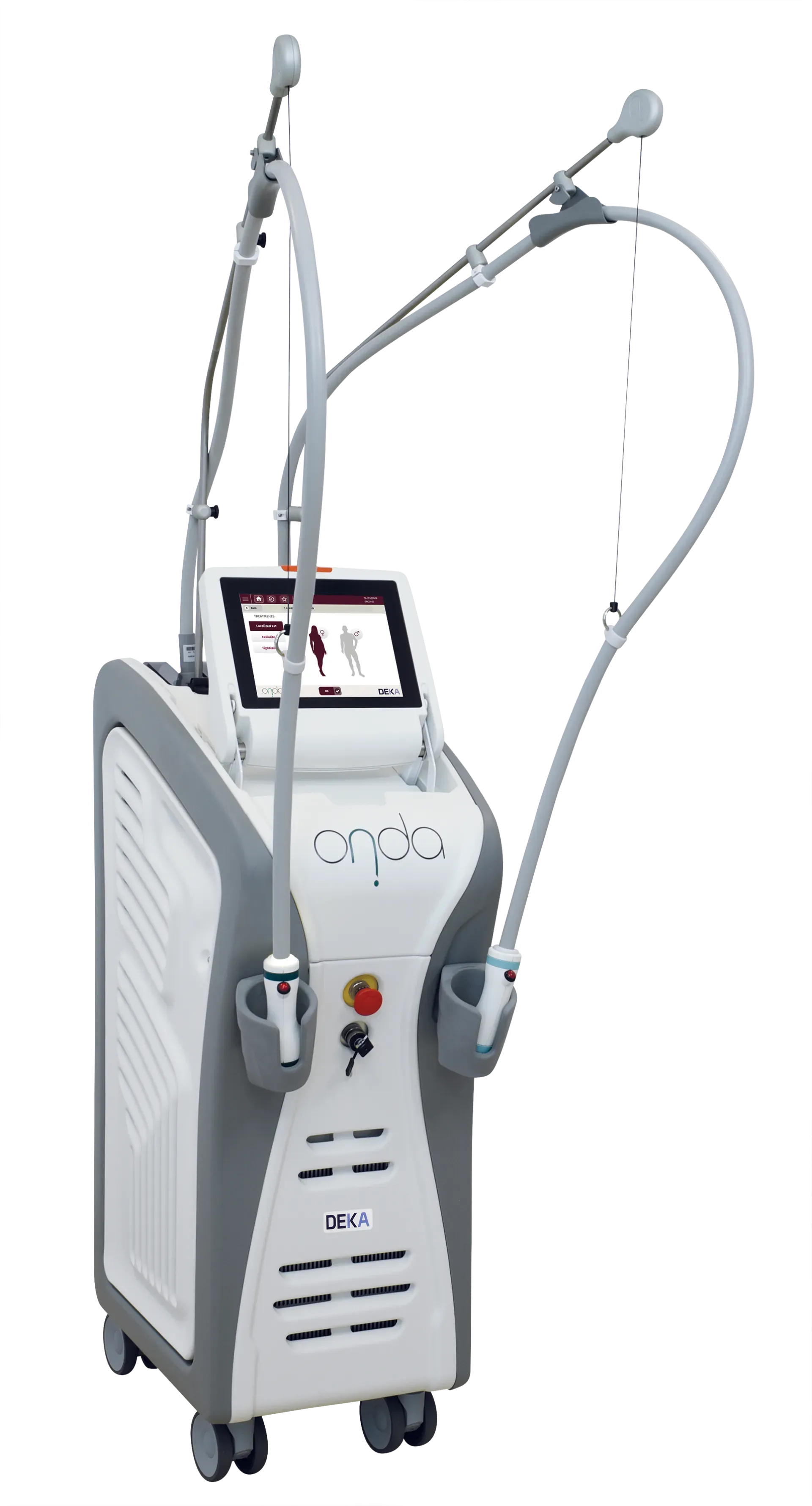
DEKA's proprietary microwave-frequency electromagnetic energy used by the Onda platform. The wavelength is designed to be selectively absorbed by subcutaneous fat tissue, with less heating in the dermis above. Primarily used for body contouring and localized fat reduction; some practitioners use Onda for lower-face contouring as well. See also: monopolar RF, bulk heating, ELECTRO modalities.
P — Photofacial, Picosecond, Plasma (J-Plasma), Profound RF, Pulse dye laser, Pulse duration
Section P covers six terms spanning IPL, laser, plasma, and RF.
Photofacial
A general term for a multi-wavelength IPL or BBL session targeting both pigment and vascular concerns in the same visit. The terminology is older than "BBL" or "M22 photofacial" — it is the category label, not a specific platform. (Tip: "photofacial" describes a treatment style, not a device — ask which IPL platform and filter combination is being used to know what you are actually getting.) See also: IPL, BBL, broadband light.
Picosecond laser (Pico)
A laser delivering pulses in the picosecond range (one trillionth of a second) — much shorter than the nanosecond pulses of Q-switched lasers. The shorter pulse produces a stronger photoacoustic effect with less thermal collateral, which is why pico is preferred for tattoo removal, melasma, and some pigmentation concerns. PicoSure (755 nm), PicoWay (532/1064/785), Discovery Pico, and Lutronic PicoPlus are the leading platforms. (Tip: picosecond is generally safer for melasma than Q-switched at higher fluences — the photoacoustic mechanism is gentler on melanocytes.) See also: Q-switched, melanin, melanophage, Spectra.
Plasma (J-Plasma)
Apyx Medical's helium-plasma device — a bipolar, helium-ionized plasma stream delivered through a wand. Used in subcutaneous tightening procedures and as an open-skin tightening tool during surgical lifts. Different from cold plasma and from nitrogen-based NeoGen plasma. (Tip: J-Plasma is generally a surgical-adjunct modality rather than a stand-alone non-surgical option — ask about practitioner training when it comes up.) See also: NeoGen plasma, cold plasma, plasma.
Profound RF
Candela's bipolar microneedling RF platform with insulated needles at fixed depths (5.0mm or 6.0mm depending on the cartridge). Differentiated from Morpheus8 by deeper fixed-depth needles and longer hold times per pulse, designed to produce a more controlled thermal dose at the deep dermal-subcutaneous boundary. (Tip: Profound is positioned for laxity-driven cases; Morpheus8 has more surface texture overlap. Different platforms, different categorical claims.) See also: Morpheus8, microneedle RF, insulated needle.
Pulse dye laser (PDL)
A laser at 585-595 nm using a fluorescent dye as the lasing medium, strongly absorbed by hemoglobin. The vascular workhorse for port wine stains, telangiectasias, rosacea, and post-acne erythema. V-Beam (Candela) and Cynergy are the most-recognized PDL platforms. (Tip: PDL produces a transient bruise-like "purpura" at standard treatment settings — modern protocols often run sub-purpuric to avoid the bruising at the cost of more sessions.) See also: hemoglobin, KTP laser, IPL vascular filter.
Pulse duration
The length of time energy is delivered in a single pulse, measured in seconds, milliseconds, microseconds, nanoseconds, or picoseconds depending on the device. Shorter pulses produce more peak energy with less collateral heating; longer pulses produce more thermal effect with less peak intensity. The pulse duration relative to the target's thermal relaxation time is what determines how selectively the target is heated. (Tip: pulse duration matters more on lasers than on MFU or RF — most ultrasound and RF devices have fixed pulse profiles, while laser platforms allow pulse-duration adjustment.) See also: thermal relaxation time, selective photothermolysis, fluence.
Q — Q-switched
Section Q covers one important pulse-mode for pigment and tattoo work.
Q-switched laser
A laser pulse-mode that produces nanosecond pulses (one billionth of a second) with very high peak power, used for tattoo removal and pigmentation treatments. The short pulse generates a photoacoustic shockwave that fragments pigment particles, which the body's macrophages then clear. Q-switched Nd:YAG (1064/532, e.g., Spectra) is the standard platform. Picosecond lasers are the next generation in this category. (Tip: Q-switched is still highly effective for many pigmentation concerns and is often more cost-accessible than picosecond — the choice between Q-switched and pico is case-by-case.) See also: picosecond, Spectra, Nd:YAG.
R — Repetition rate, RF, Ruby laser
Section R covers a key parameter and two foundational modalities.
Repetition rate (Hz)
How many pulses per second a device delivers, measured in hertz. A 10 Hz repetition rate means ten pulses per second. Higher rates speed up treatment time but also raise the average power deposited, which can require lower per-pulse fluence to stay safe. Picosecond and Q-switched lasers operate at low Hz (1-10); some IPL and diode platforms run faster scan modes. (Tip: faster repetition is convenient but does not improve outcome by itself — fluence and pulse duration are the parameters that drive results.) See also: pulse duration, fluence, J/cm².
RF (Radiofrequency)
Electromagnetic energy in the radio-wave range, used to heat tissue by causing rapid molecular vibration. RF can be configured as monopolar, bipolar, or multipolar depending on electrode placement. Different configurations reach different depths and produce different heating patterns. Monopolar RF (Thermage) reaches deepest; bipolar RF is shallower and more controlled. See also: monopolar RF, bipolar RF, multipolar RF, microneedle RF.
Ruby laser (694 nm)
A laser at 694 nanometers, historically one of the first aesthetic lasers, used for pigmented lesions and tattoo removal. Largely replaced in modern clinics by Q-switched Nd:YAG and picosecond platforms, but still present in some legacy practice menus. (Tip: ruby laser is a niche choice today; if a clinic is offering it, ask why over picosecond or Q-switched Nd:YAG, which generally outperform on most modern indications.) See also: Q-switched, Alexandrite, picosecond.
S — Selective photothermolysis, Shurink, Sofwave SUPERB, Spectra, Spot size, Sublime
Section S spans the foundational physics principle and several major device platforms.
Selective photothermolysis
The foundational principle of laser and IPL aesthetics, articulated by Anderson and Parrish in 1983. Selectively destroys a target tissue by matching three parameters: wavelength absorbed by the target chromophore, pulse duration shorter than the target's thermal relaxation time, and fluence high enough to denature the target. Every laser and IPL treatment is an application of this principle. (Tip: "selective photothermolysis" sounds like jargon, but it is the entire physics of how a laser leaves your skin alone while heating only the brown spot. Worth understanding once.) See also: chromophore, thermal relaxation time, pulse duration, fluence.
Shurink
A Korean-manufactured HIFU device, also marketed as Shurink Universe and Shurink Prime, widely used in Korean clinics as a budget alternative to Ultherapy. Uses focused ultrasound at multiple depths and has been iterated through several generations. (Tip: Shurink and Doublo are both HIFU, not MFU — they share the focal-point ultrasound mechanism but lack the imaging-guidance precision of Ultherapy.) See also: Doublo, HIFU, MFU.
Sofwave SUPERB
An Israeli-manufactured device using SUPERB (Synchronous Ultrasound Parallel Beam) technology — seven parallel ultrasound transducer beams delivering energy to the mid-dermis at approximately 1.5mm depth. FDA-cleared for brow, neck, and submental lifting. The treatment is shallower than MFU at 4.5mm but uses a different mechanism — broad parallel-beam heating rather than focal-point coagulation. (Tip: Sofwave reaches the mid-dermis, not the SMAS — the categorical claim is different from MFU.) See also: MFU, SUPERB transducer, focal point.
Spectra (Lutronic)
Lutronic's Q-switched 1064/532 Nd:YAG laser, one of the most heavily used platforms in Korean laser-toning protocols. Delivers low-fluence 1064 nm passes for melasma and dermal pigment, and 532 nm passes for surface lentigines and freckles. (Tip: "laser toning," "laser facial," and "Spectra peel" in Gangnam menus all refer to Lutronic Spectra protocols. Ask for the specific energy and wavelength setting if you want to compare across clinics.) See also: Q-switched, Nd:YAG, melanin.
Spot size
The diameter of the laser beam at the skin surface, typically 2-15mm. Larger spot sizes penetrate deeper at the same fluence because less energy is lost to lateral scattering. Smaller spot sizes give more precise placement at the cost of slower coverage. (Tip: spot size affects the effective depth of laser treatments — when comparing two clinic protocols, the spot size and fluence together determine the actual energy delivered to the target depth.) See also: fluence, depth of penetration, pulse duration.
Sublime (Candela GentleMax/Syneron)
Originally a Syneron-branded RF + infrared light combination handpiece (now incorporated into the Candela GentleMax Pro Plus and similar platforms) using simultaneous bipolar RF and 700-2000 nm infrared light for surface tightening. Lower energy than Thermage, no downtime, generally delivered as a series of sessions. (Tip: Sublime sits in the "maintenance tightening" category alongside Forma — useful between deeper modality sessions.) See also: bipolar RF, Forma RF.
T — Target chromophore, Thermage FLX, Thermal relaxation time, Tripolar RF, TRT
Section T covers the core selectivity vocabulary plus key RF platforms.
Target chromophore
The specific molecule a treatment is designed to heat preferentially. The three primary aesthetic targets are melanin (pigment treatments, hair removal), hemoglobin (vascular treatments, redness), and water (ablative resurfacing). Selective photothermolysis works by matching wavelength to target chromophore so the target heats while surrounding tissue does not. (Tip: the practical question for any laser session is "what chromophore are we targeting?" — the answer dictates wavelength, fluence, and pulse duration.) See also: chromophore, melanin, hemoglobin, water absorption coefficient.
Thermage FLX
The current generation of the Thermage monopolar RF platform, manufactured by Solta Medical (now part of Bausch Health). FLX features the AccuREP automated calibration, a vibrating tip, integrated cooling, and a larger treatment tip than earlier Thermage generations. The most-recognized monopolar RF device globally. (Tip: "Thermage" without "FLX" usually means an older generation — ask which version your clinic operates.) See also: monopolar RF, AccuREP, contact cooling.
Thermal relaxation time (TRT)
The time it takes a heated structure to lose half of its absorbed thermal energy back to surrounding tissue, measured in milliseconds or microseconds. The TRT depends on target size — small structures (melanosomes ~1 microsecond) cool faster than large structures (hair follicles ~50 milliseconds). Pulse duration shorter than TRT confines heat to the target; longer pulse durations leak heat to surrounding tissue. (Tip: TRT is why pulse duration matters — it is the physics behind why a 100-millisecond hair-removal pulse and a 1-nanosecond tattoo pulse are both "correct," just for different targets.) See also: selective photothermolysis, pulse duration, target chromophore.
Tripolar RF
A multipolar RF configuration with three electrodes on the same handpiece, with current alternating between electrode pairs. Reaches moderate depths (1.5-2.5mm) with more surface control than monopolar. The Pollogen Tripollar handpiece is the most-recognized tripolar platform. (Tip: tripolar sits between bipolar and Endymed multipolar in depth — a middle option for patients who want more than surface but less than monopolar.) See also: bipolar RF, multipolar RF, Endymed Tightening.
TRT (acronym for thermal relaxation time)
Shorthand for thermal relaxation time, used in laser physics and aesthetic device specifications. When a clinic protocol or device manual references "TRT," it means the same concept defined above — the cooling time of the target structure. See also: thermal relaxation time.
U — Ulthera, Ultherapy Prime, Ultrasound
Section U covers the MFU platform and the broader energy category.
Ulthera (Ultherapy)
The Merz Aesthetics MFU platform that introduced microfocused ultrasound with imaging guidance to the aesthetic market. "Ulthera" is the device name; "Ultherapy" is the marketed treatment name. Delivers focal-point ultrasound at three depths (1.5mm, 3mm, 4.5mm) with real-time DeepSEE imaging. The first MFU device to receive FDA clearance for non-surgical lift indications. See also: MFU, DeepSEE, Ultherapy Prime.
Ultherapy Prime
The current-generation Ulthera platform, launched as an upgrade to the original Ultherapy device. Prime features improved transducer ergonomics, faster mapping speed, updated imaging clarity, and patient-comfort refinements. The underlying depth-frequency architecture (1.5mm, 3mm, 4.5mm) is unchanged. (Tip: Prime is a hardware-and-software upgrade, not a different treatment — the depth and protocol are the same as original Ultherapy.) See also: Ulthera, device generation.
Ultrasound (medical)
Sound waves at frequencies above human hearing (>20 kHz), used in medical imaging and energy delivery. Aesthetic ultrasound modalities span LDM (kHz-range, mechanical), MFU (MHz-range, focal-point thermal), HIFU (MHz-range, broader focal spots), Sofwave (parallel-beam thermal), and HIFU body contouring. Different frequencies and beam patterns produce categorically different effects. See also: MFU, HIFU, Sofwave SUPERB.
V — Vanquish, Volnewmer, V Max
Section V covers three named platforms that come up in body and face protocols.
Vanquish (BTL)
BTL Aesthetics' contactless monopolar RF body-contouring device — selectively heats subcutaneous fat without touching the skin, using a tuned RF field at a frequency favoring fat-tissue absorption. Cleared for circumferential reduction of the abdomen and thighs. (Tip: Vanquish targets fat thickness; pair with EMS or HIFEM modalities for muscle definition. Different mechanisms, complementary outcomes.) See also: monopolar RF, ELECTRO modalities, Emsculpt.
Volnewmer (Aerolase Hybrid RF)
A Korean-manufactured high-frequency monopolar RF device positioned as a Thermage alternative, with a smaller per-shot energy footprint and proprietary tip designs. Less heavily clinically published than Thermage but increasingly common in mid-tier Korean clinic menus. (Tip: Volnewmer and Thermage FLX are both monopolar RF but differ in tip technology, energy delivery profile, and per-session cost — ask for the specific platform.) See also: monopolar RF, Thermage FLX.
V Max (Hironic)
A Korean-manufactured HIFU device by Hironic positioned as another budget Ultherapy alternative. Operates at 4.5mm and 3.0mm depths with focal-point ultrasound but without imaging guidance. Less common than Shurink in major Gangnam clinics, more common at smaller practices. (Tip: V Max sits in the same HIFU category as Shurink and Doublo — the categorical claim and limitations are the same.) See also: HIFU, Shurink, Doublo.
W — Water absorption coefficient, Wavelength
Section W covers the two physics anchors that explain why CO2 and Er:YAG behave the way they do.
Water absorption coefficient
How strongly water absorbs a given wavelength of light, expressed in cm⁻¹. Water absorption rises dramatically above 1400 nm — Er:YAG at 2940 nm has roughly ten times the water absorption of CO2 at 10,600 nm, which is itself about 1000 times higher than near-infrared 1064 nm. High water absorption means rapid surface heating and ablation; low water absorption means deeper penetration. (Tip: this single coefficient explains why Er:YAG is the most-precise resurfacing tool, why 1550 nm Fraxel reaches deeper, and why 1064 Nd:YAG can address subdermal targets through intact skin.) See also: CO2 laser, Er:YAG, Nd:YAG, depth of penetration.
Wavelength
The distance between successive peaks of an electromagnetic wave, measured in nanometers (nm) for visible and infrared light. Wavelength determines two things: which chromophore the energy is selectively absorbed by, and how deeply it penetrates tissue. The two together define what a laser can actually do. (Tip: when reading clinic copy, the wavelength number is the most important spec — "532 nm," "1064 nm," and "10,600 nm" describe different categories of treatment, not the same laser at different settings.) See also: chromophore, depth of penetration, target chromophore.
Frequently asked questions
Which terms in this glossary should I prioritize before a multi-modality consultation?
If you only have time for ten across the whole field, focus on these: target chromophore, selective photothermolysis, fluence (J/cm²), pulse duration, thermal relaxation time, depth of penetration, monopolar RF vs bipolar RF, MFU vs HIFU, fractional, and ablative vs non-ablative. These ten cover the core cross-modality vocabulary that lets you read any laser, RF, or ultrasound protocol. Patients report the C, F, and S sections carry most of the cross-cutting load.
What is the categorical difference between a laser, IPL, and LED?
A laser emits a single coherent wavelength; IPL emits a broadband range of wavelengths through a filter; LED emits non-coherent light at a single wavelength but at sub-thermal intensities. Lasers are the most selective and powerful; IPL is versatile but less precise; LED is supportive and non-thermal. (Tip: when a clinic offers "laser hair removal" using IPL, the category is being misused in marketing — IPL hair removal is a real and useful treatment, just not technically a laser.) Patients report knowing the category labels prevents this kind of confusion.
How do I choose between Q-switched and picosecond for pigmentation?
Q-switched produces nanosecond pulses with a primarily thermal-and-photoacoustic effect; picosecond produces pulses about 1000 times shorter with a stronger photoacoustic component and less thermal collateral. For melasma and reactive pigment, picosecond is generally safer at the fluences needed for results. For general sun spots and lentigines, both can work, with Q-switched often more cost-accessible. Studies suggest the choice should be case-by-case based on pigment depth, skin type, and recurrence history. Patients report asking for the specific platform name (Spectra vs PicoPlus vs PicoWay) gives a more useful answer than "do you have laser pigmentation treatment."
Is monopolar RF always deeper than MFU?
No — they operate on different mechanisms and depths. Monopolar RF (Thermage) heats a volume from roughly 2-4mm into the dermis and upper hypodermis through bulk heating. MFU (Ultherapy) deposits focal-point thermal injury at 1.5mm, 3mm, and 4.5mm, with the 4.5mm focal point reaching the SMAS layer below the hypodermis. So MFU's deepest focal point is typically deeper than monopolar's effective depth, but their heating profiles are categorically different — bulk volumetric vs discrete focal-point. Patients report many Gangnam protocols combine both, with the categorical reasoning being that the modalities are complementary rather than competitive.
What is the most overhyped term in cross-modality clinic marketing?
"FDA cleared" used as a quality signal without specifying the indication. Clearance is for a specific device generation and a specific indication — Ultherapy is cleared for brow, submentum, and neck; CoolSculpting is cleared for several body areas; many devices are used off-label legally and reasonably for areas outside their clearance. The marketing word "FDA cleared" without the indication is much less informative than the actual clearance scope. "High intensity" without specific energy parameters is similarly loose — patients report the most reliable signal of competence is a clinic that gives specific numbers when asked.
How do I read a laser protocol — what numbers should I be checking?
Five numbers cover most of what matters: wavelength (nm), fluence (J/cm²), pulse duration (ms, μs, ns, or ps), spot size (mm), and repetition rate (Hz). These five together define what a laser session does at a physical level. Ask for the wavelength first — it tells you which chromophore is being targeted. Ask for fluence and pulse duration second — they tell you whether the treatment is gentle or aggressive and whether it is thermal or photoacoustic. (Tip: a clinic that can quote these numbers off the top of their head is usually more confident in their protocols than a clinic that quotes only "high energy" or "strong setting.")
Are there terms in energy-device vocabulary that change meaning across markets?
Yes, several. "HIFU" is sometimes used colloquially in non-clinical translation to refer to MFU as well — these are different modalities. "Laser" is used in some markets for IPL and even for non-laser light devices. "Tightening" is used loosely for both lifting (structural) and skin-quality improvement (dermal). "Photofacial" describes a treatment style, not a specific platform. (Tip: when in doubt, ask what tissue layer is being treated and what the depth target is — the anatomical answer is more stable than the marketing terminology.)
Where can I read more about how to choose between modalities for a specific concern?
I wrote a longer companion piece on the comparative anti-aging treatment landscape that walks through the categorical decisions — when to choose RF vs MFU vs laser vs filler-based approaches based on the underlying concern. The glossary in this article gives you the vocabulary; the comparison piece gives you the decision framework. Patients report the combination of glossary plus comparison framework covers most of what they wished they had known before a multi-modality consultation.