Travel & Culture
Gangnam Station: I Still Don't Fully Get It, But Here's What I've Figured Out
Twelve exits, a basement city, and the constant feeling that I've come up on the wrong corner — but after four trips I've stopped panicking. Here's how.
Gangnam Station is the busiest subway station in Seoul. On a Friday night something like 200,000 people move through it. I've come up on the wrong corner of it more times than I want to admit. I've stood at exit 7 looking for a hotel that was at exit 11. I've taken the wrong corridor underground and walked twelve minutes the opposite direction of where I was going. Four trips in I've made peace with the fact that I will never fully understand this station. But I've figured out enough — and what I've figured out is most of what an American visitor needs to not feel like the city is winning every time you step off the train.
The exit number matters more than anything else
If I could go back and tell trip-one me one thing about Seoul subway travel, it would be this: before you swipe in, check which exit number you need. Not the general direction. Not "the south side." The specific exit number. Gangnam Station has twelve numbered exits, spread across roughly four city blocks of underground tunnels. Coming up exit 1 versus exit 12 is the difference between standing in front of your hotel and standing a fifteen-minute walk away on the other side of a six-lane road. Every Seoul hotel, restaurant, and clinic worth its salt lists an exit number on its website. Sometimes two — "5 minutes from exit 10, 8 minutes from exit 11." Memorize it. Screenshot it before you leave Wi-Fi. The signage inside the station is in Korean, English, Japanese, and Chinese, and the exit numbers are huge yellow blocks you can't miss, but only if you know which number you're looking for. I once spent twenty-three minutes lost underground at Gangnam Station because I'd written "south exit" in my notes instead of "exit 11." My cousin still brings this up. I deserve it.
The basement is a whole city
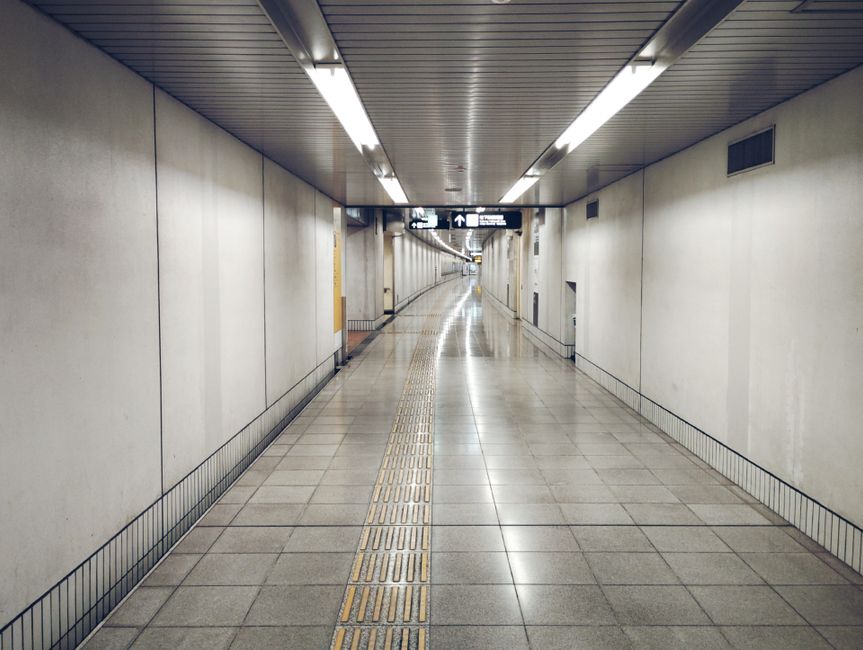
Underneath Gangnam Station there's a shopping arcade that runs for what feels like half a mile. It's officially called the Gangnam Station Underground Shopping Center. Locals just call it the underground. There are maybe 200 small shops down there — clothing, accessories, cosmetics, food courts, phone repair places, eyebrow threading, socks of every imaginable kind. The first time I walked through it I assumed it was a small connector tunnel. I was three minutes in before I realized the corridor wasn't ending. I was eight minutes in before I started to suspect I was no longer under Gangnam Station at all. I was correct. The basement connects to two adjacent stations. This is great if you need to kill an hour during a heat wave or a monsoon. The whole underground is air-conditioned in summer, heated in winter, and entirely walkable in soft post-treatment sneakers. It's also great for last-minute purchases — a phone charger, a pack of socks, a hair clip, a snack you can eat one-handed. Prices are lower than the boutiques upstairs in Cheongdam, sometimes dramatically so. A tote bag I'd seen for 80,000 won in a Sinsa shop was 18,000 won down here. I bought two. The downside is that the underground is genuinely disorienting. There are no windows. The corridors curve. The exit numbers down there don't always match the exit numbers above ground intuitively. Use the map app on your phone — it works underground in most of the station — or just surface at the first opportunity and reorient.
How to actually navigate, in practice
Here's the system I've finally landed on after four trips. When I'm meeting someone or going to an appointment near Gangnam Station, I do three things before I leave the hotel. One — I confirm the exit number. Two — I look at a satellite map (not just the line map) so I know which corner of the intersection I'm coming up on. Three — I screenshot the satellite map, so when my phone inevitably drops to one bar of LTE in the deepest part of the underground, I still have the picture. When I get off the train, I follow the yellow exit signs not the line signs. The yellow signs tell you which exits are closest from your current platform. If you're going to exit 10 and the train doors open closer to exits 1-4, you'll have a five-minute walk underground to reach exit 10. That's fine. Just budget the time. Don't assume "Gangnam Station" means "thirty seconds from anywhere in Gangnam." It means "thirty seconds from this particular concrete staircase."
Also — and this took me three trips to internalize — Gangnam Station is on Line 2 (the green loop) and the Shinbundang Line (red, going south). Most foreigners only think about Line 2. The Shinbundang Line is a fast direct connection to Pangyo and parts of Gyeonggi that some clinics quietly use as a back route in from the airport for VIPs. It's worth knowing exists. The transfer corridor is well-signed, but it's a haul — give yourself ten minutes between platforms.

The intersection above ground, decoded
Once you surface from Gangnam Station, you're standing on one of the most photographed corners in Korea. Tehran-ro runs east-west. Gangnam-daero runs north-south. The intersection is enormous — six lanes in every direction, with crosswalks that take forty seconds to clear. The buildings around it are mostly office towers with retail on the bottom three floors. Skincare flagships, casual restaurants, the same three chain coffee shops in rotation, a lot of cellphone stores. It's bright. It's loud. It's where I do almost zero of my actual Gangnam socializing. The real action — the cafés I like, the restaurants my cousin trusts, the slow streets — is north of here in Sinsa and Apgujeong. South of here is Gangnam's working district: more offices, fewer restaurants, less to do at night. West of the station is the Yeoksam neighborhood, which has a few specific spots worth visiting but isn't a casual wander. East is Seocho — quieter, more residential, also not a wander destination. So the Gangnam Station intersection itself is mostly a transit hub for me, not a hangout. I pass through it. I rarely stay. The exception is the underground mall when the weather is bad.

Things I do and don't do at Gangnam Station
Do — use Gangnam Station to transfer to other parts of the city. The Line 2 connection means you can get to Hongdae, Seongsu, City Hall, and pretty much everywhere else in central Seoul without changing trains. The exit-11 area has the most bus stops for southern destinations, so if you're doing a day trip to somewhere like Pangyo or even down to Suwon, this is your launch point. Do — go underground when the weather is hostile. Korean summer is humid in a way that I, an LA-raised person, was completely unprepared for on trip one. Korean winter has wind that comes off the Han River and finds the spaces between your scarf and your collar. The underground is climate-controlled. The corridors run for half a mile. You can move between several blocks of Gangnam without ever surfacing. Use this. Don't — try to walk from Gangnam Station to Apgujeong. People online say it's a 25-minute walk. Technically true. In practice, it's 25 minutes along an unshaded six-lane road with 80% chance of crossing eight crosswalks. Take the subway one stop to Sinnonhyeon, then a five-minute cab to Apgujeong. Or skip Gangnam Station entirely and start at Sinsa Station for the Apgujeong-Garosu-gil area. Don't — count on the wifi at Gangnam Station for anything time-sensitive. The public wifi exists. It also drops constantly, especially during rush hour when 200,000 phones are trying to use it simultaneously. Use your e-SIM or a pocket router. I learned this on trip two when my map app froze mid-walk and I ended up at a hotel I'd never seen before.
The part I still don't get
Four trips in and here's what still confuses me about Gangnam Station. The relationship between exits 7-8 and the bus terminal across the street. Why exit 12 feels so much further from the actual platform than the map suggests. Whether the corridor that branches west near exit 4 actually connects to Sinnonhyeon Station underground or whether I dreamed that one. Which of the underground shopping center's three food courts has the actually-good kimbap and which has the disappointing one I keep ending up at by mistake. The pattern of which side of which street the cherry blossom trees bloom on first in April — there's a logic, I just haven't cracked it. I've made peace with not understanding all of it. There's a thing about traveling somewhere repeatedly that I didn't expect on trip one — you learn that some places stay slightly opaque even when you know them well. Gangnam Station is mine. I don't fully get it. I probably never will. But I've stopped panicking when I come up on the wrong corner, I've stopped being late to appointments because of underground navigation, and I've stopped pretending I'm going to memorize all twelve exit numbers. Four is enough. The rest I look up when I need to. For the broader Gangnam orientation that goes beyond just this one station, I keep a more general note in my <a href="/first-time-in-gangnam-american-survival/">first-timer's survival guide</a>, and for the bigger why-I-keep-coming-back arc there's my <a href="/why-i-keep-flying-back-to-seoul/">Seoul return-trip essay</a> if you want the bigger frame. Next trip is in eleven weeks. Same hotel. Exit 11. I'll find it eventually.
“There's a thing about traveling somewhere repeatedly that I didn't expect on trip one — you learn that some places stay slightly opaque even when you know them well.”
Rachel Bennett
Frequently asked questions
Which Gangnam Station exit should I use for most hotels?
It depends entirely on which hotel — there's no single right answer. The biggest international hotels cluster around exits 7-11. Smaller boutique hotels and serviced apartments are scattered around exits 1-6. Check your hotel's website before you go. Most list the exit number in the directions section, and it matters more than the line or the station name.
Is the underground shopping center actually worth visiting, or just a transit thing?
Both. It's worth a slow browse on a hot or rainy day, especially if you're shopping for everyday items like socks, phone accessories, casual clothing, or budget cosmetics. Prices are roughly 30-50% lower than the equivalent boutiques above ground. It's not where you'd buy something special. It's where you'd grab three useful things on the way to dinner.
How long does it take to walk underground across Gangnam Station?
About 10-12 minutes corner to corner if you're moving briskly and not stopping. The shopping center connects multiple subway stations and several office towers, so you can be in the underground for a while without realizing it. Bring a screenshot of the layout, or just surface at the first useful exit and reorient above ground.
What's the difference between Gangnam Station and Sinnonhyeon Station?
Gangnam Station is the central transit hub — bigger, busier, more shops, more office towers. Sinnonhyeon is one stop north on Line 9, much quieter, with better restaurants and easier walking distance to Apgujeong. If you have a choice, I almost always recommend Sinnonhyeon for the actual neighborhood experience. Gangnam Station is for transit, not for hanging out.
Can I get a taxi easily at Gangnam Station?
Yes, but go to a specific taxi stand rather than trying to hail one on the main intersection. The official taxi queue near exit 12 moves fast, especially after 9 p.m. Kakao Taxi (the Korean Uber equivalent) also works perfectly here and is what I personally use about 80% of the time. Roughly 4,000 won to start the meter for a regular taxi.
Is Gangnam Station safe at night for a solo traveler?
Yes — extremely. Gangnam Station is well-lit, heavily trafficked at all hours, and has a steady visible police presence at the main intersection. I've walked through it alone after midnight on every trip without ever feeling unsafe. The Korea Tourism Organization has more on solo travel safety in their <a href="https://english.visitkorea.or.kr/svc/main/index.do" rel="dofollow">visitor information</a> if you want more general context.