Travel & Culture
The Han River Walks I Keep Going Back To
Four trips in, three favorite stretches, one sunset timing I refuse to share with anyone else. (Fine, I'll share it.)
I came to Seoul the first time and walked the Han River once, on a Saturday afternoon, with too many people, and basically wrote it off. Then on trip two I tried it again on a weekday morning at a different segment and it cracked open for me. Now four trips deep, the Han River is the part of every Seoul itinerary I refuse to skip — and the part I've quietly stopped recommending to my LA friends because I want it to stay this good. Here's where I actually walk, when I go, and why a few specific stretches keep pulling me back trip after trip.
Why I'm so into a river walk, when I'm not really a river person
I grew up in coastal California where the ocean is the default body of water. Rivers feel like a Midwest thing, or a New York thing where the Hudson is also a highway. The Han is different — it's wide enough that the other bank feels like a separate city, lined for miles on both sides with green parks, and the bridges across it are an event. There are 31 of them. You can walk under most of them. Some have fountains, some have neon, one has a 24-hour convenience store underneath it, which is a sentence I still don't quite believe even though I've eaten ramen there twice.
The other thing is the pace. Seoul is fast. Gangnam is faster. The Han River is the part of the city where everything slows down. People are walking, biking, picnicking, fishing (yes, fishing), reading on blankets, taking couples' photos, eating chicken from delivery apps that come right to the riverside. It's the only place in the city I see this many people moving this slowly. After a few hours of Gangnam pace I crave it, and I think locals do too. It's part of why the parks are always full but never feel crowded — there's just so much river to spread out along.
The walk I do every trip: Banpo to Apgujeong
This is the loop. Start at Banpo Hangang Park on the south bank, walk east along the riverside path past Banpo Bridge, then keep going until you hit the Apgujeong area pedestrian bridge to cross back if you want, or just turn around at Hannam Bridge and walk back the way you came. It's roughly 4 to 5 kilometers one way depending on where you stop. I usually do an out-and-back, about 8 km total, which takes me about 90 minutes at the slow pace I actually walk.
What makes this stretch the right one: you get all the big Han River views — Banpo Bridge to the west, Hannam Bridge to the east, the Seoul skyline rising on both banks, and the river bending slightly so you always have a new angle. The path is flat. There are bathrooms at the Banpo and Jamwon park areas. There's a 7-Eleven near Banpo Bridge that sells the cold instant ramen everyone Instagrams, but honestly the regular hot ramen they cook at the in-park machines is the actually-good move. You pay around 4,500 won, about $3.30 USD, and they hand you a bowl with hot water, an egg, and the option to add scallions.
I usually walk west to east. Banpo is more touristy, Apgujeong side is quieter, and the breeze tends to come off the river the right direction in fall. In spring with cherry blossoms it doesn't matter what direction you walk. Everything's beautiful. Everything's also full of people taking pictures. Just expect that.
Sunset timing, since this is the actually-important question
The single most-asked question I get from American friends is when to walk. Here's my honest answer, by season. In summer (June to August), start at 7:30 p.m. Sunset's around 7:50 to 8 p.m., and the heat starts breaking around 7. In fall (September to November), start at 5:30 p.m. Sunset's somewhere between 5:15 and 6:30 depending on the month. Fall is my favorite — the air is dry, the leaves on the bank trees turn yellow and red, and the river picks up the late light in a way that makes every photo look filtered when it isn't. Winter (December to February), if you can stand the cold, start at 4:30 p.m. and stay only as long as you can stand it. Bundle up — the wind off the river is brutal. Spring (March to May), 6 to 6:30 p.m. is the magic window.
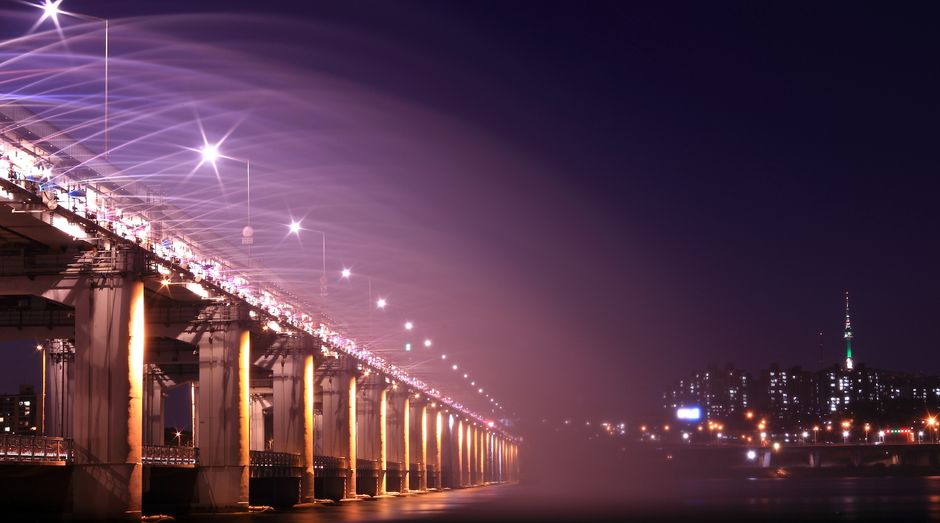
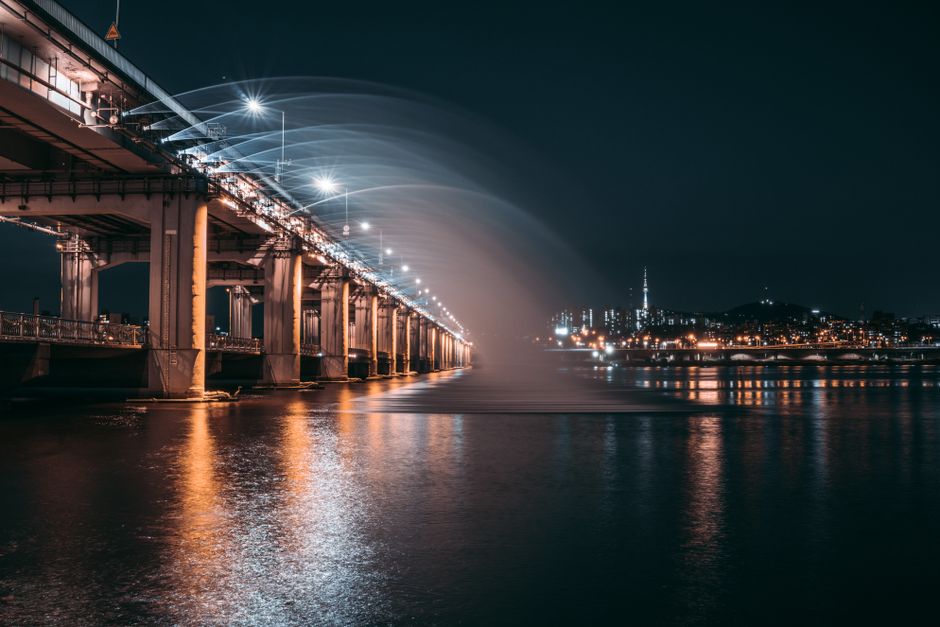
The trick that took me three trips to learn: cross to the north bank for sunset, then walk back south after it sets. The Banpo Bridge fountain runs in the evenings from late April through October, usually at 5, 6, 7, 8, and 9 p.m. for about 20 minutes each show. If you time your walk so you're near the bridge at one of those times, you get the rainbow fountain over the river while the sky is changing. I will not pretend I haven't planned an entire evening around this. The first time I saw it, my cousin was waiting at the corner with a triangle kimbap and a cold can of coffee. I still think about that night more than I should.

Yeouido in spring (cherry blossoms, but yes I still go)
Yeouido Hangang Park is the spring cherry blossom destination. Yes, it's crowded. Yes, the locals will tell you it's overrated. Go anyway, once, in early April, on a weekday morning. The Yeouiseo-ro road that runs along the back of the National Assembly is lined with cherry trees for about 1.7 km, and during peak bloom (usually April 3 to April 10 depending on the year) the road is closed to cars and turned into a walking street with food vendors and music. I've done it twice. The second time I went on a Tuesday at 9 a.m. and it was magical and uncrowded for the first 40 minutes, after which it filled in fast.
If you do Yeouido in spring, plan to also walk along the Han River side of the park, not just the cherry blossom street. The riverside path here is wider, flatter, and gets you views back across the river to Mapo. There's a Starbucks Reserve on the north end of Yeouido Park that I have been known to camp in for an hour to recover before walking back to the subway. Yeouido Station is on Line 5 and Line 9 — the Line 9 express stops here, which makes it one of the fastest park access points in the city from Gangnam.

Seoul Forest, even though it's technically not the river
Seoul Forest sits on the north bank of the Han between Apgujeong and Seongsu. Technically it's a park, not a river path, but the southern edge of it touches the river and there's a pedestrian bridge that connects it to a riverside trail. I love this combination — start in Seoul Forest, do the deer-petting area (yes there are real deer, yes you can feed them with cups the staff sells for 2,000 won), walk through the forest paths for an hour, then exit south to the river and follow it west toward Apgujeong.
The whole loop takes about three hours at my pace. Seoul Forest itself is wide-open, has a big lawn area where people picnic, and the deer enclosure is gentle and slow — perfect for a low-energy day. After a long flight I always do this on day two when I want movement but not effort. Take Suin-Bundang Line to Seoul Forest Station, exit 3. The walk to the deer area is signposted in English. I usually grab a coffee from the cafe at the south entrance — there are about four of them, all of them fine, none of them I'd specifically recommend over another.
Banpo at night, when I'm jet-lagged and can't sleep
On every trip, I have at least one night where the jet lag hits at 11 p.m. and I'm wide awake. My go-to is the riverside at Banpo. The fountain runs until 9 p.m. but the riverside path is open 24 hours, well-lit, and busy with locals until at least 1 a.m. on weekends. I walk for 30 to 40 minutes, sit on a bench, watch the bridges light up, and come back. Sometimes I stop at the under-bridge 7-Eleven and get a cold drink and an egg-roll sandwich. Sometimes I just walk. I've never felt unsafe doing this. The path is well-trafficked, the lighting is consistent, and there's a steady stream of joggers and couples and people walking dogs.
This is the part of the Han River I would not have known to look for from guidebooks. It came from a Korean friend who texted me my first trip — "if you can't sleep, just walk the river, it's better than the hotel" — and they were right. There's something about the moving water and the city lights on the other side that resets my brain enough to sleep when I get back. I've sent that exact text to two American friends now. They both went. They both came back and told me I was right.
Recovery-day pace, when I want a walk but not a workout
If I've had a long flight, a long day of appointments, or a heavy meal — basically any reason I want to be outside without exerting myself — the Han River is the easiest recovery walk in the city. The paths are flat. There are benches every couple of hundred meters. Bathrooms at every park section. Convenience stores for water and snacks. No hills, no stairs, no surprise crowds (outside spring cherry blossom and summer firework nights). I can do 20 minutes or 2 hours and the path adjusts to me.
The segments I rotate for slow walks: Banpo riverside near Hangang Park (south bank), Apgujeong riverside east of Hannam Bridge (north bank), and a stretch I just discovered last trip — Ttukseom Hangang Park, north bank, east of Seongsu. Ttukseom is quieter than Banpo, has a swimming pool area in summer, and the path runs right past a few of the picnic-blanket rental spots where you pay 5,000 won for a couple of hours and you get the blanket plus a clip on the corner to keep it from blowing away. I've never used the rental. I've watched a lot of other people enjoy it. For more soft-pace plans for swollen-face or low-energy days, see my <a href="/best-han-river-walks-recovery/">recovery-friendly Han River walks list</a> and my <a href="/gangnam-spa-day-recovery/">spa-day recovery routine</a>.
What I always pack
A reusable water bottle. The park drinking fountains work, but I trust my own bottle more. Sunglasses for fall light off the river, which can be surprisingly bright. A light scarf in all seasons except deep summer — the wind off the water gets cool faster than I expect. A small portable battery for my phone, because I take too many photos. Cash isn't necessary anywhere; T-money or card works at every cafe, convenience store, and rental booth. Comfortable shoes that you don't mind getting a little dusty if you walk on the dirt-and-gravel sections away from the paved path. I learned the hard way on trip one with white sneakers that did not survive a fall afternoon along the riverbed.
If you want the official park map and amenity list, Seoul Hangang Park Office has a <a href="https://english.visitkorea.or.kr/svc/main/index.do" rel="dofollow">visitor information page</a> that covers all 12 sectional parks with bathroom locations and bike rental stations. I check it before I head to a new sector I haven't walked yet. For everything else, just show up. The river will be there. The light will do what it does.
“There's something about the moving water and the city lights on the other side that resets my brain enough to sleep when I get back.”
Rachel Bennett
Frequently asked questions
What's the best Han River segment for a first-time visitor?
Banpo Hangang Park. It's the most accessible from central Gangnam (10-minute walk from Express Bus Terminal Station or Sinbanpo Station), has the most amenities — bathrooms, food, convenience stores — and includes the Banpo Bridge rainbow fountain which runs evenings April through October. Start there, walk east toward Hannam Bridge, and you'll get the iconic views without needing to know the city well.
How long does a typical Han River walk take?
It depends on the segment, but my standard loop (Banpo to Hannam Bridge and back) is about 8 km and takes me 90 minutes at a slow pace, including a stop for ramen or coffee. Shorter walks of 30 to 45 minutes are easy — every park section has a natural turnaround at the next bridge. Longer walks of 2 to 3 hours are also possible if you want to cross to the north bank.
Is the Banpo Bridge rainbow fountain worth timing your walk around?
Yes, once. It runs in 20-minute shows at 5, 6, 7, 8, and 9 p.m. from late April through October. The 8 p.m. show with the bridge backlit is the prettiest in my opinion. After the first time you'll know if it's something you want to plan around again. Bring a picnic blanket if you want the full experience — the south bank lawn is the best viewing spot.
Can I bike along the Han River instead of walking?
Absolutely — the Han River bike path runs about 40 km along both banks and is one of the best urban bike paths in Asia. Seoul Public Bike (Ttareungi) has rental stations along most of the river parks. Daily passes are around 5,000 won, about $3.60 USD. I tried to bike Banpo to Yeouido one trip and gave up halfway because my legs were not ready. The path itself was beautiful. My fitness level was the problem.
Is the Han River safe to walk at night?
Yes, the major park sectors are. Banpo, Yeouido, and Ttukseom all have well-lit paths, security patrols, and constant foot traffic until at least midnight on weekends. I've walked Banpo alone past 11 p.m. multiple times without feeling nervous. That said, some of the less-developed sectors east of the city are quieter — I'd stick to the central park areas after dark if it's your first trip. The Korea Tourism Organization has more on <a href="https://english.visitkorea.or.kr/svc/main/index.do" rel="dofollow">visitor safety information</a>.
What should I eat or drink on a Han River walk?
Convenience store ramen from the in-park machines is the iconic move — about 4,500 won, $3.30 USD, and they hand you a hot bowl. Chicken delivery to the riverbank is a local tradition; apps like Coupang Eats deliver to specific park bench numbers. Tteokbokki and corn dogs from the food trucks at major park sections run 4,000 to 6,000 won. Bring a reusable water bottle — the fountains work but I trust my own.