Glossary
MFU & Skin Tightening Glossary: 50 Terms Plainly Explained
A working glossary of the MFU, RF, and skin-tightening vocabulary I kept tripping over in Gangnam consultation rooms — defined in plain English, with the small honest caveats.
Three trips into the Gangnam aesthetic-clinic circuit, I noticed I was Googling the same fifteen or twenty terms before every consultation — what fluence actually means, why a 4.5mm transducer uses a lower frequency, the difference between monopolar and bipolar RF, what neocollagenesis is in plain English. So I started a notebook. This glossary is the cleaned-up version of that notebook, organized A to Z, defined the way I wished a friend had explained it to me on day one. Fifty terms, no condescension, with the small parenthetical tips I would actually text a friend. None of it is medical advice. It is the working vocabulary that lets me read a clinic brochure or follow a consultation conversation without nodding along pretending I know what monopolar means. If you are about to walk into your first MFU or RF consultation in Gangnam — or anywhere — this is the page I wish I had bookmarked before mine.
A — Acoustic, Applicator, AccuREP
Section A covers three terms that show up in the first ten minutes of most MFU and RF consultations.
Acoustic radiation force
The mechanical pressure produced when ultrasound waves travel through tissue. In MFU treatments, the focused ultrasound creates both thermal energy (heat at the focal point) and a small acoustic radiation effect — a tiny mechanical push at the cellular level. Most clinical lift effects are attributed to the thermal component, but the acoustic component is part of why ultrasound feels different from RF. (Tip: if your practitioner mentions "non-thermal effects," this is usually what they mean.) See also: focal point, MFU.
Applicator
The handheld piece a practitioner moves across your skin during an energy-based treatment. "Applicator" is the generic term; clinics may also call it a handpiece, transducer, cartridge, or tip depending on the device. Different applicators on the same device usually deliver different depths or energy patterns. (Tip: ask which applicators are included in your specific package — "light" packages sometimes skip the deepest one.) See also: handpiece, transducer, cartridge.
AccuREP (Thermage FLX)
Thermage FLX's automatic energy calibration feature — short for "accurate repair." It measures tissue impedance and adjusts RF energy delivery to each treatment zone in real time, so the same machine can deliver different energy levels depending on what the skin is reading back. The reason a Thermage FLX session feels more uniform than older Thermage generations. See also: monopolar RF, Thermage FLX.
B — Bipolar, Bulk heating
Section B covers two RF terms that frequently get confused with their cousins.
Bipolar RF
A radiofrequency configuration where the current travels between two electrodes placed close together on the same handpiece, producing a shallower, more localized heating zone — typically 1 to 2mm deep. Compared to monopolar RF, bipolar reaches less deep but is more controlled and easier to use on smaller areas like around the eyes. Many microneedling RF devices are bipolar. (Tip: bipolar is gentler on the surface but won't reach the dermal-subcutaneous depths monopolar covers.) See also: monopolar RF, multipolar RF.
Bulk heating
Heating a relatively large volume of tissue to a target temperature, as opposed to depositing energy at discrete focal points. Monopolar RF and most thermal RF platforms work this way — the goal is to bring a column of dermis-to-subcutaneous tissue up to roughly 40-45 degrees Celsius for several seconds, which patients report can drive collagen contraction. Bulk heating is the opposite philosophy from MFU's focal-point approach. See also: micro-coagulation, thermal effect.
C — Cartridge, Coagulation, Contact cooling
Section C covers three terms that show up on every device specification sheet.
Cartridge
A consumable component that attaches to the handpiece and contains either a transducer (in MFU devices) or a needle array (in microneedling RF devices). Cartridges are single-use or limited-use and represent a meaningful per-treatment cost. (Tip: ask the clinic if the cartridge is included in your package price or charged separately, especially for microneedling RF — the line counts add up.) See also: applicator, line count.
Coagulation point
A small, precisely-targeted spot in tissue where focused energy creates protein denaturation and a controlled thermal injury. MFU at the SMAS depth produces thousands of these tiny coagulation points across a treatment, each one signaling the body to recruit a collagen response. The points themselves are sub-millimeter and the surrounding tissue is largely unaffected. See also: focal point, neocollagenesis, micro-coagulation.
Contact cooling
A cooling mechanism built into the handpiece tip that pre-cools the skin surface before energy delivery. Common on monopolar RF devices to protect the epidermis from thermal damage while heat travels deeper. The Thermage FLX vibrating tip and integrated cooling spray are the most patient-recognized version. (Tip: some patients describe the sensation as "hot, then cold, then hot" — that is the cooling cycling.) See also: epidermal protection, monopolar RF.
D — Dermis, Doublo, Dot density, DEKA Onda
Section D covers four terms — three structural, one specifically Korean.
Dermis
The middle layer of skin, sitting between the epidermis (top) and the hypodermis (fat layer below). The dermis is where collagen and elastin live, and where most MFU and RF energy at the 1.5mm and 3mm depths is targeted. Dermal collagen density is what gives skin its firmness and bounce. As the dermis thins with age, fine lines and laxity become visible at the surface. See also: epidermis, hypodermis, neocollagenesis.
Doublo
A Korean-manufactured HIFU device often offered as a budget alternative to Ultherapy in Korean clinics. Doublo uses focused ultrasound at three depths similar to Ultherapy (1.5mm, 3mm, 4.5mm) but operates at higher energy per shot and lower precision targeting compared to MFU with imaging guidance. (Tip: Doublo is HIFU, not the same as Ultherapy's MFU — the visualization layer is the categorical difference.) See also: HIFU, MFU, Shurink.
Dot density
The number of treatment dots or shots delivered per square centimeter of skin during a fractional or focal treatment. Higher dot density typically means more aggressive treatment, more downtime, and stronger results — but also more discomfort and higher complication risk if pushed too far. Common in fractional laser and microneedling RF protocols. See also: line count, fractional, fluence.
DEKA Onda
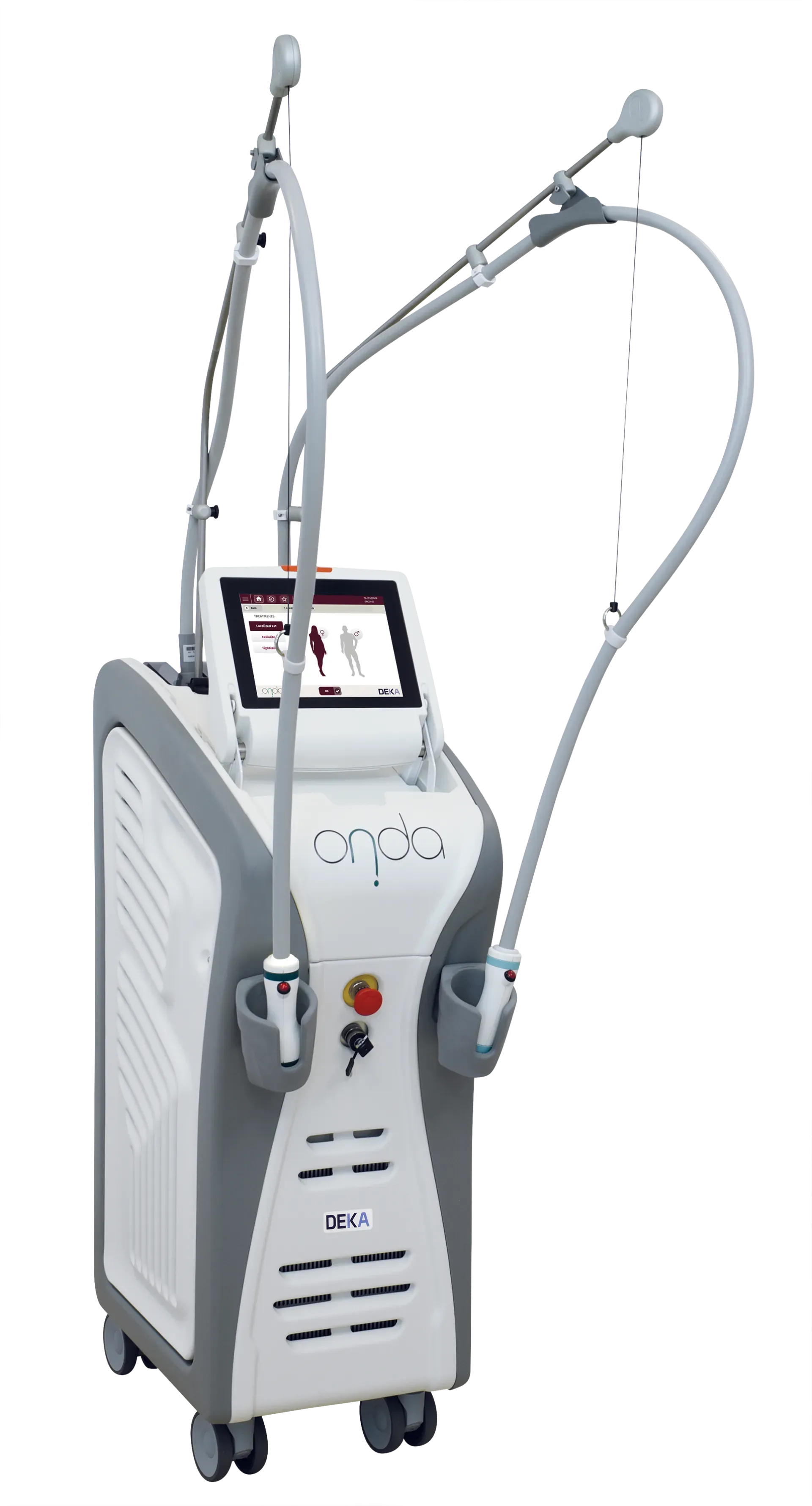
An Italian-manufactured device using "Coolwaves" — proprietary microwave-frequency electromagnetic energy — primarily for body fat reduction and skin tightening. The depth of action is in the subcutaneous fat layer, deeper than typical RF. Less common in face protocols, more common in body contouring packages. See also: bulk heating, monopolar RF.
E — Energy density, Endymed, Epidermis
Section E covers three terms — one universal physics, one specific brand, one anatomical.
Energy density (J/cm²)
Joules of energy delivered per square centimeter of treated skin — the standard unit for quantifying how much energy a treatment session deposits. Higher J/cm² values mean a more aggressive treatment, but the relationship to outcomes is non-linear: above a certain ceiling, more energy stops adding benefit and starts adding risk. (Tip: ask for the J/cm² target, not just "high energy" — the number is more informative than the marketing word.) See also: fluence, fluence ramp.
Endymed Tightening
An Israeli-manufactured RF platform using a proprietary multi-electrode "3DEEP" technology — a multipolar RF configuration that delivers energy in shifting electrode patterns to reach deeper than standard bipolar RF without the surface concerns of monopolar. Used for face and body tightening. Less common in Korean clinics than Thermage but present at some Gangnam practices. See also: bipolar RF, multipolar RF.
Epidermis
The outermost skin layer — the part you see in the mirror. Most MFU and RF treatments are designed to spare the epidermis (no surface burn, minimal downtime) by either focusing energy below it (MFU) or actively cooling it during delivery (monopolar RF with contact cooling). The epidermis is also what insulated microneedling RF needles protect by delivering energy only at the needle tip, not along the shaft. See also: dermis, contact cooling, insulated needle.
F — Focal point, Focused ultrasound, Fluence, Fractional, Forma
Section F covers five terms, several of which are core MFU vocabulary.
Focal point
The precise depth at which focused ultrasound energy converges and deposits its peak thermal effect. In MFU, the transducer's geometry and frequency determine the focal depth — 1.5mm, 3mm, or 4.5mm in the Ultherapy protocol. The tissue above the focal point is largely unaffected because the energy is converging there, not depositing along the path. (Tip: this is why a "deep" treatment is not necessarily a "hot" treatment at the surface.) See also: focused ultrasound, transducer.
Focused ultrasound
Ultrasound energy concentrated to a precise focal point at a known depth, as opposed to surface ultrasound which spreads broadly. The two main aesthetic categories are MFU (micro-focused ultrasound, with smaller focal spots and imaging guidance) and HIFU (high-intensity focused ultrasound, broader focal spots and more variable targeting). Focused ultrasound is what allows non-surgical treatment to reach the SMAS layer without damaging the skin above it. See also: MFU, HIFU, focal point.
Fluence
Another term for energy density (J/cm² or J/shot). Often used interchangeably with energy density in laser and ultrasound contexts. "Fluence" tends to come up more in laser conversations, "energy per line" or "J per shot" in MFU. (Tip: if a practitioner says "we use a higher fluence than the budget package," they mean more joules per treatment unit.) See also: energy density, J/cm².
Fractional
A treatment pattern that delivers energy to small fractions of the treatment area, leaving untreated skin between treated zones. Fractional lasers and fractional RF devices both use this principle. The untreated zones speed healing and reduce downtime compared to fully ablative treatments. (Tip: "fractional" describes a delivery pattern, not a depth — fractional devices exist at many depths.) See also: dot density, ablative.
Forma RF (Inmode)
An Inmode bipolar RF handpiece designed for non-invasive surface tightening at the upper dermis. Lower energy, zero downtime, generally delivered as a series of sessions. Used for maintenance protocols and for patients seeking subtle texture-and-tightening without committing to deeper modalities. See also: bipolar RF, Inmode.
G — Glide vs stamp
Section G covers one term that comes up specifically in microneedling RF protocols.
Glide vs stamp delivery
Two delivery patterns for microneedling RF: "stamp" technique places the handpiece on a fixed spot, fires, lifts, moves, and repeats; "glide" or "motion" technique allows the handpiece to be moved continuously across the skin while firing. Stamp is more precise and standard for face work; glide is faster and more common for body. (Tip: most Korean face protocols are stamp-based — ask if your specific protocol uses glide, since the energy distribution differs.) See also: microneedling RF, dot density.
H — Handpiece, HIFU, Hypodermis
Section H covers three foundational terms.
Handpiece
The handheld component that delivers energy to the skin during an energy-based treatment. Often used interchangeably with applicator. Different handpieces on the same device platform usually deliver different energy patterns or depths. (Tip: Inmode platforms in particular have multi-handpiece systems where you might receive treatment from three different handpieces in one session.) See also: applicator, transducer.
HIFU (High-intensity focused ultrasound)
Focused ultrasound at higher per-shot energy and broader focal spots than MFU, typically without real-time imaging guidance. Doublo and many third-tier ultrasound devices fall into this category. HIFU can reach similar depths to MFU but with less precise targeting and more variable patient experience. (Tip: HIFU and MFU are not the same thing — the visualization layer and focal-spot precision are the categorical differences.) See also: MFU, Doublo, focused ultrasound.
Hypodermis
The fat layer beneath the dermis, also called the subcutis or subcutaneous tissue. Most MFU treatments at the 4.5mm depth pass through or terminate near the hypodermis to reach the SMAS below. RF at the 2-4mm volumetric range often heats portions of the hypodermis, contributing to perceived contour changes. See also: dermis, SMAS, subcutaneous.
I — Imaging guidance, Inmode, Insulated needle, Intensity
Section I covers four terms that come up across MFU, RF, and microneedling vocabulary.
Imaging guidance (DeepSEE)
Real-time ultrasound imaging on the device screen during MFU treatment. The Ulthera platform's DeepSEE feature lets the practitioner see the tissue layers — dermis, fat, SMAS — and confirm the focal point is landing in the right layer before each pulse. The categorical feature that distinguishes MFU from HIFU. (Tip: ask if the device used in your session includes imaging guidance, since some lower-cost ultrasound treatments skip it.) See also: MFU, HIFU, focal point.
Inmode
An Israeli medical device manufacturer with a multi-handpiece RF platform widely used in Korean clinics. The Inmode lineup includes Forma (surface RF), FaceTite (minimally-invasive subcutaneous RF), Morpheus8 (microneedling RF), and several body-contouring handpieces. Often offered as combination protocols across multiple handpieces in a single session. See also: Forma RF, FaceTite, Morpheus8.
Insulated needle
A microneedling RF needle coated with insulation along the shaft, leaving only the tip uncoated. The insulation prevents RF energy from depositing in the upper dermis and surface skin, sending the energy only at the needle tip. This is what makes modern microneedling RF a tightening-plus-resurfacing modality rather than purely an ablative one. (Tip: non-insulated platforms exist and produce a different recovery profile — ask which one your clinic uses.) See also: microneedling RF, epidermis.
Intensity
A general term for treatment aggressiveness — usually a function of energy density, dot or line count, and depth selection. "High intensity" and "low intensity" are imprecise; ask for the specific energy parameters when the term comes up in a consultation. (Tip: "intensity" in marketing copy is often a stand-in for "high energy density" — but the actual J/cm² number is more informative.) See also: energy density, fluence.
J — J/cm² (energy units)
Section J covers the unit of measurement that shows up on every device specification sheet.
J/cm² (joules per square centimeter)
The standard unit for energy density delivered per area of treated skin. A useful reference point: most MFU lines deliver about 0.18 to 1.2 joules per pulse, with hundreds to thousands of pulses across a session. RF and laser fluences are typically reported per square centimeter. (Tip: when comparing two clinic packages, ask for total joules delivered or J/cm² at each depth — the numerical comparison is more honest than the marketing words.) See also: energy density, fluence.
K — KOL device generation
Section K covers one term that becomes important when comparing clinics.
Device generation
The version or model year of the specific device being used. RF and ultrasound platforms have been iterated heavily over the past decade — Thermage has gone through multiple generations from Original to FLX, Ulthera released the Prime upgrade, and most platforms have hardware and software refreshes that meaningfully change the patient experience. (Tip: ask for the device generation by name, not just the brand. "Thermage FLX" is more informative than "Thermage," and "Ultherapy Prime" is more informative than "Ultherapy.") See also: Thermage FLX, Ultherapy Prime.
L — Laxity, LDM, Line count
Section L covers three terms that span anatomy, technique, and clinical specification.
Laxity
Loss of tissue tightness — the medical term for the visible drooping or sagging of skin that drives most non-surgical lift consultations. Laxity has multiple drivers: dermal collagen loss, fat compartment changes, SMAS loosening, and bone resorption. Different modalities address different drivers, which is why a categorical map matters more than a single "best" treatment. See also: SMAS, neocollagenesis.
LDM (Local Dynamic Micro-massage)
A German-manufactured ultrasound technology using rapidly switching frequencies to produce a mechanical micro-vibration effect at multiple skin depths simultaneously. Marketed as anti-inflammatory and barrier-supportive rather than primarily lifting. Less common in Korean clinics, more popular in European medical-spa contexts. (Tip: LDM is not the same modality as MFU or HIFU — it is shallower, gentler, and the categorical claim is different.) See also: ultrasound, MFU.
Line count
The number of treatment lines delivered during an MFU session. A standard full-face Ultherapy treatment delivers roughly 800 to 1,000 lines across the three depths combined; "light" or budget packages may deliver 300 to 500 lines. The line count is one of the strongest predictors of treatment intensity. (Tip: ask for the line count breakdown by depth, not just the total — a 700-line package that skips the 4.5mm depth is a categorically different treatment than a 700-line package that includes it.) See also: dot density, fluence.
M — MFU, Micro-coagulation, MMRF, Monopolar RF, Morpheus8, Multipolar RF
Section M is dense — six terms, most of them core RF and ultrasound vocabulary.
MFU (Micro-focused ultrasound)
Ultrasound energy delivered to small focal points at precise depths, typically 1.5mm, 3mm, and 4.5mm in face protocols. The signature MFU platform is Ulthera/Ultherapy, which combines micro-focused ultrasound with real-time imaging guidance. MFU produces small thermal coagulation points at the focal depth, which the body responds to over months with new collagen synthesis. See also: HIFU, focal point, Ultherapy.
Micro-coagulation
The discrete-point thermal-injury approach used by MFU — small, precisely-targeted coagulation points at the focal depth, surrounded by intact tissue. The categorical opposite of bulk heating. The micro-coagulation philosophy is what allows MFU to treat the SMAS layer without producing surface burns or significant downtime. See also: bulk heating, coagulation point, focal point.
MMRF (Multi-pass Multi-pulse RF)
An RF treatment protocol that combines multiple passes across the same area with multiple pulses per pass at varying energy levels. Used to produce a graduated heating effect that is gentler than a single high-energy pass. Common in Korean RF protocols. (Tip: MMRF is a protocol, not a device — different machines can be run with MMRF technique.) See also: monopolar RF, bulk heating.
Monopolar RF
A radiofrequency configuration where the current travels from a single electrode on the handpiece through the body to a return pad placed elsewhere on the patient. The current path produces deeper, more volumetric heating — typically 2 to 4mm into the dermis and into the upper hypodermis. Thermage is the most recognized monopolar RF platform. (Tip: if you see a return pad being placed on your back or thigh during the prep, that is the giveaway you are getting a monopolar treatment.) See also: bipolar RF, multipolar RF, Thermage FLX.
Morpheus8 (Inmode)
An Inmode bipolar microneedling RF handpiece using insulated needles at depths from 0.5mm to 4mm. One of the more popular microneedling RF platforms in Korean clinics. Marketed for combined texture-and-tightening outcomes, with adjustable depth across the same session. See also: microneedling RF, insulated needle, Inmode.
Multipolar RF
An RF configuration with multiple electrodes (typically three or more) on the same handpiece, with the current alternating between electrode pairs. Reaches deeper than bipolar but with more surface control than monopolar. Endymed's 3DEEP platform is the most recognized multipolar RF technology. See also: bipolar RF, monopolar RF, Endymed Tightening.
N — Neocollagenesis
Section N covers the single most important biology term in the lifting category.
Neocollagenesis
The process of new collagen formation in tissue — literally "new collagen genesis." Almost every non-surgical lifting modality works by triggering neocollagenesis: MFU through focal coagulation points, RF through bulk heating, microneedling through controlled dermal injury, biostimulating fillers through particle-driven recruitment. The neocollagenesis response unfolds over weeks to months, which is why energy-based treatments do not produce immediate visible lift. (Tip: when a clinic says "results in three to six months," the gap is the neocollagenesis timeline.) See also: dermis, SMAS, coagulation point.
O — Onda Coolwaves
Section O covers one device-specific term.
Onda Coolwaves
DEKA's proprietary microwave-frequency electromagnetic energy used by the Onda platform. The wavelength is designed to be selectively absorbed by subcutaneous fat tissue, with less heating in the dermis above. Primarily used for body contouring and localized fat reduction; some practitioners use Onda for lower-face contouring as well. See also: DEKA Onda, monopolar RF.
P — Pulse duration, Plasma
Section P covers two terms that come up in laser and energy-device specs.
Pulse duration
The length of time energy is delivered in a single pulse, measured in seconds, milliseconds, or microseconds depending on the device. Shorter pulses generally produce more peak energy with less collateral heating; longer pulses produce more thermal effect with less peak intensity. (Tip: pulse duration matters more on lasers than on MFU or RF — most ultrasound and RF devices have fixed pulse profiles, while laser devices often allow pulse-duration adjustment.) See also: fluence, dot density.
Plasma (medical)
Ionized gas used in some skin-tightening devices to deliver energy through a plasma arc rather than RF or ultrasound. Less common in face protocols than RF or MFU. Plasma devices typically work at the surface and upper dermis, with results closer to fractional resurfacing than to deep-tissue lifting. See also: ablative, fractional.
R — RF, RF microneedling
Section R covers two foundational categories.
RF (Radiofrequency)
Electromagnetic energy in the radio-wave range, used to heat tissue by causing rapid molecular vibration. RF can be configured as monopolar, bipolar, or multipolar depending on electrode placement. Different configurations reach different depths and produce different heating patterns. Monopolar RF (Thermage) reaches deepest; bipolar RF is shallower and more controlled. See also: monopolar RF, bipolar RF, multipolar RF, Thermage FLX.
RF microneedling
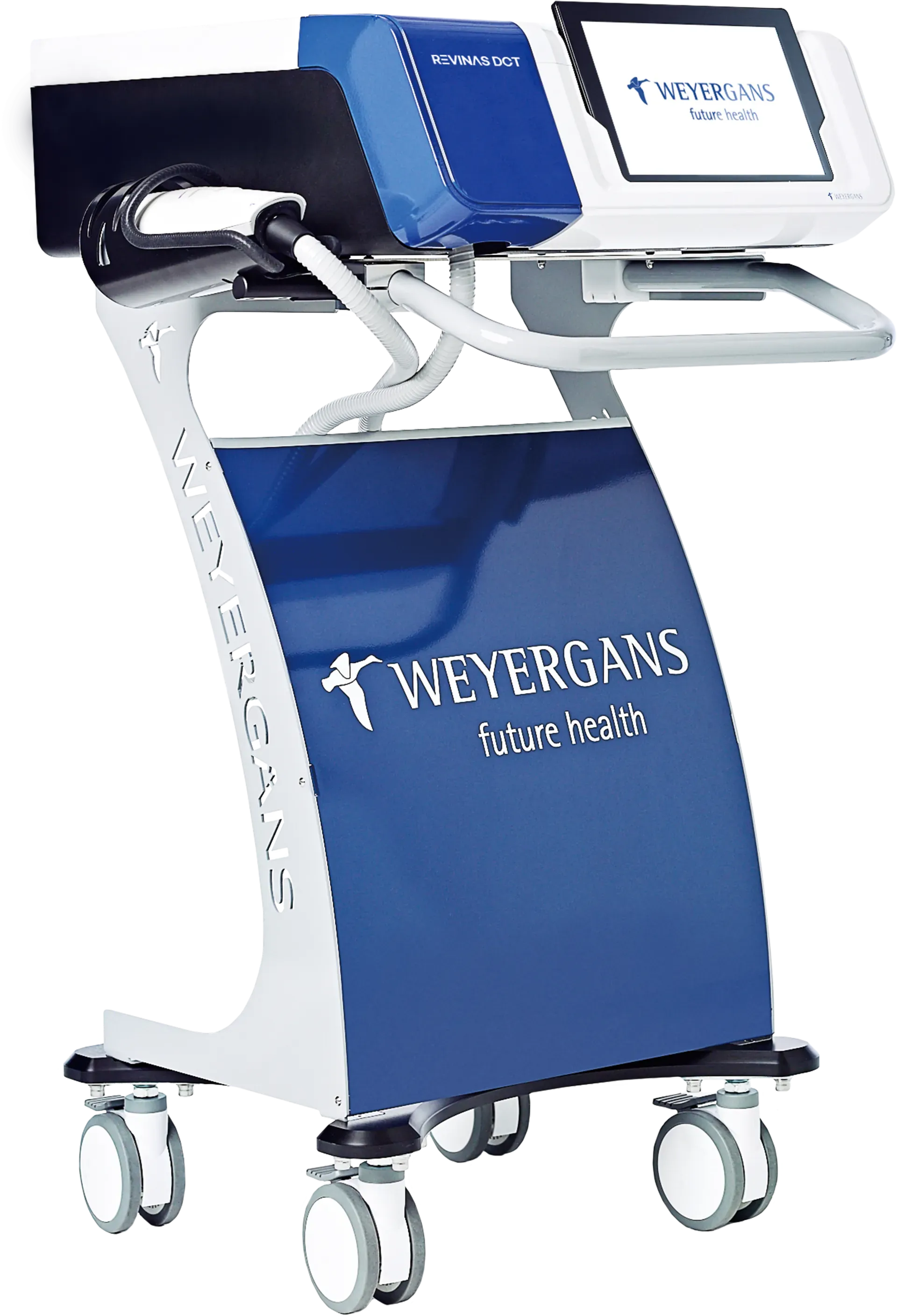
A hybrid treatment that combines microneedling (insulated needles inserted into the dermis) with RF energy delivered from the needle tips. Reaches dermal depths from 0.5mm to 4mm, depending on the platform. Produces both texture improvement (from the microneedling component) and dermal tightening (from the RF component). Recovery is longer than non-needle RF — typically three to seven days of erythema and small marks. See also: insulated needle, Morpheus8, dot density.
S — SMAS, Sofwave SUPERB, Shurink, Subcutaneous, SUPERB transducer
Section S is the densest section after M — five terms covering the SMAS layer and the major MFU/SUPERB devices.
SMAS (Superficial Musculoaponeurotic System)
The connective tissue layer beneath the skin and fat, between the dermis and the deeper muscle layer. The SMAS holds structural integrity for the lower face and is the same layer surgeons mobilize during a facelift. The SMAS is the depth target for MFU at 4.5mm and is the main reason MFU sits at the top of non-surgical lift rankings. (Tip: when a clinic talks about "structural lift" non-surgically, they almost always mean the SMAS layer.) See also: MFU, hypodermis, laxity.
Sofwave SUPERB
An Israeli-manufactured device using SUPERB (Synchronous Ultrasound Parallel Beam) technology — seven parallel ultrasound transducer beams delivering energy to the mid-dermis at approximately 1.5mm depth. Sofwave is FDA-cleared for brow, neck, and submental lifting. The treatment is shallower than MFU at 4.5mm but uses a different mechanism — broad parallel-beam heating rather than focal-point coagulation. (Tip: Sofwave reaches the mid-dermis, not the SMAS — the categorical claim is different from MFU.) See also: MFU, SUPERB transducer, focal point.
Shurink
A Korean-manufactured HIFU device, also marketed as Shurink Universe and Shurink Prime, widely used in Korean clinics as a budget alternative to Ultherapy. Shurink uses focused ultrasound at multiple depths and has been iterated through several generations. (Tip: Shurink and Doublo are both HIFU, not MFU — they share the focal-point ultrasound mechanism but lack the imaging-guidance precision of Ultherapy.) See also: Doublo, HIFU, MFU.
Subcutaneous
Beneath the skin — specifically the layer below the dermis, typically referring to the fat layer (hypodermis) and tissues immediately above the SMAS. Most non-surgical lift modalities deliver some energy to the subcutaneous layer, though the precise targeting varies. PDO/PCL threads are placed subcutaneously; biostimulating fillers deposit at the deep dermal-to-subcutaneous junction. See also: hypodermis, dermis, SMAS.
SUPERB transducer (Sofwave)
Sofwave's proprietary parallel-beam ultrasound transducer — seven beams firing simultaneously at ~1.5mm depth across a 16mm wide treatment line. The transducer geometry is what differentiates Sofwave from focal-point MFU technologies. Each beam produces a thermal coagulation zone, but the parallel-beam pattern covers more surface area per shot than a single focal point. See also: Sofwave SUPERB, transducer, focal point.
T — Thermage FLX, Thermal effect, Transducer, Tip
Section T covers four terms central to RF and MFU vocabulary.
Thermage FLX
The current generation of the Thermage monopolar RF platform, manufactured by Solta Medical (now part of Bausch Health). FLX features the AccuREP automated calibration, a vibrating tip, integrated cooling, and a larger treatment tip than earlier Thermage generations. The most-recognized monopolar RF device globally. (Tip: "Thermage" without "FLX" usually means an older generation — ask which version your clinic operates.) See also: monopolar RF, AccuREP, contact cooling.
Thermal effect
The heating effect of energy on tissue — the primary mechanism for most lift modalities. MFU produces thermal effect at focal points; RF produces thermal effect through bulk heating; lasers produce thermal effect through photon absorption. The thermal effect is what triggers neocollagenesis. (Tip: "thermal" and "non-thermal" effects often coexist — most devices produce both, but the thermal component is usually the dominant mechanism.) See also: bulk heating, micro-coagulation, neocollagenesis.
Transducer
An ultrasound-specific applicator that converts electrical energy into focused ultrasound waves at a specific frequency and focal depth. Ultherapy uses three transducers (1.5mm, 3mm, 4.5mm); Sofwave uses one SUPERB transducer; Shurink and Doublo use multiple transducers similar to Ultherapy. (Tip: in MFU, the transducer is the most patient-recognizable single component — ask which transducers your treatment includes.) See also: applicator, focal point, focused ultrasound.
Tip (Thermage)
Thermage's term for its consumable treatment cartridge, which contains the RF electrode, integrated cooling, and a chip that limits the number of pulses per tip. Different Thermage tips (Total Tip 4.0, Eye Tip, Body Tip) deliver different energy profiles for different treatment areas. The tip is single-use and represents a meaningful per-session cost. See also: cartridge, applicator, Thermage FLX.
U — Ulthera, Ultherapy Prime, Ultrasound
Section U covers the platform name and the broader energy category.
Ulthera (Ultherapy)

The Merz Aesthetics MFU platform that introduced microfocused ultrasound with imaging guidance to the aesthetic market. "Ulthera" is the device name; "Ultherapy" is the marketed treatment name. The platform delivers focal-point ultrasound at three depths (1.5mm, 3mm, 4.5mm) with real-time DeepSEE imaging. The first MFU device to receive FDA clearance for non-surgical lift indications. See also: MFU, DeepSEE, Ultherapy Prime.
Ultherapy Prime
The current-generation Ulthera platform, launched as an upgrade to the original Ultherapy device. Prime features improved transducer ergonomics, faster mapping speed, updated imaging clarity, and patient-comfort refinements. The underlying depth-frequency architecture (1.5mm, 3mm, 4.5mm) is unchanged. (Tip: Prime is a hardware-and-software upgrade, not a different treatment — the depth and protocol are the same as original Ultherapy.) See also: Ulthera, device generation.
Ultrasound
Sound waves at frequencies above human hearing (>20 kHz), used in medical imaging and energy delivery. Aesthetic ultrasound modalities span LDM (kHz-range, mechanical), MFU (MHz-range, focal-point thermal), HIFU (MHz-range, broader focal spots), and Sofwave (parallel-beam thermal). Different frequencies and beam patterns produce categorically different effects. See also: MFU, HIFU, LDM, Sofwave SUPERB.
V — Vector, Visualization
Section V covers two terms that come up specifically in pre-treatment consultations.
Vector
The directional pull of a treatment effect — the angle along which the lift occurs. Vector matters for thread lifts (where thread placement direction determines the lift direction), for SMAS-targeting MFU (where SMAS attachments dictate where the lift can be pulled), and for botulinum toxin myomodulation lifts (where muscle relaxation changes the muscular pull vector). (Tip: a good consultation will discuss the vector of the desired result, not just the procedure name.) See also: SMAS, laxity.
Visualization
The ability of the practitioner to see tissue layers in real time during treatment, almost always referring to ultrasound imaging guidance. Ultherapy's DeepSEE is the most-recognized visualization technology in the MFU category. Visualization is what distinguishes MFU from HIFU — the ability to confirm focal-point landing depth before each pulse. See also: imaging guidance, DeepSEE, MFU.
Z — Zonal protocol
Section Z covers one final term that captures how MFU and RF treatments are typically planned.
Zonal protocol
A treatment plan that maps specific zones of the face to specific transducers, energies, and line counts — rather than treating the entire face uniformly. Zonal protocols are how experienced practitioners customize a session: more 4.5mm passes in the lower-face descent zone, more 3mm coverage on the cheeks, lighter 1.5mm finishing on the upper face. (Tip: ask if your clinic uses a zonal protocol or a uniform-coverage protocol — the categorical difference shows up in the result.) See also: line count, transducer, vector.
Frequently asked questions
Which terms in this glossary should I prioritize before my first MFU consultation?
If you only have time for ten, focus on these: MFU, HIFU, SMAS, focal point, transducer, line count, energy density (J/cm²), neocollagenesis, imaging guidance, and device generation. These ten cover the core vocabulary of any MFU consultation in Gangnam or anywhere else. The rest become useful when you start comparing across modalities. (Tip: skim the M and S sections first — they carry most of the load.)
What is the categorical difference between MFU and HIFU again, in one sentence?
MFU uses smaller focal spots with real-time imaging guidance, allowing precise depth confirmation; HIFU uses broader focal spots without imaging, with more variable targeting. Both are focused ultrasound; both can reach SMAS depths; the precision and patient experience differ. Patients report the visualization layer is the categorical feature that distinguishes premium MFU from budget HIFU treatments.
How important is the device generation when comparing clinics?
More important than most patients realize. Thermage FLX delivers a meaningfully different experience and result profile than older Thermage generations. Ultherapy Prime refines patient comfort and mapping speed compared to the original Ultherapy. Many clinics do not advertise their device generation in marketing copy. Patients report asking by specific generation name ("Thermage FLX with AccuREP" or "Ultherapy Prime") usually gets a clearer answer than asking "do you have Thermage."
Is monopolar RF or MFU "better" for the lower face?
Neither is categorically better — they treat different layers and produce different result profiles. Monopolar RF delivers volumetric heating from 2-4mm with diffuse tightening; MFU delivers focal-point thermal effect at 4.5mm with structural SMAS-layer remodeling. Patients report many Gangnam protocols combine both, with the categorical reasoning being that the modalities are complementary rather than competitive. Studies suggest combination protocols produce additive results in most patients.
Why do RF microneedling treatments have more downtime than MFU?
Because the needles physically penetrate the skin, producing visible erythema and small punctate marks for several days post-treatment. MFU delivers focal-point energy below the skin surface without breaking it, so there is rarely visible downtime beyond mild flushing or transient swelling. The trade-off is that microneedling RF addresses both texture and dermal tightening in one modality, while MFU is structural-only. (Tip: most patients schedule microneedling RF earlier in a Gangnam trip to allow the recovery window to fit.)
What is the most overhyped term in clinic marketing copy I should be skeptical of?
"High intensity" without specific energy parameters. The phrase usually substitutes for actual J/cm² or line-count numbers, and the marketing word is much less informative than the specification number. "FDA-cleared" is sometimes used loosely as well — clearance is for a specific indication and device, and the same brand may have multiple device generations with different clearance scopes. Patients report the most reliable signal of competence is a clinic that gives specific numbers when asked, rather than category language.
Are there terms in MFU and RF vocabulary that change meaning across English markets?
Yes, a few. "Tightening" is sometimes used loosely to describe both lifting (structural) and skin-quality improvement (dermal) — these are different categorical claims. "Lifting" in Korean clinic marketing often refers to specific SMAS-targeting protocols; in U.S. marketing, it can describe a broader range of effects. "HIFU" is sometimes used colloquially to refer to MFU, especially in non-clinical translation contexts. (Tip: when in doubt, ask what tissue layer is being treated and what the depth target is — the anatomical answer is more stable than the marketing terminology.)
Where can I read more about how the three Ultherapy depths actually work?
I wrote a longer companion piece on the three transducer depths (1.5mm, 3mm, 4.5mm) and what each layer is doing — it goes deeper into the frequency-depth relationship, the SMAS targeting, and the imaging-guidance workflow. The categorical map in this glossary is the starting point; the depth article is the next layer of detail. Patients report the combination of glossary plus depth article covers most of what they wished they had known before their first consultation.