Treatment Guide
MFU vs. HIFU: Are They the Same Thing? (Short Answer: No)
An honest, slightly nerdy explainer from someone who got it wrong on three separate consult calls before figuring it out.
I will admit something embarrassing. For my first three Seoul consultations I used MFU and HIFU interchangeably — sometimes in the same sentence, sometimes corrected mid-sentence by a very polite coordinator. I thought they were marketing names for the same thing. They are not. The distinction is small but it actually matters, especially if you're deciding between Ultherapy in Gangnam and one of the cheaper HIFU machines that show up on every other beauty street in Seoul. This is the explainer I wish a friend had sent me before my first consult call, written in plain English by someone who learned the hard way and is not, repeat not, a doctor.
What MFU actually means (and why it's not just HIFU rebranded)
MFU stands for Microfocused Ultrasound, and it refers to a specific technology that delivers tightly focused ultrasound energy to a precise depth in the skin. HIFU — High-Intensity Focused Ultrasound — is the broader umbrella category, used in everything from cancer tumor ablation to fibroid treatment to, yes, some aesthetic devices. So technically every MFU device is a kind of HIFU, but not every HIFU device is an MFU device. It's the rectangle-and-square thing. I had to write this sentence on the back of a coffee receipt in a Sinsa cafe to get it to stick in my head.
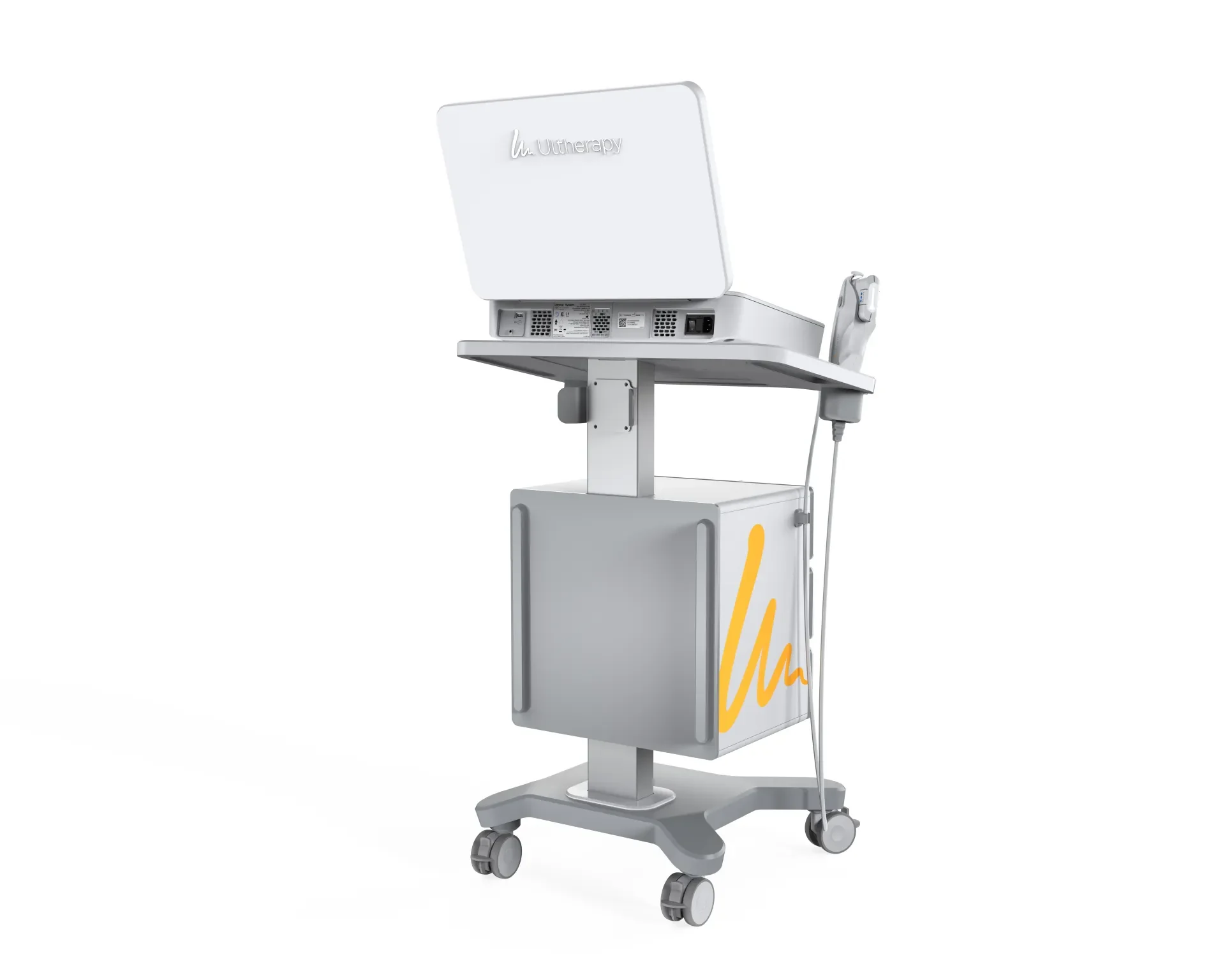
The practical difference, as far as I now understand it, is precision and visualization. Ultherapy — the device most Gangnam clinics use as their flagship — is the only FDA-cleared MFU system that pairs the ultrasound delivery with real-time ultrasound imaging, so the practitioner can actually see the layer they're aiming at before the energy fires. Most aesthetic HIFU machines I've seen in Seoul (and Bangkok, and Mexico City) deliver the energy without that imaging step. The provider relies on transducer specs and protocol experience instead of a visual confirmation. According to the manufacturer's <a href="https://www.merzaesthetics.com/our-portfolio/ultherapy/" rel="dofollow">Ultherapy product information</a>, this DeepSEE imaging is one of the platform's defining features.
The other word that gets used loosely is "focused" itself. In ultrasound physics, focused means the energy converges at a single focal point — like sunlight through a magnifying glass — rather than spreading diffusely. Both HIFU and MFU are technically focused; the difference is how tightly. MFU's focal zone is small and well-bounded, which is what allows the layered protocol Ultherapy uses. Wider-focal HIFU machines can heat broader strips of tissue, which produces a different biological response. Patients often can't feel the difference acutely, which is part of why the marketing terms blur on consumer-facing pages.
The energy and depth differences I had to write down to remember
MFU as delivered by Ultherapy operates at frequencies typically between 4 and 10 MHz, depending on the transducer, and reaches three specific depths — 1.5mm, 3mm, and 4.5mm — corresponding to dermis, deeper dermis, and the SMAS (the connective tissue layer surgeons lift in a facelift). Each pulse is a small, intense thermal coagulation point. The skin between the points is left untouched. The clinical idea is that the body responds to these tiny zones of controlled injury by laying down new collagen in the surrounding tissue over the following weeks and months.
Generic aesthetic HIFU devices vary much more widely in frequency and depth, and the depth options often aren't as precisely calibrated. Some HIFU machines deliver wider, less-focused thermal lines rather than discrete coagulation points. The resulting collagen response can be similar in spirit but tends to be less predictable in clinical studies. A 2018 review in <a href="https://pubmed.ncbi.nlm.nih.gov/29065174/" rel="dofollow">Dermatologic Surgery</a> on focused ultrasound for skin tightening makes the distinction explicit — Ultherapy MFU has the longest published track record and the most consistent imaging-guided protocol of the focused-ultrasound aesthetic devices.
Frequency is also worth understanding here, because it's where the depth precision actually comes from. Higher-frequency ultrasound focuses at a shallower depth; lower-frequency ultrasound focuses deeper. The 1.5mm Ultherapy transducer runs at the highest frequency in the set; the 4.5mm tip runs at the lowest. That physics is why MFU can target three discrete layers from the same handheld device, and why a generic HIFU machine without those specific transducer-frequency pairings can't replicate the same layered map. It's not magic, it's just careful engineering with patents on it.
Why my Gangnam coordinator cared about the difference
My coordinator at the Gangnam clinic was the one who finally drew the distinction on a piece of paper for me. Her point was practical, not technical. She said something like: when a patient walks in asking for HIFU, she wants to know which HIFU. There are dozens of HIFU-style machines on the Korean market and the price range is enormous — from very cheap mid-tier devices to Ultherapy's MFU at the top end. The patient experience, the safety profile, and the durability of results can all differ. She also reminded me, gently, that the consultation is the patient's opportunity to ask, not the clinic's job to volunteer.
She also pointed out — and this matched what I'd read on Korean beauty forums — that some Seoul clinics will market "HIFU" without specifying the device. If you're paying for a treatment because you read about Ultherapy's results, but the clinic is using a generic HIFU machine, you may not get the same outcome. She wasn't trying to trash HIFU as a category. She was saying ask which device. That single question saved me from a budget consultation that would have been the wrong tool for what I was actually looking for.
The other thing she mentioned, which I've since heard from two other Gangnam practitioners, is that the patient population for each technology tends to be slightly different. Patients who book Ultherapy specifically are usually researching the SMAS-layer lift indication and willing to pay for the imaging guidance. Patients who book a generic HIFU treatment are often optimizing for price or maintenance. Neither population is wrong — they just want different things. The mismatch happens when a patient wants the first thing and ends up paying for the second without realizing it. Naming the device on the booking call is the simplest way to avoid that mismatch.
Side-by-side: how I now explain it to friends
When my California friends ask me what to book in Gangnam, I draw a small comparison on a napkin. It's not perfect, and it's not medical advice — it's just my cheat sheet from the consultations I've sat through. The categorical comparison below is what I now keep in my notes app for quick reference. It's not a ranking. It's an orientation. I needed to see it laid out side by side before the difference clicked, and I suspect I'm not the only one.
The key thing I tell them: HIFU as a category isn't bad. There are good HIFU treatments and there are mediocre ones, and the same applies to MFU. What you're really paying for, when you book Ultherapy at a reputable Gangnam clinic, is the imaging-guided protocol, the FDA clearance for lift indications, and the operator who's done thousands of cases on Asian skin. Those things are real. The technology category alone — MFU or HIFU — only tells you part of the story. The rest is who's holding the handpiece, on which day, with how many cases of muscle memory behind them.
| Feature | MFU (Ultherapy) | Generic Aesthetic HIFU |
|---|---|---|
| Technology category | Microfocused ultrasound — narrowest beam, point delivery | High-intensity focused ultrasound — varies widely by device |
| Real-time imaging | Yes (DeepSEE ultrasound visualization built in) | Usually no — protocol-based delivery only |
| Treatment depths | Three calibrated transducers: 1.5mm, 3mm, 4.5mm | Varies by device, often less precise |
| Regulatory clearance for lift | FDA-cleared for brow, submental, neck lift indications | Varies — many are CE-marked but not FDA lift-cleared |
| Typical use case | Patient seeking SMAS-layer collagen response with imaging guidance | Patient seeking general tightening at a wider price range |
| Sessions | Often single annual treatment | Varies — some protocols call for series |
Common myths I kept hearing on Korean beauty forums
Reading through Naver and Reddit threads on this topic, I noticed a few claims that show up over and over and don't quite hold up. One: that MFU and HIFU "have the same effect, just different names." Patients report different experiences and the published literature treats them as related-but-distinct categories. Two: that all HIFU is dangerous and all MFU is safe. Both can be safely delivered by trained providers, and both can produce side effects when delivered poorly — the device category is not the only safety variable. The operator's training, the cooling protocol, the patient screening — all of that matters, and none of it is captured by the acronym on the marketing page.
Three: that paying more for MFU is always worth it. This one's more nuanced. For someone with mild laxity who wants gentle maintenance, a well-delivered HIFU treatment from a reputable clinic may be perfectly reasonable, and a fraction of the cost. For someone wanting the SMAS-targeted lift indication that Ultherapy is specifically cleared for, the imaging guidance and depth precision tend to matter more. Studies suggest patient outcomes correlate with operator experience as much as with device class, which is humbling for everyone. A great practitioner with a mid-tier device can produce results that surprise patients; a mediocre practitioner with the best device can produce results that disappoint them. The story is rarely just about the machine.
One more myth worth naming: that MFU and HIFU are the only ultrasound options for skin tightening. They aren't. There are also unfocused-ultrasound devices, microneedling-with-ultrasound hybrids, and combination platforms that pair ultrasound with radiofrequency. Each has its own clinical position, and each is worth considering separately rather than lumping under one umbrella term. If a clinic is using "ultrasound facelift" as the entire description, that's a sign to ask another layer of questions.
What I'd ask a Gangnam clinic before booking either
If I were rebooking from scratch tomorrow, here are the questions I would ask out loud during the consult. First: what specific device are you using, and is it Ultherapy MFU or a different focused-ultrasound system? A clinic that hesitates on this question is a clinic I'd think twice about. Second: how many treatments will the practitioner have performed on this device, and on Asian skin specifically? Third: will the practitioner use real-time ultrasound imaging during the treatment, or is it a protocol-only delivery?
Fourth, and this is the one I forgot on my first trip: what's the realistic timeline for collagen response, and what should I expect at week two, month three, and month six? Most providers I've spoken with describe Ultherapy's collagen remodeling as a slow build — patients often report visible changes around the three-month mark. Studies suggest peak effect typically lands somewhere between three and six months. If the clinic promises immediate dramatic lift, that's a red flag for any focused-ultrasound treatment, MFU or HIFU. The technology doesn't work that way.
Fifth question, which I've added since my second trip: what does the line count look like for my anatomy, and is it within the manufacturer's recommended range? Some lower-cost packages are advertised as Ultherapy but use significantly fewer lines than the standard protocol, which can affect outcomes. Reputable clinics will tell you the line count upfront. Sixth: what's the practitioner's plan for managing discomfort during the SMAS passes, and what aftercare instructions will I leave with? These aren't trick questions; they're the questions a patient should expect to ask any time a thermal energy device is going near their face.
The honest takeaway from someone who isn't a doctor
I'm not a clinician. I'm a person who's now had Ultherapy at a Gangnam clinic, asked enough questions to be embarrassing, and read enough PubMed abstracts to be slightly more dangerous than I started. What I've concluded is that MFU and HIFU are related cousins, not synonyms, and the conversation patients should be having isn't "which acronym" — it's "which specific device, which provider, and which indication for me." That reframing changes what you Google before the consult and what you listen for during it.
If you're a first-time patient researching Gangnam clinics from California or anywhere else, I'd say: bookmark the device names, ask the consult questions out loud, and don't let anyone collapse MFU and HIFU into the same word during your booking call. Even if it makes the call slightly awkward — and it might — the clarity is worth it. Three trips in, that single distinction is the one I most wish someone had handed me on day one.
What I'd also say, gently, is that the goal of the research isn't to become a sub-expert. It's to be the kind of patient who can have a real conversation with a practitioner about a real treatment. The clinic's job is to do the medicine; my job is to know enough to ask the right questions and to recognize a good answer when I hear one. That's the bar I now hold myself to before I sit down for any aesthetic consult, in Gangnam or anywhere else. The acronyms are just the door. The conversation is the room.
Frequently asked questions
Is MFU just a marketing word for HIFU?
Not quite. MFU (microfocused ultrasound) is technically a subset of HIFU (high-intensity focused ultrasound) — narrower in beam and more precisely calibrated for skin layers. All MFU is a form of HIFU, but most aesthetic HIFU devices are not MFU. The most-cited MFU device is Ultherapy, which adds real-time ultrasound imaging that generic HIFU machines typically don't have.
Does Ultherapy actually feel different from a generic HIFU treatment?
Patients report a range of sensations across both categories, so it's hard to generalize. Ultherapy is often described as a deep, brief warmth at each pulse, sometimes intense at the SMAS depth. Generic HIFU sensations vary more by device and protocol. Anecdotally, friends who've tried both have said the imaging-guided MFU felt more 'targeted' and the generic HIFU felt more diffuse — but that's personal experience, not clinical fact.
Will a Gangnam clinic always tell me which device they're using?
Most reputable clinics will tell you upfront, especially if you ask directly. The branded Ultherapy logo and certification are something Merz Aesthetics tracks, so authorized clinics tend to display it openly. If a clinic dodges the device question or uses 'HIFU' as a generic catch-all without specifying, that's worth following up on. Korean beauty forums regularly remind first-time patients to ask explicitly.
Is HIFU significantly cheaper than Ultherapy MFU in Seoul?
It can be, depending on the clinic and the specific device. Generic HIFU treatments at Seoul beauty clinics often run a fraction of the Ultherapy price, sometimes as low as a quarter to a third. Whether that's a good deal depends on what you're trying to achieve — for SMAS-layer lift indications specifically, Ultherapy's clearance and protocol track record are what most patients are paying for. The price gap can be confusing for first-time foreign patients researching Korean beauty pricing online, since the same surface description ("ultrasound facelift") covers both ends of the price range. Asking which device the clinic uses is the fastest way to read the actual quote.
Can I get the same results from HIFU if I do more sessions?
Maybe, in some cases — but the comparison isn't straightforward. HIFU and MFU work on the same biological principle (focused ultrasound triggers collagen remodeling) but the precision and depth predictability differ. More sessions of a less-precise device isn't a perfect substitute for fewer sessions of a more-precise one. Patients should discuss session counts with the specific clinic and the specific device, since recommendations vary.
Are there safety differences between MFU and generic HIFU?
Both can be safely delivered by trained providers. Reported adverse events for either category are uncommon and typically transient (redness, swelling, occasionally numbness or bruising). Risk profile correlates more strongly with operator experience and patient selection than with the specific device class. Always ask the clinic about contraindications, expected side effects, and how they handle adverse events before booking. The published literature emphasizes that careful patient screening — checking for active skin infection, recent fillers in the treatment zone, certain implants, or pregnancy — is part of safe focused-ultrasound practice across all device categories.