Treatment Guide
Ultherapy Around the Eyes and Brow: A Mini Eye Lift?
A hedged, first-person look at MFU on the upper face — what brow Ultherapy actually feels like, what shows up in the mirror, and how to read the marketing.
The phrase 'mini eye lift' shows up a lot in Korean clinic brochures, and it's the part of the Ultherapy conversation I'm most careful about. The brow and the area around the eyes can lift — slightly, slowly, in a way you notice in photos before the mirror — and the literature backs that up at a hedged level. But the gap between what people imagine when they hear 'lift' and what MFU can actually do on the upper face is real, and worth being specific about. This is what the brow session felt like, what I see now seven months out, and what I'd tell a friend who's deciding whether to do it. I'm hedging a lot. The upper face is the area where hedging is the responsible move, and the patients I know who got the most out of MFU here are the ones who walked in with calibrated expectations.
What is Ultherapy on the eye and brow area?
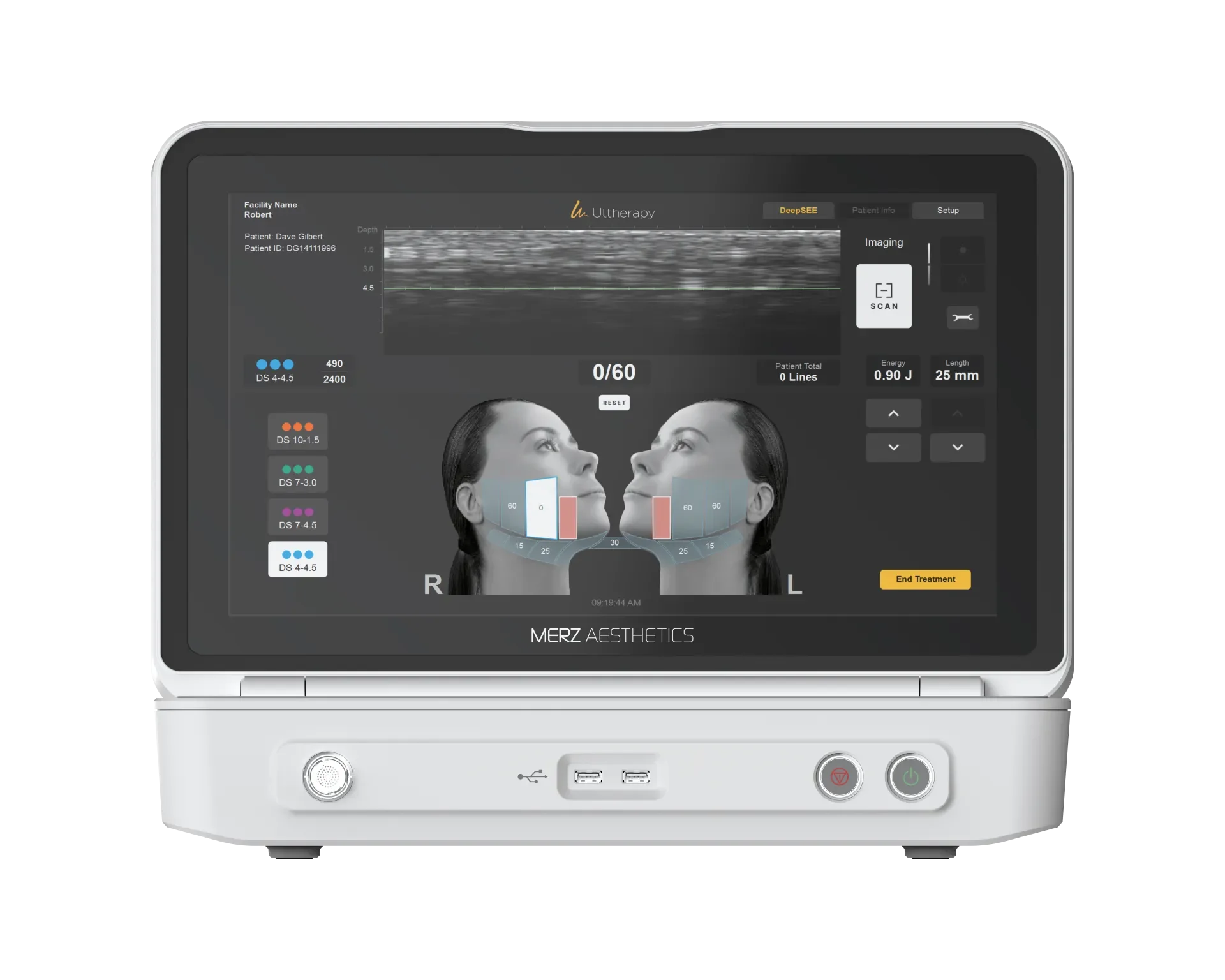
Ultherapy on the upper face is a non-invasive procedure that uses microfocused ultrasound — typically with the visualization (MFU-V) feature — to deliver heat at specific depths around the orbital bone and the brow. On the upper face, the practitioner usually works with a 1.5mm or 3.0mm transducer, sometimes adding selected 4.5mm passes outside the orbital bone, and never directly over the eye itself. The visualization step is what lets the specialist see the underlying tissue layers and place the energy precisely above the brow rather than into the orbit.
The goal isn't a surgical brow lift. The U.S. Ulthera prescribing information specifically describes a non-invasive lift of the eyebrow as a cleared indication, and a 2014 Sasaki and Tevez paper documented modest mean brow elevation in a non-surgical population. 'Modest' is the word that matters. My specialist quoted me a typical range she sees on patients with the right anatomy, in the millimeter range, and reminded me that a millimeter on the brow reads as more than a millimeter elsewhere because the eye is the most-noticed feature on a face. That framing helped me set the right expectation.
Why the upper face is the hardest area to read honestly
The face I see in the mirror isn't the face other people see, and the upper face exposes that gap fastest. We look at our own brows in a forward, lifted position — we hold the muscle slightly active when we look at ourselves, especially in good light. So the day-of-the-appointment mirror photo is an unreliable baseline. The honest baseline is a photo someone else took of you at a meeting, in flat fluorescent light, when you weren't paying attention. I have those photos because my friends are tactless and post them. They're the only fair comparison.
This matters because brow Ultherapy results are reported as gradual, modest, and most visible in unposed third-party photos at month four to six. Patients report being underwhelmed at the day-three mirror selfie and then seeing a noticeable change when they compare an unposed work meeting photo from before to one taken several months after. I think the entire frame of expectation should sit there, not at the mirror. Studies suggest the same thing in dryer language. Patients in Gangnam who go in expecting a surgical brow position the next morning are the patients who write disappointed reviews.
I'd add one more thing here that I've come to think is underrated. The upper face is also asymmetric on most people, more than we realize. Many of us have one brow that sits a little higher and one that drifts a little lower, and a procedure that lifts both modestly may make the asymmetry more visible at first because the relative gap stays. My specialist measured both sides during mapping and adjusted, but she also told me to expect the asymmetry to look slightly different at month two and to wait until month four for the honest comparison. That patience is hard. I had to make myself stop checking in the bathroom mirror at week three because I was reading week-three swelling as result, and result as failure. Both readings were wrong.
Who tends to do well, and who probably should consider alternatives
From what I've gathered across two consults and the published literature, patients who tend to be good candidates for upper-face MFU are adults from the late 30s into the early 60s with mild to moderate brow ptosis, decent skin quality, and realistic expectations about millimeters of elevation rather than visible lift you'd see in a surgical before-after. The patients who tend to do less well are those with significant excess upper-eyelid skin (dermatochalasis) where the limiting factor is skin redundancy that surgery would address more cleanly, and patients with very deep static frown or forehead lines that energy devices alone can't resolve.
Who should usually skip it or talk to a physician carefully first: anyone with active skin infection, anyone pregnant or breastfeeding (limited evidence), anyone with implanted electrical devices in the field, and anyone with a history of orbital trauma or recent eye surgery. My specialist also flagged that patients with very thin skin over the brow sometimes report more sensation, and that patients with darker skin tones should ask specifically about post-inflammatory pigment risk in this area. None of this is medical advice from me — I'm a person who reads consultation notes and wants you to read yours too.
What the brow session actually felt like
I'll be specific. The chair was reclined to about 20 degrees. The mapping took maybe twelve minutes — pencil marks above the brow, on the temple, and out toward the lateral canthus, with a deliberate gap above the eye where no energy would be delivered. Gel went on, the visualization screen came up, and the specialist did a few test pulses on the temple before working in tight rows above the brow. Each pulse on the brow felt like a small, hot tap on the bone — sharper than I expected because the brow is so close to bone, and very brief. Maybe a second. Then nothing.
I did not have sedation. I had two ibuprofen 30 minutes before, with my specialist's okay, and I held a cool gel pack the staff handed me. The deepest discomfort was on the bony lateral brow, the way you'd expect anywhere with bone right under the surface. Patients report a wide range here and several specialists offer pro re nata pain control. The session for the upper face only was about 35 minutes. I walked out, put on sunglasses, and went directly to my hotel — which I recommend over the cafe-and-light-shopping detour I'd planned. My eyes were fine. They didn't want to be photographed.
A few practical notes from the chair I want to flag for anyone planning a brow session. Bring sunglasses for after — the kind that wrap. Your eyes will be fine but the bright Gangnam afternoon will feel intense in a way you'd expect. Wear a soft top with a low collar that day, because anything that has to go over your head is annoying with brow tenderness. Skip eye makeup that morning; you don't want anything to remove from the orbital area in the next 24 hours. And — this one is small but real — don't book the appointment back-to-back with another appointment somewhere else in the city. Give yourself 90 minutes of buffer on either side. The upper face needs more rest than the brochure language implies.
Recovery and the timeline I had
Hour one to twenty-four: the brow felt warm and slightly tender, especially when I raised my brows on purpose to test it. I had two small pinpoint bruises at the temple by morning — not painful, gone in five days. No swelling around the eye itself. Days two to seven: warmth resolved by day two, the bruises faded, and I had a brief few-day window where my brows felt subtly heavier when I'd been reading on a screen, which my specialist said is reported and usually self-resolves.
Week two to month three: I couldn't honestly point to a change in the mirror. I didn't believe the marketing slow-curve language until my month-three appointment, when the specialist showed me a side-by-side from baseline. The lateral brow had lifted. I could see it in the third-party photo. In the morning mirror it looked the same to me — but in the meeting photo a friend sent me from a wedding I'd been at six months later, my eyes looked open in a way that wasn't makeup. That's the result, in honest framing. Studies report continued slow improvement up to about month six to nine.
Risks, side effects, and the questions I asked before signing
The upper face has specific risks that the lower face mostly doesn't, and I read carefully before booking. Most common reported side effects: temporary redness, mild swelling, tenderness, small bruises, brief brow heaviness. Less common but documented: transient nerve irritation along the supraorbital or temporal nerve branches (numbness, tingling — usually self-resolving over days to weeks), small surface burns if coupling fails, post-inflammatory pigment changes in patients with darker skin tones. A 2017 Dermatologic Surgery review summarized these and described the safety profile as favorable in trained hands, with the caveat that operator experience matters more here than on the lower face.
The questions I asked the specialist directly: how many upper-face MFU sessions she had personally done in the past year, what her plan would be if I noticed prolonged numbness above the brow after I flew home, whether she would use the visualization screen on every pass (I asked to see it), and whether she'd ever decline to treat the upper face on a patient — and why. I wanted answers, not reassurance. She had answers. If a clinic can't or won't engage with those questions, I'd treat that as information. The eye is not the area to optimize for price.
How it compares to alternatives (Sofwave, RF microneedling, surgery)
I went into the consult having read a comparison sheet and printed it out. The honest version is that the upper-face options work via different mechanisms at different depths and produce different kinds of results, and they aren't interchangeable. MFU (Ultherapy) targets specific depth layers ultrasonically. Sofwave delivers synchronous ultrasound parallel beams in mid-dermis. RF microneedling combines micro-injury with radiofrequency for collagen remodeling. Botulinum toxin chemodenervation lifts the brow by relaxing depressor muscles — entirely different mechanism, different timeline, different repeat schedule. Surgical brow lift is, of course, surgical. The categorical table below is what I built from package inserts, peer-reviewed reviews, and consults — I am deliberately not ranking, because the right answer depends on your anatomy and what you actually want.
What I'd say from my own reading and the friends I've talked to: MFU on the brow is the most 'lift' an energy device can claim with reasonable evidence behind it, but the result is modest and slow. Botox can produce a more visible lateral brow lift faster but lasts months, not years, and addresses muscle balance rather than skin laxity. Sofwave on the brow has limited published data so far and is sometimes described as more comfortable. Surgery is the only option if what you want is a brow position that's clearly different in any photo. The right framing for the table is 'what's the goal' — not 'what's best.'
| Option | Mechanism | Realistic upper-face effect | Sessions / repeat | Downtime |
|---|---|---|---|---|
| Ultherapy (MFU-V) | Microfocused ultrasound, visualized | Modest brow elevation, slow appearance | 1, possible repeat 12-18 months | 0-2 days |
| Sofwave (SUPERB) | Synchronous ultrasound parallel beam, mid-dermis | Texture and modest tightening, limited published brow data | 1, occasional touch-up | 0-1 days |
| RF microneedling | Micro-injury + radiofrequency, dermal | Texture and skin quality improvement, less direct lift | 3-4 sessions over 3 months | 1-3 days per session |
| Botulinum toxin (chemodenervation) | Muscle relaxation, depressor balance | Visible lateral brow lift, lasts months | Every 3-4 months | 0 days, fast onset |
| Surgical brow lift | Surgical repositioning of brow | Significant lift, durable | 1 procedure, surgical recovery | 1-2 weeks |
What I'd do differently and what I tell friends now
If I went back for upper-face MFU, three things would change. First, I'd ask my photographer friend to take a flat-light, no-effort baseline photo a week before the appointment, and a matching one at month four — not selfies, not mirror shots. The result curve only reads honestly in third-party photos and I almost missed mine because I kept looking in the bathroom mirror. Second, I'd schedule the upper face on its own day rather than combining it with same-session lower-face work. The brow needs more focus from the practitioner and more rest from the patient than I gave it. Third, I'd be honest with myself about the goal — if what I actually wanted was a clearly different brow position in every photo, MFU is not the device for that, and a good consultation should have walked me toward Botox plus a longer conversation, or eventually a surgical option, instead.
When friends in California ask me about it, I tell them three things. The marketing language around 'mini eye lift' undersells how subtle the change is and oversells how dramatic it looks day one. The specialist matters more here than on any other zone — visualization, transducer choice, and pulse placement near the orbit are skill-dependent in a way the cheek isn't. And the post-procedure morning is not the day to walk Garosu-gil. The slow Gangnam recovery day I run after every procedure is mandatory for the upper face, and the right hotel makes a real difference. The treatment is fine. The plan around it is the part most people underestimate.
The other thing I tell them is to wait six months before deciding whether the procedure was worth it. I almost convinced myself at month one that it hadn't done anything, and I was wrong, but I didn't know I was wrong until much later. The whole MFU result curve is built around patience, and the upper face is the region where impatience does the most damage to your read of the result. If you can't wait — if you need a visible change next week for an event — you're looking at the wrong tool, and a good consultation will tell you that and steer you toward something faster like a careful Botox plan or a different conversation entirely. The right device matched to the right timeline is the whole game. Everything else is texture.
“The visualization step is the part patients can't see in marketing photos — it's the part that decides where the energy goes. On the brow, where the orbit is millimeters away, that's the entire decision.”
Specialist consultation note, Gangnam, paraphrased with permission
Frequently asked questions
Will Ultherapy actually lift my brows in any visible way?
Patients report and the literature describes modest, gradual brow elevation — typically measured in millimeters and most visible in unposed third-party photos at months three to six. It is cleared by the U.S. FDA as a non-invasive lift of the eyebrow. 'Visible' depends on what you mean — visible in side-by-side comparison photos, often. Visible to a stranger glancing at you the next morning, almost never. Manage expectations toward subtle and slow.
How safe is Ultherapy near the eye?
Studies suggest the safety profile is favorable when an experienced specialist uses the visualization (MFU-V) feature, places transducers carefully outside the orbit, and selects appropriate depths. The energy is never delivered directly over the eye, and the orbital bone provides natural protection. Specialist experience matters substantially in this zone — ask how many upper-face sessions the practitioner has personally done and whether they will use visualization on every pass.
Is the brow session more painful than the lower face?
It depends on anatomy. The brow has bone right under the skin, so the bony pulses can feel sharp — a brief tap rather than a long discomfort. Patients report pain ranging from mild to moderate, with most experienced specialists offering options for adjustment in real time. I had two ibuprofen 30 minutes before with my specialist's permission and used a cool gel pack between zones. Tell your specialist immediately if any zone feels harder than another.
How long do brow Ultherapy results last?
Published data suggest peak visible effect around month three to six with continued slow improvement up to nine months in some studies, and a result duration commonly cited as up to one to two years before patients consider a maintenance round. Aging continues regardless of any single procedure, and sun protection, sleep, and overall skin health affect how long any non-invasive result is appreciable.
Can I combine brow Ultherapy with Botox or filler?
Many specialists do combine MFU with neuromodulators or with strategic filler placement, but timing matters and the decision is patient-specific. A typical Korean protocol I've seen waits one to two weeks between MFU and Botox, with longer windows for filler depending on the area. Ask your specialist for a written treatment plan and don't book the most ambitious version of your itinerary for the day after.
How do I find a Korean specialist experienced specifically with eye and brow MFU?
I ask three things during a consult: how many upper-face MFU sessions the specialist has personally done in the past 12 months, whether they will show me the visualization screen during the session and explain transducer placement, and what the post-procedure plan is if I have a question after I've flown home. KHIDI's foreign-patient resource and the Visit Korea medical-travel portal are sensible starting points for verifying licensing, but the consultation itself is where the real signal lives.