Treatment Guide
Full Face Ultherapy vs. Zone-Based: How I Decided
A diary-style breakdown of when full-face Ultherapy makes sense, when zone-only is smarter, and how I worked out the right answer for my own face.
I have had Ultherapy in Gangnam twice. The first time was full face. The second time was a zone-based session focused on the jawline and lower neck. Both were the right call at the time, and the reasons they were the right call had almost nothing to do with which one is "better" and almost everything to do with what I was actually trying to fix at age 34 versus age 36. This is the diary of how I sorted through that decision both times, what I asked, what I'd ask now, and the comparison framework I wish I'd had on trip one. I'm not a doctor and I do not play one on the internet. I'm a person who has done this twice and finally has a clean answer for my Berkeley friends.
What "full face" actually means in a Gangnam Ultherapy quote
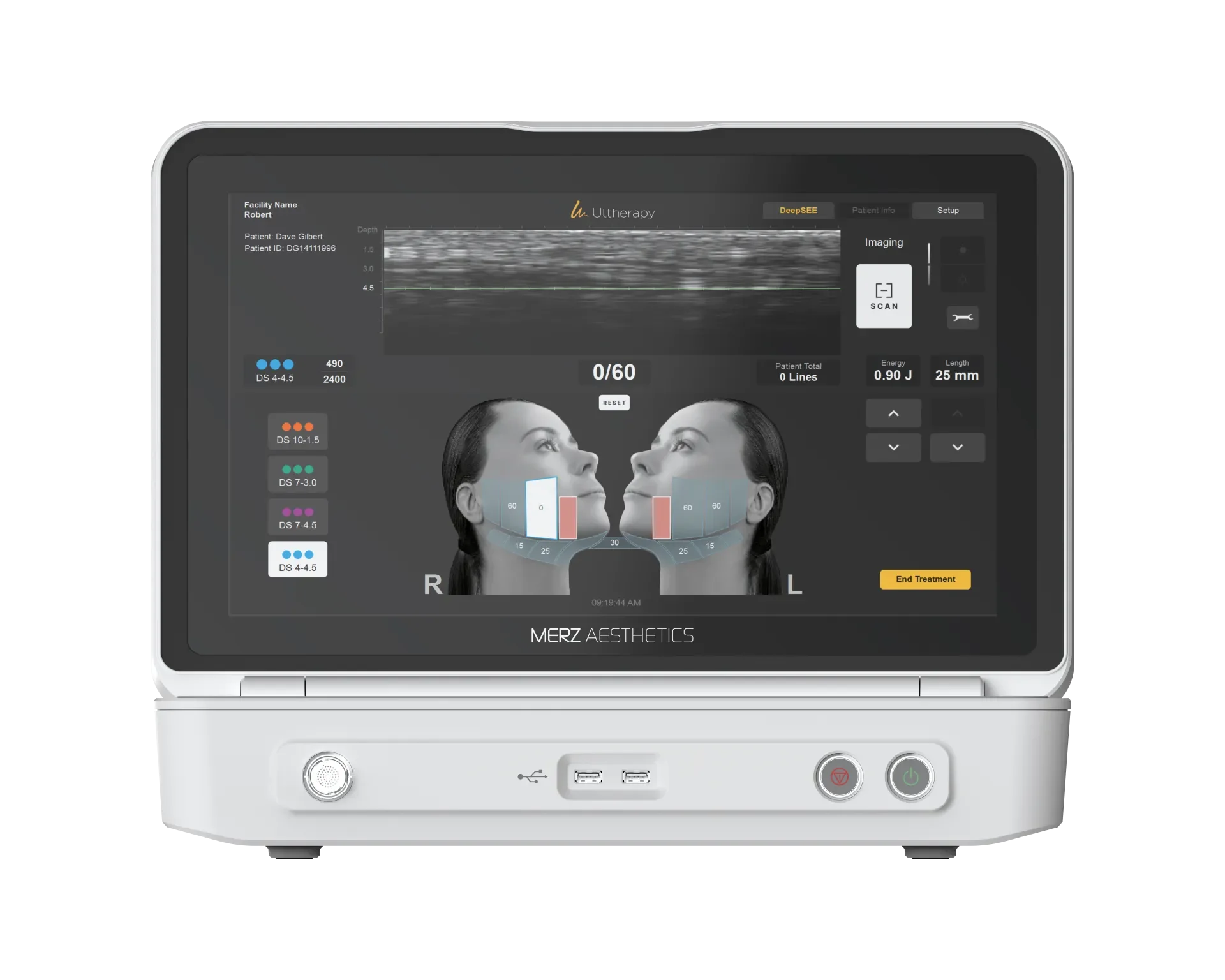
Full-face Ultherapy in a Korean clinic typically refers to a single-session protocol covering the forehead and brow, mid-face (cheeks and lateral cheek), lower face (jawline and submental area), and often a portion of the upper neck — using multiple transducer depths (1.5mm, 3.0mm, 4.5mm) across roughly 300-400 lines, depending on the clinic's standard protocol. That's the working definition. What it isn't: a body treatment, a décolletage treatment, or a treatment that includes intra-oral work or the immediate eye area unless the doctor specifically adds those. The term "full face" varies by clinic, which is the part nobody tells you. Some Gangnam clinics include the upper neck as standard. Others quote the upper neck separately and call only forehead-through-jaw "full face." The first time I booked, I assumed full face meant the whole front of my head from hairline to clavicle, which is not what it meant. I got forehead through jaw plus a small extension to the upper neck, and the décolletage was an entirely separate conversation that I had to schedule on a different visit. Which is to say: when a coordinator says "full face," the next question I now always ask is exactly which anatomical zones are included, and which are not. I've also learned to ask for the answer in writing on the consultation form, because what gets nodded to verbally and what gets done on the table are two slightly different conversations. Korean coordinators have generally been good about clarifying this when asked. The miscommunication was on my end the first time.
What zone-based Ultherapy targets, and why people pick it
Zone-based Ultherapy is a session deliberately limited to one or two anatomical regions — the jawline, the submental area, the upper neck, the brow, or a single side if there's facial asymmetry being treated. It's a smaller protocol, typically 100-250 lines, and the per-session cost in Gangnam is correspondingly lower than full-face pricing. Patients tend to choose it for one of three reasons: they have a specific concern that doesn't justify treating the whole face, they're returning for a touch-up after a previous larger session, or their budget or pain tolerance won't accommodate a full-face protocol that day. I fell into the touch-up category for my second session. My first had been a 320-line full-face treatment in 2023. By 2024, the upper face still looked good — the brow lift effect was holding, the mid-cheek had not slid back to where it had been — but the jawline was the area I felt was starting to drift. So I went back, asked specifically for a jawline-and-submental session at 220 lines, and skipped the rest. The session ran 35 minutes instead of 60, the puffiness lasted 24 hours instead of 48, and the cost was meaningfully less than a second full-face would have been. The results, three months out, looked exactly as I'd hoped — sharper jawline, no change to the rest of the face, no over-treated weirdness anywhere. The argument for zone-based is essentially: don't pay to treat the parts of your face that don't need treating. The argument against it, which Korean coordinators have raised when I've asked, is that aging is not actually localized — the cheek that's still holding up at 34 may benefit from preventive treatment at 36 even if it doesn't look like a problem yet. Reasonable people disagree on this. I'm in the "treat what's drifting now, retreat the rest later" camp. Other people I respect are in the "keep the whole face on the same maintenance schedule" camp. Both work.
How I'd think about it at different ages and starting points
Early thirties, no prior Ultherapy, mild laxity along the jawline only: I'd lean toward zone-based, 200-250 lines, jawline and upper neck. The argument is that at this age the rest of the face is still doing its work, and treating it preventively is a cost-benefit conversation rather than a need-based one. A peer-reviewed review of focused ultrasound outcomes (Fabi & Massaki, 2014, Dermatologic Surgery) noted that response to MFU-V is correlated with baseline tissue quality, which tends to be better in younger patients — meaning the same dose may produce a more visible response in a 32-year-old than a 42-year-old, but the visible need may not yet be there. Mid-thirties to early forties, no prior Ultherapy, multi-zone concerns: I'd lean toward full face, 300-400 lines, with an honest conversation about whether the décolletage should be added. This is the sweet spot, in my experience and from Bay Area friends who've done this trip, where full-face is doing the most work for the money. The collagen response peaks around month 3-6 post-procedure (Suh et al., 2011, Aesthetic Surgery Journal observed this timeline), and the layered effect of treating multiple zones at once produces the "rested" look most patients describe. Mid-forties and older, no prior Ultherapy, significant laxity: this is the conversation where the doctor's recommendation matters more than the framework. Some patients in this range will benefit more from a combined protocol — Ultherapy plus radiofrequency, or Ultherapy across two sessions 4-6 weeks apart — than from a single full-face MFU-V session. A coordinator who only offers Ultherapy is not the coordinator I'd want to plan a more complex case with. Patients report that the lifting effect of Ultherapy alone is more subtle in this age group, and managing expectations is part of the planning. Hedging because individual response varies enormously by skin quality, weight history, and prior procedures.
The honest cost-and-time math, when it matters
Pricing in Gangnam shifts constantly and varies by clinic positioning, doctor seniority, device generation, and bundle structure, so I refuse to put numbers in this post that will be wrong by next quarter. What I will say is that the relationship between full-face and zone-based pricing is not a simple half-of-full-face equation. Most clinics I've consulted with price the zone-based session at roughly 40-60% of their full-face quote, depending on which zone and how many lines. The time math is where the comparison gets concrete. A standard full-face session in my experience runs 50-75 minutes on the table including numbing setup. A jawline-only zone session runs 25-40 minutes. The recovery is similar in pattern but compressed in scale — full-face means 48 hours of moderate puffiness and a soft-clothing rule for 72 hours, while zone-based means 24 hours of puffiness and a soft-clothing rule for 48. If you're flying in for the procedure and flying back the same week, that 24-hour difference is the difference between landing back in Berkeley with your face still doing the puffy thing and landing back already past it. Which brings up the trip-planning piece, since most Bay Area readers who message me are flying in for this. A full-face session works better if you have at least 4-5 days post-procedure before the return flight. A zone-based session can be done with 2-3 days. I've done full-face with only 3 days afterward and I would not do that again. The flight made the puffiness last longer than it should have, and my Uber driver in Oakland gave me the kind of look you give someone whose face is doing something.
Comparing full-face Ultherapy with zone-based and adjacent device options
Some readers asking about full-face versus zone are actually asking a different question — should I be doing Ultherapy at all, or should I be looking at Sofwave, Thermage FLX, or HIFU equivalents like Ultraformer III. The answer is not the same as the full-face-vs-zone answer, but it overlaps, because some devices are better suited to focal zone work and others to broader treatment. Below is a categorical reference table comparing the format each device tends to be deployed in. This is not a ranking and the table doesn't say which is best — it depends on the goal, the operator, and the face. None of this replaces a consultation with a licensed provider.
| Device / Modality | Best For | Typical Format | Single-Zone Capability | Energy Type |
|---|---|---|---|---|
| Ultherapy (full face) | Multi-zone SMAS-level lift | 300-400 lines, single session | Yes, but often paired with full-face | Focused ultrasound (MFU-V) |
| Ultherapy (zone-based) | Targeted jawline, brow, or neck | 100-250 lines, single session | Designed for it | Focused ultrasound (MFU-V) |
| Sofwave | Mid-dermal collagen, fine lines | 5-7 passes, single or split session | Possible, less common | Synchronous ultrasound (SUPERB) |
| Thermage FLX | Volumetric tightening, contour | 600-900 shots, full face standard | Less typical, often full face | Monopolar radiofrequency |
| Ultraformer III (HIFU) | Multi-depth lift, broad area | 600-1000+ shots, often full face | Yes, configurable by zone | Macro/micro focused ultrasound |
What I asked at consultation, and what I'd add now
On my first consultation I asked four questions: what does the procedure feel like, how long does it last, what's the line count, and what's the price. That was a fine starting list. It missed at least four questions that would have helped me make a better full-face-vs-zone decision. I write them out here because I tell every Berkeley friend who's flying for this trip to ask them. First: which specific anatomical zones are included in your full-face protocol, and which are not. Second: how does the line count split across the 1.5mm, 3.0mm, and 4.5mm depths, and how does that split change if I do zone-based instead. Third: based on what you see on my face in this consultation, what would you specifically recommend, full-face or zone, and why. (This is the question that produces the most useful answer and the one I forgot to ask the first time.) Fourth: if I do zone-based now, what's the timeline you'd suggest for the rest of the face, and what would that cumulative cost look like over 18 months. The coordinator at my second clinic answered all four without hedging, which is part of why I went back there. The first clinic answered three out of four, hedged on question three ("it depends on what you want") and frankly that answer is part of the reason I tried a different clinic the second time. Korean clinics that have a clear point of view on which protocol is right for which face are, in my opinion, the ones worth working with. The ones that present both options as equivalent and let the patient pick by price are giving you a service-industry answer to a clinical question, and the clinical question deserves a clinical answer.
What I'd pick today, knowing what I know
If I were 34 again and starting over, I would still pick full-face for my first Ultherapy. Not because it was clearly superior to a zone-based start, but because it gave me a baseline understanding of how my face responds to MFU-V — how much lifting at the jaw, how much at the brow, how much at the cheek, how much puffiness, how much pain tolerance — that has informed every decision since. You learn your face's response curve from the first full-face session in a way you cannot learn it from a zone-only session. That information has value beyond the immediate cosmetic result. If I were 38 and had already done a full-face two years prior, I would pick zone-based again, exactly as I did at 36, and I would target whichever zone had drifted most. The decision tree gets simpler with each session, because you have a baseline to work from. Patients I've spoken with who have done three or four sessions over a 5-7 year window almost universally settle into a zone-based maintenance rhythm rather than repeating full-face every time. The full-face is the calibration session. The zones are the maintenance. And if I were 45 and considering a first Ultherapy at a starting point with significant laxity, I would honestly slow down and have a longer conversation. I would not assume full-face Ultherapy is the right starting tool. I would ask whether radiofrequency, combined protocols, or surgical consultation should be part of the planning. I would also ask my Berkeley dermatologist what she thinks, separately from any Korean clinic conversation, because second opinions matter and the financial incentives of a clinic that sells the procedure are not perfectly aligned with the patient's question of should I be doing this at all. None of this is a reason not to do it. It's a reason to ask more questions before you do.
Frequently asked questions
Is full-face Ultherapy always more expensive than zone-based?
Almost always, yes, because line count and session time both scale with the number of zones treated. Most Gangnam clinics price zone-based sessions at roughly 40-60% of their full-face quote, but the exact percentage varies by clinic positioning and the specific zone. Some bundle pricing makes the per-line cost lower in a full-face protocol than in a zone-based one, which can flip the cost calculus if you're treating multiple zones anyway. Always ask for both quotes side-by-side and ask how the per-line cost compares between the two formats.
Can I do zone-based Ultherapy on my first session, or should it be full-face?
You can absolutely do zone-based as your first Ultherapy, and many patients with a single localized concern do exactly that. The argument for starting with full-face is that it gives you a baseline understanding of how your face responds to MFU-V across multiple depths, which informs future decisions. The argument for starting zone-based is that you're not paying to treat areas that don't need treating yet. Both are valid. A coordinator who reflexively pushes you toward full-face when your concern is localized is, in my experience, worth a follow-up question.
How do I know if I'm a candidate for zone-based instead of full-face?
The honest answer is that a licensed provider examining your face is the right source for this decision, not a blog post. That said, patients who are typically good candidates for zone-based are those with a single isolated area of concern (most commonly the jawline or submental area), patients returning for maintenance after a previous full-face session, and patients with budget or recovery-time constraints that make a smaller protocol more practical. Patients with diffuse multi-zone laxity tend to do better with a full-face protocol. Studies suggest individual response varies, so ask your provider for a recommendation based on examination, not just what you tell them.
Will doing zone-based Ultherapy first then full-face later cost more total?
Usually yes, in raw dollar terms, because you're paying for two sessions instead of one. The counter-argument is that zone-based maintenance over time may produce a more natural-looking result with smaller incremental adjustments than infrequent full-face sessions, and that the per-session cost is lower. Whether the cumulative cost makes sense depends on your budget cadence and how you value the maintenance versus calibration approach. I personally do one full-face every 4-5 years and zone-based touch-ups in between, and the math has felt right for my situation.
Are recovery and downtime different between full-face and zone-based?
Yes, in scale rather than in kind. Full-face Ultherapy typically produces moderate puffiness for 24-48 hours and a soft-clothing recommendation for 72 hours, while zone-based produces shorter and milder versions of the same recovery pattern — often 12-24 hours of puffiness and 48 hours of soft clothing. Sun protection (SPF 50, hat) is the same recommendation regardless of protocol — at least 14 days for both. Heat restrictions (no jjimjilbang, no hot yoga, no aggressive cardio) are typically 1-2 weeks regardless of zone or full-face, because the heat sensitivity is about the treated tissue, not the area.
If I'm flying to Seoul specifically for Ultherapy, does full-face vs zone change my trip length?
It can. A full-face session benefits from at least 4-5 days post-procedure before a return international flight, because the puffiness and any post-treatment sensitivity want time to settle before the cabin pressure and dehydration of long-haul travel. A zone-based session can be done with 2-3 days post-procedure, which makes a shorter trip viable. I've done full-face with only 3 post-procedure days and would not do that again — the flight extended the puffiness in a way I felt for a full week afterward. If your trip length is fixed, zone-based may be the more comfortable fit; if your trip length is flexible, full-face works fine with adequate buffer.