Treatment Guide
Ultherapy for the Jawline and Jowls: My Personal Focus Zone
A first-person guide to MFU on the lower face — the zone I keep coming back to, and what I'd want a friend to know before her first session.
I had my first Ultherapy session three years ago, and the jawline is the part I keep talking about. The neck mattered, the cheek mattered, but the place where my face had started to look slightly tired — the line from earlobe to chin, and the soft pillow above it that nobody warned me about in my early thirties — that's the zone where the energy did the most for me, and that's the zone I keep coming back to. This is the guide I wish someone had handed me before I sat down. What MFU actually felt like at the angle of the jaw, what showed up at month four, what the literature describes, and what I'd plan differently next time. I'm one woman with one face and one set of opinions. Everything here is hedged where hedging belongs.
What is Ultherapy for the jawline and jowls, exactly?
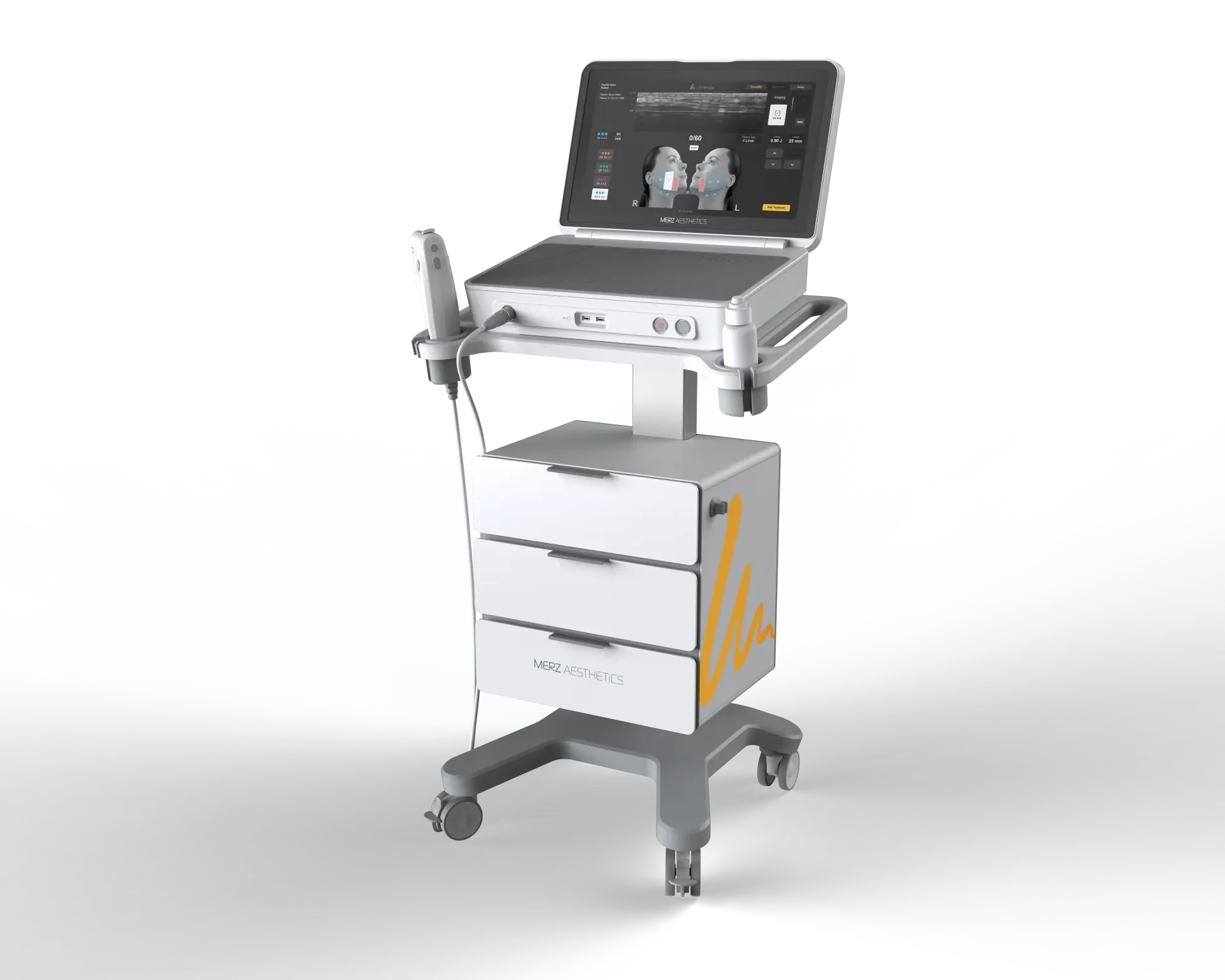
Ultherapy on the jawline and jowls is a non-invasive procedure that uses microfocused ultrasound — MFU, often paired with visualization as MFU-V — to deposit thermal energy at specific depths beneath the skin of the lower face. The device targets two main layers in this zone: roughly 4.5mm, which corresponds to the superficial musculoaponeurotic system or SMAS, and 3.0mm, which sits in the deeper dermis. The 1.5mm transducer comes out for the very thin skin near the marionette area or the perioral border, but most of the jawline work happens at the deeper two settings.
What that meant for me, sitting in the chair: rapid pulses of heat at very specific points along the line from the earlobe down toward the chin, with each pulse lasting about a second and concentrated in a column rather than spread across the surface. The mechanism the brochures describe — controlled thermal injury at depth, triggering a neocollagenesis cascade over the following months — is the same one summarized in reviews like the 2017 Dermatologic Surgery paper on MFU safety and outcomes. The lower face has the thickest SMAS layer, which is part of why the jawline tends to be the zone where patients report the most consistent visible response.
Why the jawline responds well, and why the jowls are slower
The jawline has the SMAS running underneath it, and the SMAS is exactly the tissue MFU was designed to address. The 4.5mm transducer reaches that fascial plane and creates discrete thermal coagulation points that the body then heals over months. That part is reasonably well-supported in the literature, and it's also the part of my face where I noticed the clearest change at month four. The jowl itself — the soft pad that sits forward of the masseter and below the cheek — is a slightly different story, because what people call a jowl is actually a combination of skin laxity, fat-pad descent, and bone resorption, and only one of those three things is something MFU can really influence.
My specialist in Gangnam explained this to me in a way that stuck. She said something close to: 'I can tighten the envelope. I cannot move the cushion inside it.' For some patients, tightening the envelope is enough — the jowl looks smaller because the skin around it is firmer and the angle of the jaw reads sharper. For other patients, the fat-pad descent is the dominant variable and a single MFU session won't be the answer. I think that distinction matters because it sets expectations correctly. Patients who come in expecting a surgical jowl-lift result from a non-invasive device often report disappointment, and that's a recurring note across patient forums and the published literature.
There's also the variable of how the lower face moves. We talk, we chew, we sleep on one side or the other, we hold the phone in a way that compresses the same patch of skin every day. The jawline that comes back to the clinic in a year is the result of the procedure plus twelve months of those small mechanical inputs. I think about that more than I used to.
Who tends to do well, and who probably should consider other options
From what I've gathered across two specialists in Korea and one in California, the patients who tend to do well with jawline MFU are adults from roughly their mid-30s to early 60s with mild to moderate skin laxity, decent collagen reserves, realistic expectations, and a face shape where the bony architecture under the skin is still defined enough for a tightening response to read visibly. Studies suggest that patients with significant fat-pad descent, advanced jowling with hanging skin, or substantial bone loss are often steered toward combination protocols or surgical consultation rather than a single MFU session.
Who probably should pause and ask harder questions: anyone with active skin infection in the treatment area, anyone pregnant or breastfeeding (where evidence on MFU is limited), anyone with implanted electrical devices in the field, and anyone who has had recent fillers in the lower face that might change the energy distribution. My specialist also flagged that patients with very thin facial fat sometimes report more discomfort over the bony angle of the jaw because there's less cushioning. None of this is medical advice from me. I'm a person who reads the prescribing information for fun and asks for the device protocol in writing before she signs.
The session itself: what the energy felt like along the jaw
I want to be specific because this is the part I wanted specifics on before my first appointment. The room was quiet, the chair reclined to about 30 degrees, and the practitioner spent close to twenty minutes mapping the lower face with a fine white pencil. She drew lines along the angle of the jaw, marked the path of the marginal mandibular nerve so she could keep her transducer placement appropriate, and made notes about asymmetry I had not noticed in any mirror. Then the gel went on, and the deeper transducer came out first.
The pulses on the jawline at 4.5mm felt like small hot pinches, sharper than the cheek. Each pulse lasted roughly a second. The 3.0mm pass was less sharp, more of a warm thud. Total line count for my jawline-and-jowl session was somewhere in the 350 to 500 range, which my specialist said was on the higher side because she was being thorough. I had taken two ibuprofen 30 minutes before, and I held a cool gel pack the staff handed me. I declined sedation. Patient discomfort scores in the literature range from mild to moderate with the highest scores typically over the bony angle and the chin, which tracks for me — the angle of the jaw was the area I noticed most.
A few things from the chair I want to flag for anyone planning. The mapping is not the part to rush. It's where the practitioner makes the decisions about transducer choice, energy level, and where the marginal mandibular nerve sits in your specific anatomy. A specialist who takes a quiet twenty minutes here is doing it right. I asked questions during mapping that I would not ask during pulses, where I wanted to focus on breathing. I accepted a brief water break at the halfway mark, which I'd recommend; it lets the technician switch transducer heads cleanly and lets your shoulders unclench. Keep your hair fully off the face. The lower face goes faster when nothing is in the way.
Recovery, the timeline I actually had on the lower face
Hour one through twenty-four: the jawline felt warm and slightly tender to touch, the way it does after a long day of intense talking. The skin looked subtly flushed but not red. No bruising on my first session, two small dot-bruises near the chin on my second. Days two through five: the warmth faded by day two, the residual flush resolved by day three, and the lower face felt slightly tight when I smiled hard, which patients commonly report and which usually settles within a week. I cancelled a friend's birthday dinner on day three, but in retrospect I could have gone — I just didn't want to chew on something hard.
Week two through month one: nothing visible, which felt anticlimactic. The early softening showed up around weeks five to six in soft morning light, and even then I had to look for it. Month three is when the jawline started to look better in honest photos, particularly the angle from earlobe down to mandibular border. Month four was when a friend who hadn't seen me in a while asked if I'd lost weight. I hadn't. The published peak for visible MFU outcomes is around months three to six, with continued slow improvement noted in some literature up to about nine months, and that matched my own observation. I'm at month eight now and the line of the jaw still reads cleaner than my own three-year-old photographs, which is the most honest before-and-after I can offer.
Risks, side effects, and what I read carefully before signing
The most common reported side effects of jawline MFU are temporary redness, swelling, tenderness, and small bruises — the things I had. Less common but documented in the literature: transient marginal mandibular nerve irritation (typically self-resolving in days to weeks), small surface burns if the transducer coupling isn't clean, and post-inflammatory pigment changes in patients with darker skin tones. A 2017 review in Dermatologic Surgery summarized these and noted the overall safety profile is favorable in trained hands but is not zero-risk. The Ulthera prescribing information available through the U.S. label is worth reading slowly before any first session.
I asked my specialist directly about each of these before I signed. I asked how many lower-face sessions she had done in the past twelve months, what her marginal mandibular nerve incident rate was, what her plan would be if I had a complication after I flew home, and whether the device's energy levels would be documented in my chart so I could refer to them on a future visit. She had answers I was satisfied with. If a clinic can't or won't answer those questions, that's information. The lower face is the area where the published literature pays the most attention to nerve anatomy, and I think a patient is allowed to ask a careful question.
How jawline MFU compares to alternatives, categorically
I went into my second consult with a printed comparison sheet because I'd been reading. The honest framing is that MFU (Ultherapy), synchronous ultrasound parallel beam (Sofwave), monopolar radiofrequency (Thermage FLX), and various lower-cost HIFU devices each work via different mechanisms at different depths. They aren't interchangeable, and the right choice depends on which tissue layer your specialist wants to influence and what your skin actually needs. The categorical table below is what I assembled from package inserts, peer-reviewed reviews, and my consultations. I am deliberately not ranking, because the right answer is patient-specific and a good consultation will tell you which device fits your anatomy.
What I'd say from my own experience on the jawline specifically: MFU at 4.5mm reaches the SMAS in a way the others don't, which matters for the angle of the jaw. A friend who chose Sofwave on her lower face told me her result felt more textural and less structural, which is consistent with what the literature says about its mid-dermal target. A different friend who'd done Thermage FLX preferred the comfort but described the lower-face result as warmer and more diffuse. None of those single anecdotes is a reason to pick a device. The table is a frame for a real conversation, not a verdict.
| Device | Energy type | Target depth | Sessions (typical) | Downtime |
|---|---|---|---|---|
| Ultherapy (MFU-V) | Microfocused ultrasound, visualized | 1.5 / 3.0 / 4.5 mm (SMAS reach) | 1, sometimes repeat at 12-18 months | 0-2 days |
| Sofwave (SUPERB) | Synchronous ultrasound parallel beam | ~1.5 mm mid-dermis | 1, occasional touch-up | 0-1 days |
| Thermage FLX | Monopolar radiofrequency | Volumetric, dermal/sub-dermal | 1, every 1-2 years | 0-2 days |
| HIFU (non-Ulthera) | High-intensity focused ultrasound, varies by device | Varies, 1.5-4.5 mm | 1-3 depending on device | 0-3 days |
What I'd do differently on a second jawline-focused session
If and when I go back for maintenance, three things would change. First, I'd start a serious sun-protection routine on the lower face at least three months ahead, because the practitioner's read of skin quality is influenced by photodamage and a tan from a Big Sur weekend made my specialist's job harder than it needed to be. Second, I'd schedule the appointment at the start of a Gangnam trip, not the end. I'd planned a long Bukchon walk for the day after my first session and what I actually wanted was a slow morning, a soft scarf, and the slow Gangnam recovery day I run after every procedure. Third, I'd ask about a planned conservative second session at month twelve rather than waiting for the result to fade and then chasing it.
I'd also be more honest with myself about the budget. I treated the jawline as the headline zone, which was right, and I treated everything else as an add-on, which was also right. What I underestimated was the planning cost. The right place to stay on a treatment trip matters more than the per-night number suggests, and a quiet hotel near the clinic mattered to me more than I realized when I was choosing on the booking app.
The last thing I tell friends who ask is something my specialist said almost as an aside on my way out. The procedure is one input. The jawline you bring back to her in a year is the result of that input plus twelve months of sleep, sun, posture, hydration, and whether you actually used the sunscreen on the days you didn't feel like it. MFU on the jawline isn't a one-time event you collect. It's the start of a slow remodeling that you either feed with reasonable habits or undermine with the same habits that brought you to the chair. That sentence is the most honest thing I heard about the procedure, and it didn't come from any brochure.
“I can tighten the envelope. I cannot move the cushion inside it. The patients who do best with MFU on the jowl are the ones whose anatomy still favors a tightening response, and the consult is where we figure that out before we book.”
Specialist consultation note, Gangnam, paraphrased with permission
Frequently asked questions
How many Ultherapy sessions do I need on the jawline and jowls?
Most U.S. and Korean specialists I've consulted describe a single full session for the jawline with possible touch-up at 12 to 18 months, depending on how the result is holding. For more pronounced jowl laxity, some specialists discuss a planned second session at the one-year mark rather than waiting for visible regression. Studies suggest most visible benefit appears between months three and six. Your specific protocol depends on skin laxity, anatomy, and your specialist's read.
Does Ultherapy on the jawline hurt more than on the cheek?
Patient discomfort scores in the literature range from mild to moderate, and many patients I've spoken with describe the angle of the jaw and the chin as the sharper-feeling areas because the transducer is depositing energy close to bone. The cheek tends to feel more diffuse and warmer rather than pinching. Tell your specialist in real time if a zone is harder than another — they can adjust energy on the fly.
When will I actually see a jawline result, realistically?
Subtle softening sometimes shows up around weeks four to six, but the published peak for MFU outcomes is around months three to six, with continued slow improvement reported up to nine months in some literature. The week-one selfie is rarely the photo you want. The month-four photo, in honest morning light, is usually the one that tells the story for the lower face.
Can MFU actually fix jowls, or just tighten the skin around them?
MFU primarily addresses skin laxity and the SMAS layer, which can make a jowl read smaller because the envelope is firmer and the jaw angle reads sharper. It does not move fat pads or address bone resorption directly. If your jowl is dominated by fat-pad descent, your specialist may discuss combination protocols rather than relying on a single MFU session. The honest framing in consults I've had is 'tighten the envelope, not move the cushion inside it.'
Is MFU on the lower face safe near the marginal mandibular nerve?
Studies and the U.S. prescribing information support the use of MFU on the lower face when an experienced specialist maps nerve anatomy carefully and uses appropriate transducer depth and energy. Transient nerve irritation has been reported and is typically self-resolving in days to weeks. A specialist who maps the path of that nerve before placing the transducer — and who can articulate why — is generally a stronger signal than someone who treats the lower face the same way they treat the cheek.
How do I find a Gangnam specialist who's experienced with jawline MFU specifically?
I ask three things during a consult. How many lower-face sessions has the specialist personally done in the past 12 months. Whether they will document the device's depth and energy settings in my chart so I have them for a future visit. What the post-procedure plan is if I notice something after I've flown home. KHIDI's foreign-patient resource and Visit Korea's medical-tourism portal are sensible starting points for verifying licensing, but the real signal is the consultation itself.