Treatment Guide
Ultherapy on the Neck and Décolletage: What I Actually Felt
A first-person, hedged guide to MFU on the neck and chest — what the energy felt like, what showed up at month three, and how it compares.
I had my first Ultherapy on the lower face two years ago, and the neck was an afterthought — an add-on the coordinator suggested almost casually, the way someone might offer you matching socks. I said yes, and that's the part of the treatment I think about the most now. The neck and the décolletage tell on you in ways the cheek doesn't, and the energy felt different there too. This is the guide I wish someone had handed me before I sat down — what the MFU actually felt like below the jaw, what showed up at month three, what the literature says, and what I'd do differently next time. Everything here is hedged where it should be hedged. I'm one person with one set of skin and one set of opinions, and the only thing I can really speak to with full confidence is my own experience and what I read in the materials before I signed.
What is Ultherapy on the neck and décolletage?
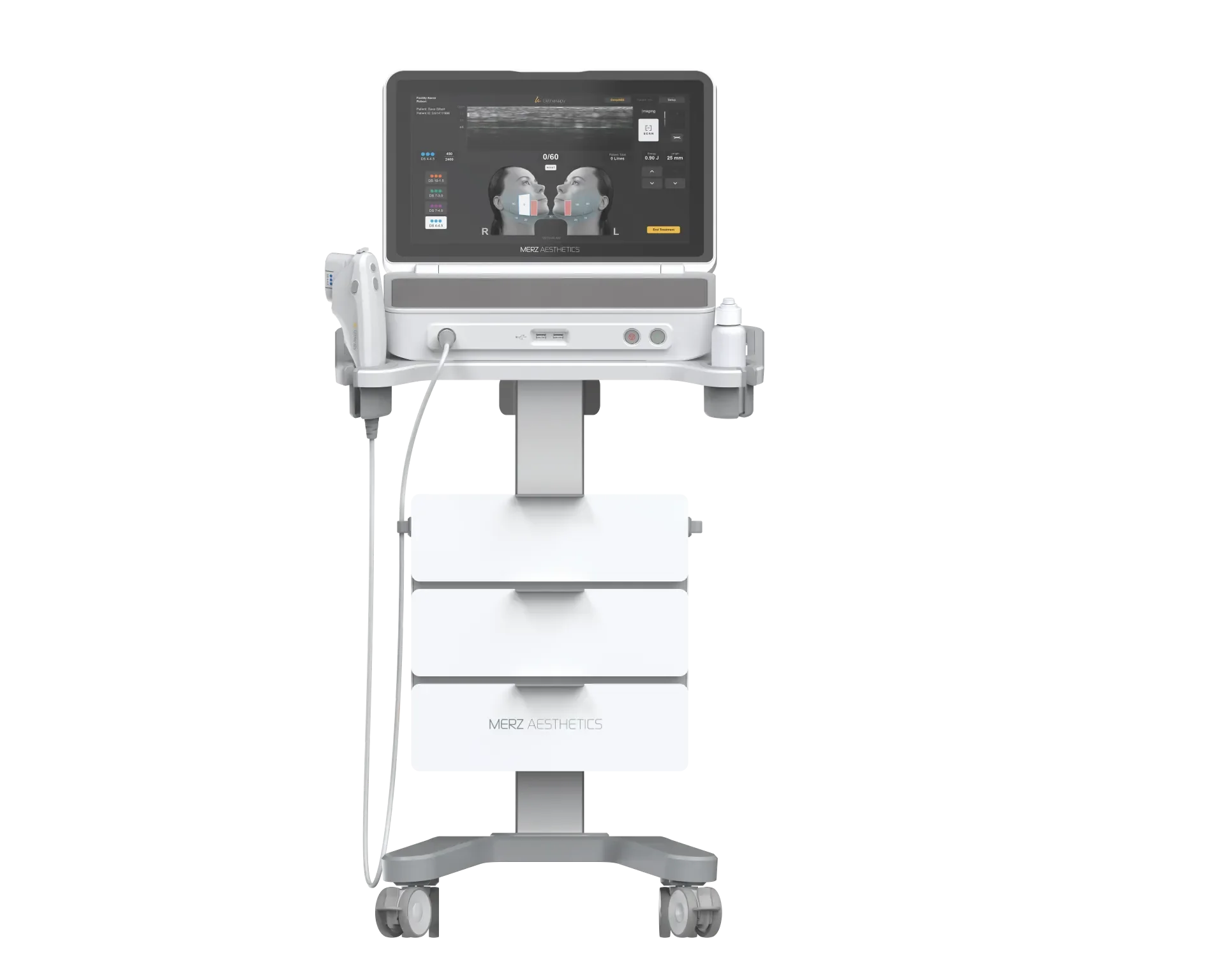
Ultherapy on the neck and décolletage is a non-invasive procedure that uses microfocused ultrasound — MFU, sometimes paired with visualization as MFU-V — to deliver heat below the surface of the skin in the area from the jawline down to the upper chest. The device targets two main depth layers: roughly 4.5mm, which corresponds to the superficial musculoaponeurotic-system equivalent below the jaw, and 3.0mm, which sits in deeper dermis. On the décolletage specifically, the practitioner usually uses a 1.5mm or 3.0mm transducer because the skin there is thinner and the anatomy is different.
What that meant for me, sitting in the chair: a series of small, fast pulses of heat at very specific points along the platysma area on the neck, and then a different rhythm of pulses across the chest. The mechanism the brochures describe — controlled thermal injury at depth, triggering a wound-healing response that lays down new collagen over months — is the same one papers like the 2014 Suh et al. study describe, but the experience of it varies a lot by where on the body the energy is being delivered. The neck, for me, was the most sensation-heavy zone.
Why the neck and chest are different from the face
The lower face has a layer of fascia and muscle (the SMAS) that responds to MFU energy in a fairly predictable way, which is why most of the early Ultherapy literature focused on it. The neck doesn't have that exact equivalent — the platysma is thinner and more variable — and the décolletage skin sits over bone and lung field with very little subcutaneous cushion. So the calculations the practitioner makes are different. Less depth on the chest, slightly different transducer choice on the neck, and a more conservative pattern overall.
My specialist in Gangnam explained this to me in a way I appreciated: the neck is closer to nerves and superficial vessels, the chest skin is more sun-damaged and thinner than I think it is, so the goal isn't to chase tightness the way you might on the cheek but to encourage gradual remodeling without overshooting. I think that framing matters because it sets expectations correctly. Patients who come in expecting a dramatic neck-lift result from one MFU session may report disappointment — that's a recurring note in the literature and in patient forums I've read.
There's also a movement variable on the neck that the face doesn't have. The face mostly stays still during normal life. The neck rotates, flexes, gets compressed by sleep position, gets pulled at by phone-staring posture, and the chest above the bra-line gets repeatedly creased by everything from sleep to carrying a heavy tote. So what you're really asking the device to do is start a slow remodeling response in tissue that lives a more active mechanical life than the cheek. That doesn't mean it doesn't work. It does mean the result curve is genuinely slower in this zone, and that the home-side variables — sleep position, sun exposure, posture, bag straps — matter more for the durability of the result than they do on the lower face.
Who is it for, and who probably should skip it
From what I've gathered talking to two Korean specialists and reading the U.S. Ulthera prescribing information, the people who tend to do well with neck and décolletage MFU are adults between roughly their late 30s and early 60s with mild to moderate skin laxity, decent collagen reserves, and realistic expectations about what an energy device can do without surgery. Studies suggest patients with a lot of platysmal banding or significant hanging skin are usually steered toward surgical options or combination protocols.
Who probably should skip it, or at least talk to their physician carefully first: anyone with active skin infection in the treatment area, anyone pregnant or breastfeeding (where evidence is limited), anyone with implanted electrical devices in the field, and anyone with severe untreated photodamage on the chest who hasn't done baseline sun-protection work. My specialist also flagged that very thin patients sometimes report more discomfort because there's less cushioning over the bone on the décolletage. None of this is medical advice from me. I'm a person who keeps detailed notes from her clinic appointments and reads the package insert when I'm bored.
The session itself: what the energy actually felt like
I'll be specific because this is the part I wanted specifics on before I went in. The room was quiet, the chair reclined to about 30 degrees, and the practitioner spent maybe 15 minutes mapping the neck and chest with a white pencil. Then she applied gel and started with the deeper transducer on the neck, just under the jawline, working in lines from ear toward midline. Each pulse felt like a small hot pinch — sharp at the deepest depth, less so at the shallower one — that lasted about a second and then was gone. On the neck, this happened maybe 250 to 400 lines, depending on how detailed your specialist is. The décolletage portion used a different transducer and felt more like a warm, dense buzz than a pinch, and it went faster.
I didn't take any sedation. I had two ibuprofen 30 minutes before, which my specialist said was fine, and I gripped a cool gel pack the staff handed me. Studies report patient discomfort scores ranging from mild to moderate, with the highest scores usually on the bony prominences — the lower jaw angle, the collarbone area on the chest. That tracked for me. The chest right above the sternum was the area I noticed most. Total session was about 70 minutes for both areas combined. I walked out and got into a taxi without sunglasses, which in retrospect I should have brought.
A few things from the chair I want to flag for anyone reading this trying to plan. The mapping is not the part to rush — it's the part where the practitioner is actually making the decisions about transducer choice and energy levels, and a specialist who takes fifteen quiet minutes here is doing it right. I asked questions during mapping that I would not ask during pulses (where I wanted to focus on breathing). I was offered, and accepted, a brief water break at the halfway mark, which I'd recommend; it lets the technician switch transducer heads cleanly and lets you reset your shoulders. Bring a hair tie if your hair is longer than chin-length; the chest portion goes faster if your hair is fully off the area.
Recovery, the timeline I actually had
Hour one to twenty-four: the neck felt warm and slightly tender to touch, like I'd done a set of weighted neck stretches at the gym. The décolletage was pinker than I expected and stayed that way overnight. No bruising on the neck, two small dot-bruises near the collarbone on the chest. Days two to five: the warmth faded by day two, the pinkness on the chest resolved by day three, and the neck felt slightly tight when I turned my head — patients report this, and it usually settles inside a week.
Week two to month one: nothing visible, which felt anticlimactic. The first early softening — what the literature calls the early collagen response — I couldn't really see until somewhere around week six, and even then it was subtle. Month three is when the neck started to look better in photos, particularly the area just below the jawline where I'd had the most laxity. Month six is the published peak for visible MFU outcomes, according to multiple reviews. I'm at month seven now and the chest crepiness — which I'd assumed was permanent — has softened in a way I didn't expect from one session. Whether I'd describe that as a 'lift' depends on what you mean by the word. It's improvement. It's not surgery.
Risks, side effects, and the things I read carefully before signing
The most common reported side effects are temporary redness, swelling, tenderness, and small bruises — the things I had. Less common but documented in the literature: transient nerve irritation (especially marginal mandibular nerve numbness on the lower face/neck border, usually self-resolving in days to weeks), small surface burns if the transducer coupling isn't correct, and post-inflammatory pigment changes in patients with darker skin tones. A 2017 review in Dermatologic Surgery summarized these and noted the overall safety profile is favorable in trained hands but not zero-risk.
I asked my specialist directly about each of these before I signed. I asked how many neck and décolletage sessions she had done, what her marginal-mandibular-nerve incident rate was, what her plan would be if I had a complication after I flew home, and whether she'd do test pulses on the chest skin before committing. She had answers I was satisfied with. If a clinic can't or won't answer those questions, I'd consider that information. My friends back in Berkeley sometimes ask why I bother asking — and the honest answer is that the chest skin in particular has bone underneath it and I wanted to know the practitioner had thought about that before I had.
How it compares to alternatives (Sofwave, Thermage, HIFU)
I went into the consult with a printed comparison sheet because I'd been reading. The honest summary is that MFU (Ultherapy), synchronous ultrasound parallel beam (Sofwave), monopolar radiofrequency (Thermage FLX), and lower-cost HIFU devices each work via different mechanisms and at different depths. They aren't interchangeable, and the right choice depends on which tissue layer your specialist wants to influence and what your skin actually needs. The categorical table below is what I built from package inserts, peer-reviewed reviews, and my consults — I am deliberately not ranking, because the right answer is patient-specific and a good consultation will tell you which device fits your anatomy.
What I'd say from my own experience: MFU on the neck felt more sensation-heavy than I expected and the results came in slowly. A friend who had Sofwave on her neck described less discomfort but also said her result was more about texture than lift. A different friend who'd done Thermage FLX on her face wouldn't do it on her chest because the heat distribution is different and bothered her there. None of these single data points are enough to choose from. The table is a starting frame for a conversation with a specialist, not a verdict.
| Device | Energy type | Target depth | Sessions (typical) | Downtime |
|---|---|---|---|---|
| Ultherapy (MFU-V) | Microfocused ultrasound, visualized | 1.5 / 3.0 / 4.5 mm | 1, sometimes repeat at 12-18 months | 0-2 days |
| Sofwave (SUPERB) | Synchronous ultrasound parallel beam | ~1.5 mm mid-dermis | 1, occasional touch-up | 0-1 days |
| Thermage FLX | Monopolar radiofrequency | Volumetric, dermal/sub-dermal | 1, every 1-2 years | 0-2 days |
| HIFU (non-Ulthera) | High-intensity focused ultrasound, varies | Varies, 1.5-4.5 mm depending on device | 1-3 depending on device | 0-3 days |
What I'd do differently on a second neck and décolletage session
If and when I go back for a maintenance round, I'd do three things I didn't do the first time. First, I'd start sun-protection seriously on the chest at least three months before the appointment, because the practitioner's read of the skin is influenced by photodamage and I think I made her job harder by showing up with a tan from a Big Sur weekend. Second, I'd schedule the appointment for the start of a Gangnam trip, not the end — I wanted to walk Bukchon the day after, and what I actually wanted was to sit by a Han River cafe and let my neck feel weird in private. Third, I'd ask about combining a single low-energy chest pass with a proper retinoid program at home over the prior six months, which my specialist mentioned in passing and I didn't follow up on.
I'd also be more honest about the budget. I treated the neck and chest add-on as a small thing, and price-wise it was, but the recovery and the slow result curve were not small. If you're planning a Gangnam trip with treatments, my softer suggestion is to put the neck and décolletage on a separate day from any face work if your schedule allows — your skin reads it as more than the marketing language suggests. That's not a complaint. It's a planning note. The slow Gangnam recovery day I run after every procedure made the difference, and the right place to stay also matters more than I realized.
The last thing I tell friends who ask is something my specialist said almost as an aside on the way out. The procedure is one input. The neck and chest you bring back to her in a year are the result of that input plus twelve months of sleep, sun, posture, hydration, and whether you actually used the sunscreen on the days you didn't feel like it. MFU isn't a one-time event you collect. It's the start of a slow remodeling that you either feed with reasonable habits or undermine with the same habits that brought you to the chair. I think that's the most honest thing anyone said to me about Ultherapy on the neck and décolletage, and it didn't come from any brochure. It came at minute seventy-one, on the way to the taxi.
“The mechanism is straightforward — controlled thermal injury at depth, neocollagenesis over months. The neck is where patients often need the most expectation-setting, because the result curve is slow and the day-three photo is rarely the photo you want.”
Specialist consultation note, Gangnam, paraphrased with permission
Frequently asked questions
How many Ultherapy sessions do I need on the neck and décolletage?
Most U.S. and Korean practitioners I've consulted describe a single full session with possible touch-up at 12 to 18 months for the neck, and a single conservative session for the décolletage with maintenance every one to two years if the patient wants to extend the result. Studies suggest most visible benefit appears between months three and six. Your specific protocol depends on skin laxity, photodamage, and your specialist's read — none of this is one-size-fits-all.
Does Ultherapy on the chest hurt more than on the face?
Patients report a wide range, but the décolletage tends to feel different rather than necessarily worse — more of a dense buzzing warmth than the sharper deep pinch you sometimes feel under the jawline. The bony prominences (collarbone, sternum edge) are where most patients I've spoken with notice the most. Your specialist can adjust transducer depth and energy on the fly, so tell them in real time if a zone is harder than another.
What's the realistic timeline before I see results on the neck?
Subtle softening sometimes shows up around weeks four to six, but the published peak for MFU outcomes is around months three to six, with continued slow improvement reported up to nine months in some literature. Expect anticlimactic week-one photos. The neck is the area I noticed most clearly at month three when I compared honest morning-light selfies side by side.
Is the chest area safe to treat with MFU? I've read mixed things.
Studies and the U.S. prescribing information support its use on the décolletage when an experienced specialist uses appropriate transducer depth (commonly 1.5 or 3.0 mm) and a conservative energy pattern. The skin is thinner over bone, so transducer choice matters. A specialist who treats the chest differently than the face — and who can articulate why — is generally a better signal than someone who treats it the same way.
Can I combine neck Ultherapy with other procedures on the same trip?
It depends on the procedure and the specialist. Many Gangnam clinics will do MFU on the lower face and neck in a single session, but combining MFU with same-day Thermage, certain lasers, or fillers in the immediate area is decision-by-specialist and depends on your skin's recovery profile. Ask for a treatment plan in writing, follow the printed aftercare, and don't book the most ambitious version of your itinerary for the day after.
How do I find a specialist in Korea who's experienced with neck and décolletage MFU specifically?
I ask three things during a consult: how many of these specific sessions the specialist personally has done in the past 12 months, whether they'll show me the device's depth settings and explain transducer choice, and what the post-procedure plan is if I have a question after I've flown home. A clinic that handles those questions cleanly is usually a clinic that documents its work cleanly. KHIDI's foreign-patient resource and Visit Korea's medical-tourism portal are sensible starting points for verifying licensing, but the real signal comes from the consult itself.