Treatment Guide
Ultherapy Prime vs. Original Ultherapy: What Actually Changed
The Prime upgrade — what's actually different in the device, in the chair, and in the result. From someone who's done both.
I had original-generation Ultherapy for the first time in 2019 in Berkeley. I had the Prime upgrade in Gangnam in 2024. The difference in the chair was real enough that I went home and read every Merz spec sheet I could find, asked three different Korean providers what they thought, and checked the FDA filings to figure out what had actually changed under the hood versus what was marketing repackaging. This is that comparison, in the kind of detail I wish someone had handed me before booking the second time. If you're trying to decide whether the Prime label matters, this should make it clearer.
What "Ultherapy Prime" actually refers to
Ultherapy Prime is the next-generation version of the Merz Ulthera platform — same core MFU (microfocused ultrasound) technology, upgraded hardware and software, released in stages from roughly 2022 onward. It's not a new device category and it doesn't replace the underlying Ultherapy mechanism I covered in detail elsewhere. It's a refresh of the system that delivers the focused ultrasound: the device cart, the handpiece, the transducers, and the imaging sensor. The headline marketing claims are improved comfort, faster treatment time, and better visualization for the provider.
A quick note on naming, because it confused me too. "Ultherapy" is the brand name. "Ulthera" is the device. "Prime" is the platform generation. Some Korean clinics still casually use the original-device name even when they've upgraded to Prime hardware, and a few clinics market "Prime" without confirming which specific transducer set they actually have on hand. When I book now, I ask the clinic to confirm in writing which generation device and which transducers they'll be using on me. It's a five-second question that filters a lot of marketing fog.
I also want to flag a smaller but related thing. The phrase "Ultherapy Prime" gets used in some Korean marketing as if it implies a different procedure entirely — a higher tier, a premium service, a longer session. It doesn't. Prime is the platform, not a service tier. A "Prime session" should mean a session performed on the Prime device with appropriate transducers, nothing more. If a clinic is charging significantly more for "Prime" but the underlying line count, transducer choices, and provider experience aren't different, you're paying a marketing premium, not a clinical one. The platform name shouldn't be load-bearing on its own.
The hardware changes that actually matter
Three things changed between the original Ulthera and the Prime platform that I think genuinely affect the patient experience. First, the imaging system was upgraded — Prime uses a higher-resolution real-time ultrasound visualization, which lets the provider see deeper layers more clearly before each shot fires. That matters because Ultherapy is a blind procedure on the original device in the sense that the energy depth is fixed by the transducer, but Prime's improved imaging helps the provider confirm tissue contact and avoid wasting lines on areas with insufficient depth.
Second, Prime introduced new transducer designs with refined energy delivery. The two most-talked-about additions are a transducer optimized for the lower face that delivers a slightly modified pulse pattern, and a body-treatment transducer for areas like arms, abdomen, and knees that wasn't part of the original consumer rollout. Third, the device cart itself was redesigned with faster firing intervals — the gap between consecutive ultrasound shots is shorter, which compresses the total session time and reduces the cumulative discomfort window. None of these changes alters the fundamental mechanism. The collagen-remodeling biology underneath is identical.
The comfort difference: what it actually feels like in the chair
I'll be specific because this is the difference patients ask about most. On the original device in 2019, full-face Ultherapy took about 75 minutes. On Prime in Gangnam in 2024, the same line count took about 50 minutes. That alone is meaningful — being in the chair for 25 fewer minutes when each minute involves a series of brief but sharp heat pulses is genuinely better. The total amount of energy delivered isn't lower; the delivery is just more time-efficient.
The per-shot sensation is also slightly different, in a way that's harder to describe but real. On the original device, the deeper-layer shots over my jawline registered as sharp electrical heat that took a moment to dissipate. On Prime, the same depth shots felt sharper at onset but resolved faster — like a quick flash instead of a slow burn. Patients report this consistently in clinic feedback, and Korean providers I've asked say roughly 70 to 80 percent of repeat patients describe Prime as more tolerable than the original. It's still not pleasant. I still asked for an oral sedative before the second session. But the dread between shots is genuinely lower.
There's also a psychological component I didn't expect. On the original device, the spacing between shots was long enough that I had time to brace, anticipate, and wind myself up — which made each shot feel worse than it physically was. On Prime, the faster cadence didn't give me as much time to spiral. The pulses came, resolved, and moved on before my nervous system could fully crest into anticipation. Whether that's a real physiological difference or a function of the rhythm being less stress-inducing, I can't tell you. But the subjective experience was meaningfully different, and several friends who've now done both have described the same thing in different words.
Does Prime produce better results than the original?
Honestly, this is where I have to hedge most carefully. Studies suggest the Prime platform delivers comparable clinical results to the original Ulthera device when treating the same indications with equivalent line counts — meaning the tightening you can expect at three to six months should be similar, not dramatically better. Merz and independent studies have published efficacy data for both generations, and the published outcome metrics for skin laxity improvement and patient satisfaction are within a similar range. A 2022 study indexed on PubMed evaluating MFU outcomes found measurable improvement in skin laxity scores at six months, consistent across device generations.
What may genuinely improve with Prime isn't the magnitude of the result — it's the consistency. The improved imaging means fewer wasted lines on areas with poor tissue contact, which theoretically tightens the variance between patient outcomes. In practice, this means a less skilled provider on Prime may produce more reliable results than the same provider on the original device, but a highly experienced provider on either device will likely produce excellent results. Patients report that provider experience matters more than device generation. The machine doesn't carry the result. The hand on it does.
The price gap: is it justified?
Korean clinics typically charge a 15 to 30 percent premium for Prime sessions over original-device sessions when both are still offered. In Gangnam specifically, the Prime premium tends to sit toward the lower end of that range because Prime adoption is now widespread enough that supply has caught up with demand. The premium covers the device acquisition cost, the updated transducer cartridges (which are consumable), and the marketing position. Whether it's worth it depends entirely on what you're optimizing for.
If you're optimizing for comfort and total session time, the premium is probably worth it — being in the chair 25 minutes less, with shots that resolve faster, is a real quality-of-life upgrade. If you're optimizing for the cheapest path to a comparable clinical result, the premium is harder to justify, since the magnitude of the tightening effect is similar across generations. If you're optimizing for body-area treatments (arms, knees, abdomen), Prime is materially better because the dedicated body transducers weren't part of the original platform. My honest take: the premium is worth it for full-face treatments only marginally, and worth it more clearly for body treatments or for patients who found the original device too uncomfortable to repeat.
One thing to factor into the price math that doesn't show up on the menu — provider experience. A clinic with a senior provider running 30 Ultherapy sessions a month on the original device will probably produce a better result than a junior provider running their first 10 sessions on a Prime device. The platform helps, but it doesn't replace clinical judgment, line planning, or the ability to read your specific tissue response. When I'm comparing two clinics in Gangnam, I'd rather have an experienced provider on an original device than a new provider on Prime. Ask how many Ultherapy sessions your specific provider has performed in the last year. The answer matters more than the device generation.
What didn't change between original and Prime
I think it's worth being explicit about what stayed the same, because the marketing language sometimes implies a more dramatic upgrade than actually happened. The underlying technology — focused ultrasound delivered at 1.5mm, 3mm, and 4.5mm depths — is unchanged. The collagen-remodeling biology your body does in response to the controlled tissue heating is the same. The recovery timeline (mild swelling and tenderness for several days, full results visible at three to six months) is the same. The contraindications are the same. The risk profile is the same.
What this means in practical terms is that if you've had original-generation Ultherapy and were happy with the result, you don't need Prime to get a comparable outcome on a future session — though you may prefer it for the comfort difference. Conversely, if original Ultherapy didn't deliver the result you wanted on your skin, switching to Prime probably won't change that outcome significantly, because the limiting factor is your tissue's response to ultrasound energy, not the device generation. Patients who didn't see meaningful tightening on the original device often need to consider different treatment modalities entirely — not a newer version of the same one.
The reason I keep emphasizing this is that I see patients (and friends) make the wrong inference repeatedly. They had a disappointing original-Ultherapy result three years ago, they read about Prime, and they assume Prime will solve the problem. It won't, in most cases. The right next step for those patients is usually a thorough re-consult with a senior provider, an honest conversation about whether MFU is still the right tool for their face today, and a willingness to consider combination protocols (MFU + RF, MFU + threads, MFU + filler) or to step up to a more invasive option. Throwing more money at the same modality with a slightly newer device is rarely the answer. Studies suggest the patient-side variables matter more than the device-side variables.
Risks, side effects, and the upgrade-doesn't-change-this list
Both Ultherapy generations share the same risk profile, and any Prime-specific marketing that suggests otherwise should make you skeptical. The most common side effects across both devices are temporary: redness, swelling, mild bruising, tenderness over treated bone areas, and small linear marks along the transducer path that resolve within a week or two. Less common but documented effects include temporary numbness in patches of treated skin, small fat-loss pockets in patients treated with aggressive settings on thin-fat zones, and rare reports of nerve irritation. A 2018 review on the .gov-indexed StatPearls dermatology resource discusses adverse events in non-invasive skin tightening procedures and is worth reading regardless of which device generation you're considering.
The questions I ask my provider are identical for original-device and Prime sessions: How many lines, what areas, which transducers, in what order? Have you treated patients with my specific skin laxity profile? What's your protocol for unusual post-procedure symptoms? What result are you realistically expecting at three months and six months? The device generation is one variable. The provider's experience, the line plan, and the realistic expectation-setting are the bigger variables. Don't let "we use Prime" become a substitute for "we have a thoughtful treatment plan for you."
A last note on what I've come to think of as the Prime trap. Some patients arrive at a Korean clinic specifically because they read about Prime online and decide that's the only acceptable device, then end up at a clinic with the right hardware but a less experienced provider, and pay a premium for a result they could have gotten more reliably from a senior provider on an original device down the street. The marketing creates the wrong filter. The right filter is provider experience first, device generation second, price third. I've watched this play out across friend groups three or four times now, and the pattern is consistent. The Prime device is genuinely good, but it's not magic. The hand on it still does most of the work.
Quick comparison and how to read it
Here's the side-by-side I now keep in my notes. The point of this table isn't to declare a winner — both devices are clinically validated, both produce real results, and the choice is more nuanced than "newer is better." The point is to show you which variables actually differ, so you can have a more concrete conversation with your provider about which fits your goals, your pain tolerance, and your budget.
| Variable | Original Ulthera | Ultherapy Prime |
|---|---|---|
| Core technology | MFU (microfocused ultrasound) | MFU (same) |
| Imaging resolution | Standard real-time | Higher resolution |
| Transducer depths | 1.5 / 3 / 4.5mm | 1.5 / 3 / 4.5mm + body options |
| Body-area transducers | Limited | Expanded |
| Full-face session time | ~75 minutes | ~50 minutes |
| Per-shot sensation | Sharp, slower resolution | Sharp, faster resolution |
| Comfort (patient-reported) | Reference baseline | Generally rated more tolerable |
| Result magnitude at 6 months | Comparable | Comparable |
| Result consistency | Provider-dependent | Slightly tighter variance |
| Recovery profile | Same as Prime | Same as original |
| Risk profile | Same as Prime | Same as original |
| Price premium (Korea) | Reference baseline | +15-30% typical |
Frequently asked questions
If I had original Ultherapy and liked it, should I switch to Prime?
Not necessarily, but you'll probably prefer it. The clinical result will be similar if you're treating the same areas with comparable line counts. What you'll notice is the comfort difference and the shorter session time, both of which are genuine quality-of-life improvements. If your original session was tolerable and the result was good, sticking with the original device at a clinic you trust is a reasonable choice. The Prime premium is real but the result delta is modest.
If original Ultherapy didn't work for me, will Prime?
Probably not significantly, and this is the honest answer most providers don't volunteer. The limiting factor in non-responders is usually the patient's tissue response to focused ultrasound energy — skin laxity profile, collagen reserves, age-related elasticity loss — not the device generation. Patients who didn't see meaningful tightening on original Ultherapy often need a different treatment modality entirely, like a thread lift, combined RF and MFU protocols, or a surgical consultation. A good provider will tell you this directly.
Is Ultherapy Prime FDA-cleared?
Yes, the Prime platform has FDA clearance for the same indications as the original Ulthera device — non-invasive lifting of the brow, under-chin area, and neck, plus improvement of décolletage lines. You can verify the clearance via the FDA medical device database. Korean clinics often use Ultherapy on additional off-label areas like the jawline and body, which is legal in Korea but worth understanding as off-label use. Ask your provider to confirm.
How can I tell if a clinic actually has Prime versus marketing it as Prime?
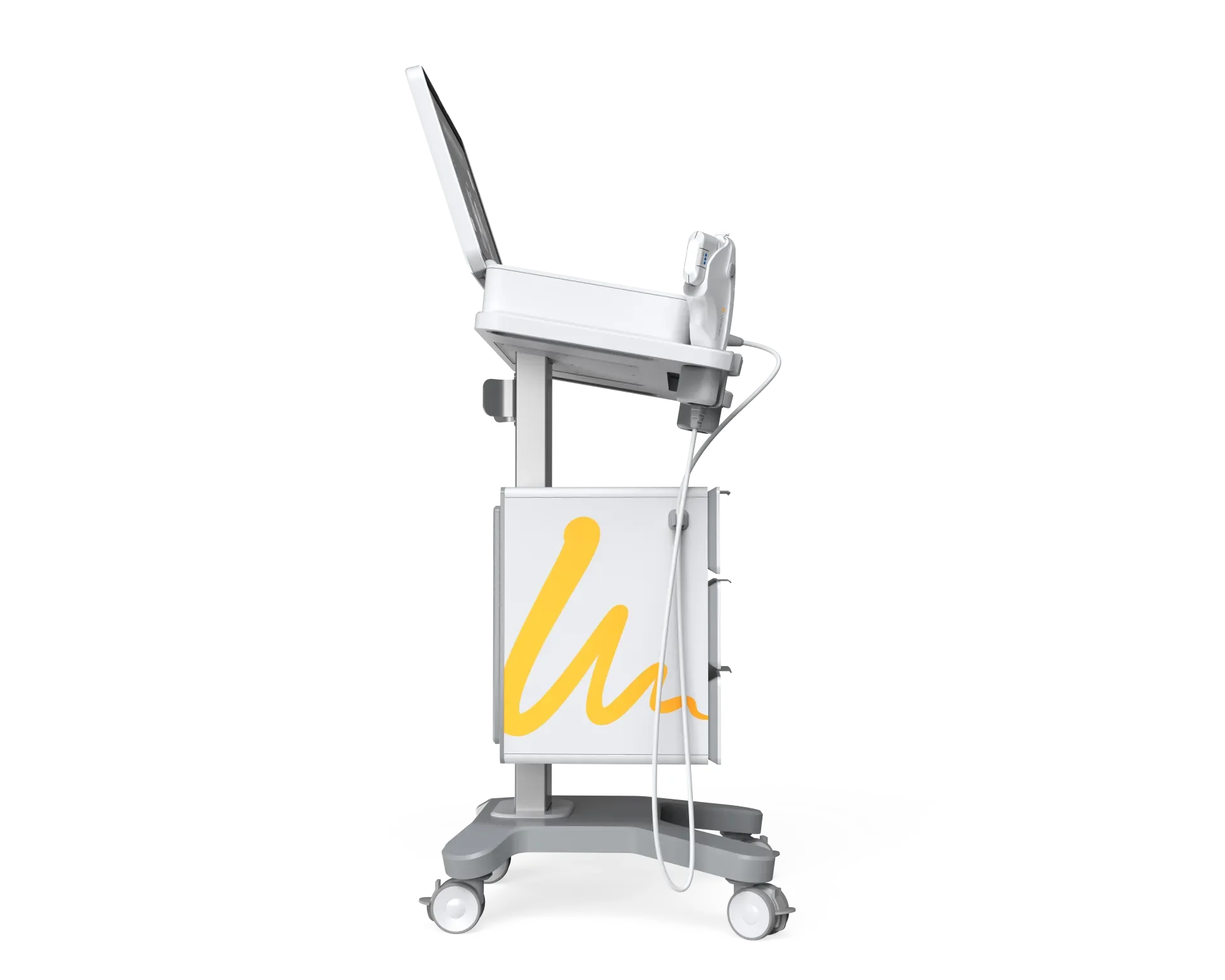
Ask the clinic to confirm in writing which device generation and which specific transducer cartridges they'll use on your session. Reputable clinics will answer immediately and may show you the device. The Prime device cart looks visibly different from the original — the redesigned chassis is recognizable. If the clinic hesitates or gives a vague answer, treat it as a red flag and consider a different provider. The question takes thirty seconds and the answer should be trivial.
Does Prime allow body treatments the original device couldn't do?
Yes, and this is one of the more meaningful platform differences. Prime introduced dedicated body transducers for areas like upper arms, abdomen, knees, and inner thighs that weren't part of the original device's standard rollout. If you're considering body MFU specifically, Prime is materially better positioned. For face-only treatments, the body-transducer expansion is irrelevant to your decision.
Are the long-term results different between original and Prime?
Studies suggest long-term outcomes are comparable. The collagen-remodeling effect peaks at three to six months and gradually softens over 12 to 18 months on both device generations, with maintenance sessions typically recommended at the 12-to-18-month mark. The duration and quality of the result are driven primarily by tissue response, sun exposure, lifestyle, and aging rate — not the device generation that delivered the energy. Don't expect Prime results to last meaningfully longer than original-device results.