Treatment Guide
Ultherapy vs Shurink vs Doublo: Honest Korean MFU Compare
Three Korean MFU lifting devices, one American patient with a notebook, and the honest side-by-side I wish I had on my first trip.
On my second trip to Gangnam I sat across from a coordinator who slid three brochures across the table — Ultherapy, Shurink, Doublo — and asked which one I wanted. I had spent six hours on Reddit the night before and I still did not have a real answer. So I asked her to walk me through all three, took two pages of notes in the hotel that night, and cross-checked the numbers against PubMed and the FDA listing the next morning. This guide is what I wish someone had handed me before that consultation. It is not a ranking. It is a side-by-side that respects how different these devices actually are.
What MFU is, and why the three devices are not interchangeable
Micro-focused ultrasound, or MFU, is a non-invasive lifting technology that delivers focused ultrasound energy below the skin to create small thermal coagulation points in the SMAS layer, which patients report can stimulate a remodeling response over the following months. That is the broad mechanism shared by all three of the devices in this comparison. Where they differ — and they really do differ — is in the transducer design, the depth options, the cartridge cost structure, and how the energy is delivered.
A 2023 review in the Journal of Clinical and Aesthetic Dermatology of MFU and HIFU technologies for facial laxity describes the SMAS-targeting depth (typically 4.5mm) as the lifting workhorse, with shallower depths (3.0mm and 1.5mm) for the dermis and superficial layers. All three devices in this guide hit those depth ranges. The differences live in the details — and the details are what determine whether the result feels worth the price tag.
The other thing nobody told me clearly on my first trip is that MFU is not a single procedure standardized across clinics. It is a category. Within that category, line count, depth pattern, energy parameters, and operator pacing change the result more than the device label does. I learned this slowly. The first time I asked "how does Ultherapy compare to Shurink" I expected a clean answer. The honest answer is that the comparison is layered — and you cannot evaluate the layers from a brochure or a Reddit thread. You evaluate them in the room, with the coordinator, asking specific questions about the protocol they will run on you.
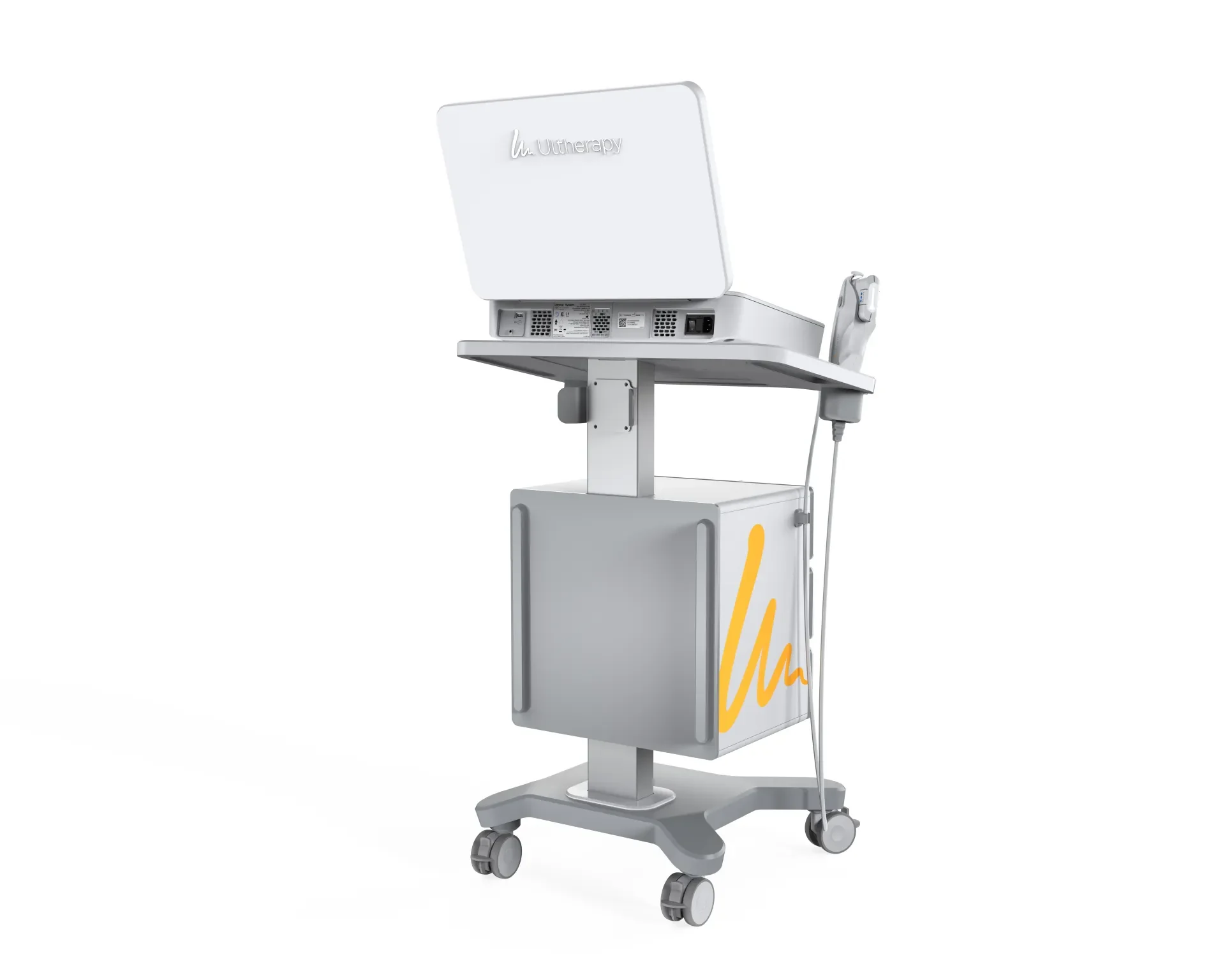
Ultherapy — the FDA-cleared original
Ultherapy was the first MFU device cleared by the U.S. FDA for lifting indications on the brow (2009), submentum, and neck (2012), with later clearance for upper chest lines. That FDA paper trail is the single biggest practical reason American patients ask for it by name in Gangnam. Studies suggest the SMAS-targeting at 4.5mm is the structural lifting layer; the 3.0mm and 1.5mm transducers handle dermal tightening and fine-line work.
In Korea, Ultherapy is run on the original Merz platform with the visualization screen — meaning the practitioner can see the layer the transducer is treating in real time. My provider in Gangnam was specific that this visualization is what she pays for; she has used the cheaper devices in other clinics and described Ultherapy as "the one where you stop guessing." Cartridges are single-use and the per-shot cost runs higher than the Korean alternatives. A typical full-face protocol uses 300 to 600 lines depending on the indication.
For American patients in particular, the FDA clearance creates a paper-trail comfort that matters when you are explaining the procedure to your primary care doctor at home, your insurance for an unrelated claim, or a slightly skeptical mom on a phone call. "FDA-cleared" is a phrase that closes conversations cleanly. I do not pretend that is a clinical argument; it is a logistics argument, and on a ten-day trip with limited time and a U.S. follow-up plan, logistics is real. May help is the right framing for the documentation comfort, too — the clearance does not guarantee a result, but it lowers the friction in every conversation around the result.
Shurink — the Korean MFU that Korean patients ask for
Shurink is a Korean-developed MFU platform manufactured by Classys, which received Korean MFDS approval and has built out the local market substantially since launch. Shurink Universe is the current generation, with redesigned cartridges and a wider transducer set that some Korean clinicians say allows faster treatment of larger areas. Korean patients I have spoken with — and I have asked at three separate clinics — tend to default to Shurink for cost reasons; cartridges run a meaningful amount lower than Ultherapy, which translates into a session price difference that adds up.
The trade-off, in my reading of the available material, is documentation density. Ultherapy has more peer-reviewed literature in U.S.-led journals because it has been on the U.S. market longer; Shurink has growing publication output in Korean-led aesthetic journals but the English-language base is smaller. May help is the right framing here — both can produce comparable results in a skilled hand, but the body of evidence behind each looks different. My Gangnam provider said the depth and energy specs are similar; what differs is the platform's energy stability and the practitioner's familiarity.
A second thing worth knowing: Shurink Universe added a wider linear transducer that can run higher line counts in a similar session window, which means a Shurink session at the same time budget may deliver more total lines than an Ultherapy session. Whether more lines is better is not a settled question — it depends on the indication, the depth pattern, and the operator's discipline. Patients report that line count alone does not predict the lifting result; line count plus depth selection plus operator hand does. I asked my provider whether she would run a Shurink session on me at the same line count she runs Ultherapy. She said yes, with caveats, and that the result would likely look comparable but the consultation would need to map the depth pattern carefully because the platforms cue depth slightly differently.
Doublo — the third option you will hear in Korean clinics
Doublo is a Korean MFU device manufactured by Hironic, with KFDA clearance and a presence in Korean dermatology clinics that has expanded over the past several years. Doublo Gold is the iteration most commonly quoted in current Gangnam pricing sheets. The depth options cover the same 1.5/3.0/4.5mm range; the transducer count and the per-line cost structure differ from both Ultherapy and Shurink.
One specific thing my coordinator pointed out — Doublo is sometimes positioned as a "value" option in Korean clinics, but the price difference compared to Shurink narrows once you compare the same line count. I did not pick Doublo on either of my trips, but a friend who flew in from Vancouver chose it because her clinic ran a package she trusted. She reported a comparable result to my Ultherapy session at a lower per-session cost. One data point, two different patients, two different faces — I am not drawing a conclusion from that. I am telling you what I saw.
The published English-language outcome data on Doublo is the thinnest of the three, in my reading. That is not the same as saying it does not work — it is saying that if you are the kind of patient who reads the literature before deciding, you will find less material to read for Doublo than for Shurink and meaningfully less than for Ultherapy. Studies suggest the mechanism is comparable across MFU platforms; what is harder to evaluate from the literature alone is platform-specific consistency at the energy parameters Korean clinics actually use. My friend's clinic in Vancouver had run Doublo for several years and the operator was experienced. Operator experience may matter more than literature volume for any of the three devices, and that is part of why I keep coming back to the same point — pick the practitioner first, then pick the device they are most comfortable on.
Side-by-side: the comparison table I built in my hotel
I built this table from the brochures my coordinator gave me, the manufacturer technical sheets, and what I could verify on FDA and KFDA listings. The cells are categorical, not ranked — different patients, different faces, different priorities. Pricing cells are intentionally omitted because they shift across clinics and cartridge counts; ask for an itemized line count when you consult.
| Feature | Ultherapy | Shurink Universe | Doublo Gold |
|---|---|---|---|
| Manufacturer / origin | Merz Aesthetics (US-based) | Classys (Korea) | Hironic (Korea) |
| Regulatory clearance | U.S. FDA + KFDA | KFDA + select international | KFDA + select international |
| Energy type | Micro-focused ultrasound (MFU-V) | MFU (HIFU-class) | MFU (HIFU-class) |
| Depth options (mm) | 1.5 / 3.0 / 4.5 | 1.5 / 3.0 / 4.5 | 1.5 / 3.0 / 4.5 |
| Visualization screen | Yes (real-time) | No (blind delivery) | No (blind delivery) |
| Typical session line count | 300-600 (full face) | 300-800 (full face) | 300-800 (full face) |
| Recovery downtime | Minimal (mild redness, possible swelling) | Minimal | Minimal |
| Result onset | Gradual, 2-3 months peak | Gradual, 2-3 months peak | Gradual, 2-3 months peak |
| Best-fit indication | Documented lifting (brow, submentum, neck) | Volume-area lifting at lower per-line cost | Value-tier lifting in clinic packages |
What I actually asked my coordinator (and what she answered)
On my second consultation I came in with five questions written in my notebook. The first one — which device do most of your American patients pick? Ultherapy, by a wide margin, mostly because of the FDA recognition. The second — which one do most of your Korean patients pick? Shurink, mostly because of cost. The third — is there a clinical reason to pick one over the other for a forty-something American with mild lower-face laxity, no surgery interest, ten-day trip window? Her answer was honest: any of the three can produce a result in the right hands; what matters more is the practitioner's line-count discipline and the depth selection logic.
The fourth question — what do you personally use? She had Ultherapy done on herself two years ago. The fifth — what would change your recommendation? If a patient was on a tight budget and the price gap mattered, she would walk them through Shurink with the same depth protocol and have an honest conversation about the documentation difference. I respect that answer. I went with Ultherapy because the visualization screen mattered to me, but I left the consultation feeling like the decision had a logic instead of a marketing layer.
A sixth question I added on my third trip — what is your case volume on each platform in the last year? She had run roughly seventy percent Ultherapy, twenty-five percent Shurink, and a small remainder on other devices. That ratio is meaningful. A practitioner running mostly one device every week is going to be tighter on that platform than one rotating evenly. If your provider is heavily concentrated on a device that is not your first choice, ask whether the difference matters to your indication. Sometimes the answer is no, and the operator's hand on their primary device wins. Sometimes the answer is yes, and you are better off with a different practitioner whose primary device matches your goal.
Citations, hedging, and why this guide ends without a winner
A 2023 systematic review in Lasers in Medical Science on micro-focused ultrasound for facial skin laxity reported that across pooled studies, MFU treatments produced measurable improvement in jawline definition and brow position with a favorable safety profile, while noting that direct head-to-head comparisons of the three platforms in this article are limited. Studies suggest comparable mechanism-of-action; what is harder to compare in published English-language literature is platform-specific outcome data at the same energy parameters and patient profile. The published base for Ultherapy is the largest; Shurink and Doublo have growing Korean-led publication bases.
Hedging is the honest move here. Patients report different outcomes for reasons that include skin biology, baseline laxity, line-count discipline, depth selection, and the practitioner's hand. Anyone telling you one device is universally superior to the other two is selling you a brand, not a result. My personal pick was Ultherapy on both of my trips, and I would pick it again — but I would not call that a winner declaration. It was the right fit for my face, my budget, my comfort with the visualization screen, and my preference for a longer published track record. Yours might land somewhere else, and that is fine.
The other reason I refuse to crown a winner is that the question itself is malformed. "Which device is best" assumes a fixed patient and a fixed practitioner, and neither of those is fixed. The right question is: given my face, my budget, my trip window, and the specific practitioner I am about to book, which device on offer at this clinic gives me the best chance of the result I want? That question has a real answer, and the answer is different for different patients in the same waiting room. Make peace with that, and the brand-versus-brand framing dissolves into the more useful framing: protocol-on-this-face-by-this-operator.
How to actually decide between the three on consultation day
Walk into the consultation with a written list of three things — your primary goal area (jawline / submentum / brow / neck), your downtime tolerance, and your absolute budget ceiling. Ask the coordinator for an itemized line count quote on each device for your goal area. Ask whether the same practitioner runs all three platforms; if not, the comparison is between practitioners, not just devices. Ask what energy settings and depths they would actually use on you (not the brochure default).
If the coordinator can answer those four questions specifically and without hedging on numbers, you are in a clinic that takes line-count discipline seriously. If the answers are vague or pivot to a package upsell, that is a signal — and it is a signal that holds whether you are looking at Ultherapy, Shurink, or Doublo. The device matters less than the hand that runs it. I keep relearning this. The third trip I had Ultherapy with a different practitioner and the result was visibly different from trip one and trip two — same device, same depth protocol, different operator. The brand is the floor. The provider is the ceiling.
Frequently asked questions
Are Ultherapy, Shurink, and Doublo all approved in Korea?
Yes. Ultherapy is cleared by the Korean MFDS in addition to its U.S. FDA clearance; Shurink (Classys) and Doublo (Hironic) are Korean-manufactured devices with KFDA approval. All three are commonly used in Gangnam aesthetic clinics. Patients should still ask their provider for the specific platform model (e.g., Ultherapy with visualization, Shurink Universe, Doublo Gold) since older generations of each are still in circulation at lower-tier clinics.
Why does Ultherapy cost more than Shurink or Doublo in Korean clinics?
Cartridges and per-line cost run higher because Merz Aesthetics is a U.S.-headquartered manufacturer with import pricing; Shurink and Doublo are Korean-made and have a structurally lower cost base. The cost difference also reflects a longer published research history for Ultherapy and the visualization screen feature that the other two devices do not include. Whether the price gap is worth it depends on what you weight — documentation, visualization, or per-line value.
Which device has the most published research behind it?
Ultherapy has the largest body of peer-reviewed English-language literature, partly because it has been on the U.S. market since 2009 and has FDA-required post-market data. Shurink and Doublo have growing publication output in Korean-led journals, and their evidence base is expanding, but the English-language pool is smaller. Studies suggest comparable mechanism-of-action across MFU platforms; head-to-head outcome data at matched parameters is still limited.
Can I get all three quotes at the same Gangnam clinic?
Most large Gangnam clinics carry at least two of the three platforms, and a few carry all three. Ask the coordinator at booking whether the consultation will include itemized line-count quotes for each device available, and whether the same practitioner runs all platforms. If you want all three side-by-side, schedule the consultation as an information visit rather than a same-day treatment, so you have time to compare without pressure.
Is the visualization screen on Ultherapy clinically meaningful?
May help — that is the honest framing. The visualization lets the practitioner confirm transducer-to-tissue contact and depth in real time, which patients report can reduce missed lines or off-layer shots. Shurink and Doublo rely on the practitioner's manual technique without on-screen confirmation. Whether the difference matters in your hands depends on the operator's experience; a senior practitioner on Shurink can outperform a junior on Ultherapy. Ask about practitioner case volume on whichever device you choose.
How do I know if my clinic is using the latest version of each device?
Ask directly. For Ultherapy, the current visualization-equipped platform is the standard; for Shurink, ask whether it is Shurink Universe (newest) or an earlier Shurink generation; for Doublo, Doublo Gold is the most current iteration commonly in use. Older cartridges and platforms are sometimes still in clinical rotation. The clinic should be willing to show you the device model and cartridge packaging — if they decline, that is a useful data point.