Treatment Guide
Ultherapy vs. Sofwave: A Real Comparison (No Brand Loyalty)
What I learned about two ultrasound-based lifting devices after sitting in both chairs in Gangnam — and what I'd tell a friend now.
I have no loyalty to either of these brands. I have loyalty to my face and to the friend in California who keeps texting me asking which one to book in Gangnam — so I sat down and wrote out the honest comparison instead of paraphrasing the brochure. Ultherapy and Sofwave are both ultrasound-based, both non-invasive, and both pitched as "lifting and tightening" devices. They are also genuinely different in how they work, who they suit, and what the chair experience is like — and the marketing in both directions has gotten loud enough that I think a normal-person breakdown is overdue.
Ultherapy: focused ultrasound to deep layers
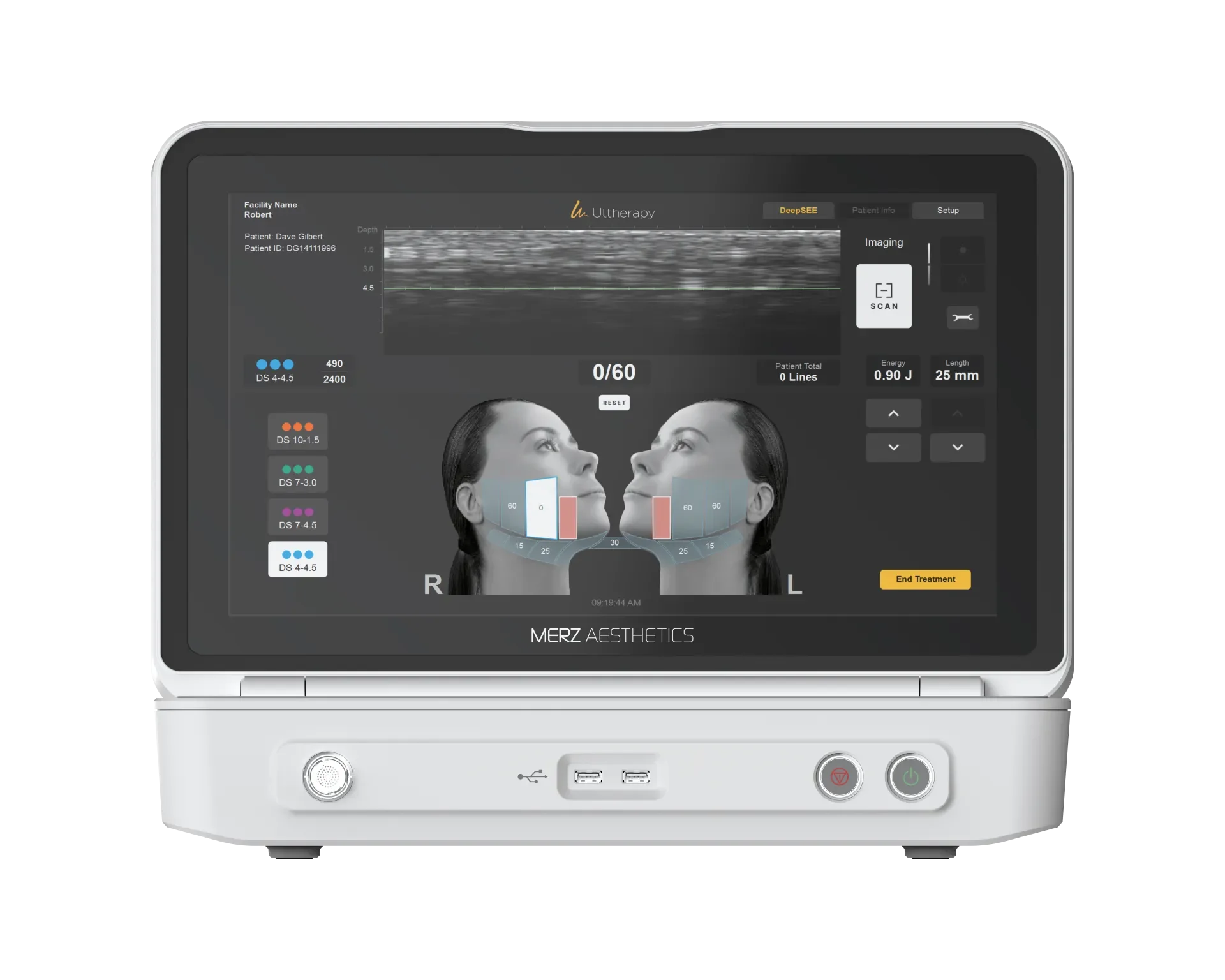
Ultherapy is a non-invasive procedure that uses Micro-Focused Ultrasound (MFU) to deliver heat to discrete focal points at three depths — 1.5mm, 3.0mm, and 4.5mm — including the SMAS, the deeper fibromuscular layer associated with structural facial support. The device generates tiny coagulation zones at each focal point, which the body remodels into new collagen over the months following treatment. It also includes real-time ultrasound visualization, which lets the provider confirm they're treating the layer they intend to treat.
In the chair, this translates to a series of discrete deep "pings" along marked treatment lines on the jaw, lower cheek, brow, and neck. The depth is the headline feature: Ultherapy reaches a layer that most other non-invasive devices don't. That depth is also why it tends to be the device my Gangnam coordinators reach for when the concern is structural — jowls, brow descent, neck-band laxity. It's not subtle in marketing, and it's not always subtle in sensation, but the targeting is precise.
The FDA cleared Ultherapy for non-invasive lifting of the brow, submental area, and neck, and for the appearance of décolletage lines. That cleared-indications list is worth holding in mind when you read marketing copy that pushes the device for everything from cheek volume to fine lines — those broader claims are off-label, and your provider should be transparent about that distinction. I've had the question come up at consult and I now ask it directly: "Is what you're recommending an on-label use, and if not, what's the basis?" The answer is always informative, regardless of what the answer is.
Sofwave: synchronous parallel beams at the mid-dermis
Sofwave is a non-invasive lifting and tightening procedure that uses Synchronous Ultrasound Parallel Beam (SUPERB) technology to deliver seven parallel ultrasound beams to a fixed depth of approximately 1.5mm in the mid-dermis. The beams create a row of thermal coagulation zones in the dermis, which the body remodels into new collagen and elastin over the following months. A built-in cooling mechanism on the transducer keeps the skin surface comfortable while the heat is delivered below.
In practical terms, Sofwave is a shallower, broader-coverage device than Ultherapy. It doesn't reach the SMAS — it works on the dermis. The chair experience tends to be more even and arguably more comfortable than Ultherapy at the deepest setting, in part because of the surface cooling. Sessions are usually shorter, around 30 to 45 minutes for a full face, and downtime is typically minimal. The trade-off is that Sofwave doesn't address structural sag the way Ultherapy can; it's working a different layer for a different goal.
Sofwave is FDA-cleared for the improvement of facial lines and wrinkles, the lifting of lax submental and neck tissue, and the improvement in the appearance of cellulite. The lift claim on submental and neck tissue is the one that creates the most confusion versus Ultherapy in marketing copy, because it sounds like the same indication. The clinical mechanism is different — Sofwave is creating dermal coagulation zones that remodel into firmer surface tissue, not reaching the SMAS — and the visual outcome reads more as firming than as repositioning. I find this distinction often gets lost when people compare the two devices on price alone.
The depth question, plainly
If you take one thing from this article, take this: Ultherapy and Sofwave are both ultrasound, but they treat different depths, and depth determines what they can plausibly improve. Ultherapy reaches the SMAS at 4.5mm, plus 3.0mm and 1.5mm transducers. Sofwave is fixed at roughly 1.5mm, in the mid-dermis. A 2022 paper in the Journal of Cosmetic Dermatology comparing skin-tightening modalities described focused ultrasound and SUPERB as targeting "adjacent but distinct anatomical layers," which is a precise way of saying they don't really do the same job.
For structural lift — jowl, neck bands, the architectural look of the lower face — depth matters. For dermal tightening and texture improvement, depth matters less and coverage matters more. Sofwave is engineered for the latter; Ultherapy is engineered for the former, with some dermal-level work via the shallower transducers. My honest summary, after sitting in both chairs: if your face is sagging at the structure, Ultherapy is the closer match. If your face is mostly losing skin quality and your structure is still intact, Sofwave is the closer match. The cleanest mistake I see friends make is treating them as interchangeable when they're not.
The corollary nobody likes hearing: a 1.5mm dermal device cannot compensate for SMAS-level slack, regardless of pulse count, regardless of session number, and regardless of how a clinic positions it. Studies suggest that for patients with significant structural laxity, dermal-level intervention produces outcomes that read as "better skin" rather than "lifted face," and that's a meaningful difference in a mirror. The reverse is also true: a deeper-acting device used on a face whose primary issue is dermal texture is overkill and won't necessarily produce the texture improvement the patient was hoping for. The match between concern and depth is not a marketing detail. It's the whole question.
Who Sofwave is actually for
Patients report better matches with Sofwave when the primary concern is skin laxity at the dermal level, fine crepe-like texture, and overall tone, especially in earlier stages of aging or in younger patients who want to delay the conversation about deeper-layer intervention. The shorter session and the surface cooling also make it a reasonable choice for people who found Ultherapy uncomfortable in the past or who are time-constrained on a Gangnam trip and want a single 45-minute appointment rather than a 60-to-75-minute one.
Sofwave also tends to come up when the patient is in their early 30s to early 40s, has decent underlying structure, and the goal is preventive maintenance rather than correction. It is not the device I'd choose for someone with visible jowls or significant neck banding — that's a depth mismatch and the result is likely to be subtle to the point of being disappointing. My friend in Berkeley who's 36 and has great bone structure but slightly crepey skin under the eye area: Sofwave was a good fit. My aunt who's 58 and has real jowling: I would not steer her there.
There's also a category of patient I've seen Sofwave suit well that the marketing doesn't talk about as much: people who've had Ultherapy in the past, are happy with the structural result, and want a complementary maintenance treatment that addresses the dermal-level changes happening on top of that maintained scaffolding. In that sequence, Sofwave isn't replacing anything — it's working a different layer that Ultherapy didn't optimize for. I haven't done this combination myself yet, but it came up in a consult last year and made sense as a logic, not as a sales pitch. Whether it's the right choice depends on individual anatomy and goals.
- Sofwave fit signal: dermal laxity, fine texture, early-stage aging, preventive maintenance
- Sofwave session length: 30-45 min, surface cooling for comfort
- Sofwave less ideal for: visible structural sag, jowls, advanced neck bands
Ultherapy vs. Sofwave comparison table
Here is the comparison I built for myself after the second consult, with the sales language stripped out and the actual numbers I could verify with providers in Gangnam. Specifics vary by clinic, transducer choice, and protocol; treat ranges as ranges and confirm with your provider.
| Factor | Ultherapy | Sofwave |
|---|---|---|
| Energy type | Micro-Focused Ultrasound (MFU) | Synchronous Parallel Beam Ultrasound (SUPERB) |
| Target depth | 1.5mm / 3.0mm / 4.5mm (down to SMAS) | Approx. 1.5mm (mid-dermis), fixed |
| Best-fit concern | Structural lift, jowl, neck bands | Dermal tightening, texture, early laxity |
| Visualization | Real-time ultrasound imaging | No imaging; fixed-depth protocol |
| Surface cooling | No (relies on transducer protocol) | Yes, integrated cooling |
| Typical session length | 45-75 minutes (full face + neck) | 30-45 minutes (full face) |
| Downtime | 0-2 days redness, mild puffiness | 0-1 day mild redness |
| Visible result timeline | 2-6 months (collagen remodel) | 2-3 months initial, up to 6 months |
What the session feels like, in both chairs
Ultherapy, for me, is a series of discrete deep heat pulses along treatment lines marked on my face. The 4.5mm transducer along the jaw is the sharpest sensation; the 3.0mm and 1.5mm work feel progressively milder. I take Tylenol an hour before and have done full-face sessions of around 60 minutes without sedation. The discomfort is real but bounded, and I walk out tired but functional. Day-of swelling is minor, redness fades within a day or two for me.
Sofwave was noticeably more comfortable in the chair. The surface cooling does most of that work — the sensation is a warm pressure rather than a deep ping, and the device covers ground faster because each pulse treats a wider area. A full-face session ran about 35 minutes for me, and I went straight to a Sinsa cafe afterward without anyone asking what was wrong with my face. Recovery for both was short, but Sofwave felt closer to a "have a snack and walk it off" device, while Ultherapy was more of a "go back to the hotel for a quiet evening" device. Same recovery window, different chair experience.
The other practical difference: scheduling around the trip. Sofwave at 35 to 45 minutes can fit into a half-day in Gangnam without disrupting plans, which is genuinely useful if you're combining a clinic visit with a Bukchon walk or a coffee meeting. Ultherapy at 60 to 75 minutes plus consult plus aftercare paperwork basically claims a morning, and I now budget the entire morning even when the clinic says "about an hour." If you're on a tight three-day Gangnam trip and the device match is genuinely close to a tie, the time math may break the tie in Sofwave's favor — not because it's better, but because it's more compatible with travel. That is, embarrassingly, a real factor in how friends of mine end up choosing.
Risks, side effects, and how I choose between them
Both devices have established safety profiles in trained hands and short tails of less common side effects worth knowing. Ultherapy's reported events include transient numbness, mild bruising, and rare nerve irritation in the temple or jaw area, most of which resolve over weeks. Sofwave's reported events include surface redness, mild swelling, and very rare cases of small surface burns when protocols aren't followed correctly. Studies suggest that adverse events for both technologies are predominantly transient and mild when device protocols are respected and the operator is appropriately trained.
My decision flow now, after both: if my concern is structural — jaw, neck, mid-face descent — I book Ultherapy. If my concern is texture, tone, and dermal-level firmness with intact underlying structure, I book Sofwave. If a provider tries to sell me one for both jobs, I pause. If a provider tells me "Sofwave is just a newer, better Ultherapy," I leave — that's a marketing line, not a clinical statement, and the depth difference is real. The honest, brand-neutral version is: they're different tools, they're both good at what they do, and your face will tell you which one was the right call about three months later.
A last note on contraindications: both devices generally aren't recommended during pregnancy, on areas with active infection or open lesions, or near specific implants and devices depending on the area being treated. Sofwave specifically asks about implanted electrical devices in some protocols even though it's ultrasound, because the device itself uses electrical components. Bring your full medication list, any procedure history including filler appointments going back at least six months, and any chronic conditions that affect healing. The consult goes faster, the protocol comes out more conservative where it should be, and the provider can flag a contraindication you might not have known to surface. None of this replaces a medical conversation, but the prepared version of you walking into a Gangnam consult is the version that gets the best protocol.
- Confirm device generation and transducer plan in writing
- Confirm provider operates the device, not a junior tech
- Ask the provider to identify the specific concern your face has and explain why their device matches it
- Get printed aftercare timeline before leaving the consult
Frequently asked questions
Can Sofwave replace Ultherapy for jawline lifting?
Generally no. Sofwave works at approximately 1.5mm in the mid-dermis and doesn't reach the SMAS, which is the structural layer associated with jawline and lower-face lifting. Patients report dermal-level tightening from Sofwave that can produce subtle improvement in skin firmness around the jaw, but for visible jowling or genuine structural sag, most providers I've spoken with in Gangnam still reach for Ultherapy or a deeper-acting modality. Ask your provider directly whether your specific anatomy is a depth match for the device they're recommending.
Which one hurts less?
Sofwave was noticeably more comfortable for me, primarily because of the integrated surface cooling and the broader coverage per pulse. Ultherapy at the 4.5mm depth along the jawbone is the sharpest sensation I've experienced from either device. Both are tolerable for most patients, especially with pre-medication, but if pain tolerance is a real concern, mention it to your coordinator and ask about numbing options before you commit to a specific device. The chair experience also varies between providers — a more experienced operator delivering a clean, fast Ultherapy session is often more comfortable than an inexperienced one delivering a slow Sofwave session, even though the technologies say otherwise on paper.
Are results from Sofwave shorter-lived than Ultherapy?
Studies suggest both produce collagen remodeling that lasts roughly 12 to 24 months on average, but the kind of result is different. Sofwave dermal tightening tends to look like skin-quality improvement and subtle firming. Ultherapy SMAS-level work tends to look like a structural lift. They're not directly comparable on duration — they're addressing different concerns. If your concern is texture, Sofwave's window may feel sufficient. If your concern is sag, you may want Ultherapy's depth even if the duration is similar.
Can I do Sofwave first, then Ultherapy later?
Yes, this sequence is reasonable, especially for younger patients who don't yet have structural concerns and want to start with dermal-level maintenance. Most providers I've spoken with prefer to space treatments by at least 4 to 8 weeks if you're treating the same area, but combining them in one trip on different anatomical zones is sometimes done. This is a clinic-specific conversation; don't stack them aggressively for travel convenience without medical sign-off.
Is one of them safer than the other?
Both have established safety records when the device is current-generation and the operator is properly trained. Sofwave's surface cooling adds a layer of comfort and reduces some surface-heat risks, while Ultherapy's real-time imaging adds a layer of depth-targeting precision. The dominant safety variable is operator skill and protocol adherence, not which brand is in the room. I ask the same due-diligence questions for both: who is operating, what is the protocol, and what is the printed aftercare plan. If a clinic can answer those three questions cleanly, the brand on the device is a secondary concern. If they can't, no device is safe enough to make up the gap.
How do I know which one I actually need?
Ask a provider to point at the specific concern on your face and explain — out loud, in plain terms — why one device addresses it better than the other. If the answer is generic or focuses on which device the clinic happens to own, get a second opinion. The cleanest signal is whether your concern is structural or dermal: structural concerns generally favor Ultherapy, dermal concerns generally favor Sofwave. If you genuinely have both, the answer might be sequencing, not picking one. I now bring a printed photo of my face from a year ago to the consult, because the change happens slowly enough that month-to-month it's invisible, and a year-over-year photo gives the provider better information about what's actually shifted.