Treatment Guide
What Ultherapy Actually Is — Explained Like I'd Tell a Friend
Plain-English Ultherapy: how the focused ultrasound works, who it's actually for, what it feels like, and what it can't do.
I've had Ultherapy three times — once in Berkeley, twice in Gangnam — and every single time someone in my California friend group texts me afterwards asking what it actually is. And every single time I realize the brand websites and the clinic brochures explain it in this weird half-medical, half-marketing register that doesn't actually answer the question. So this is the version I'd give my friend Sara over coffee, with no buzzwords, no hype, and a few honest hedges where the science gets fuzzy. If you're considering it, this is the explainer I wish I'd had on trip one.
So what is Ultherapy, actually?
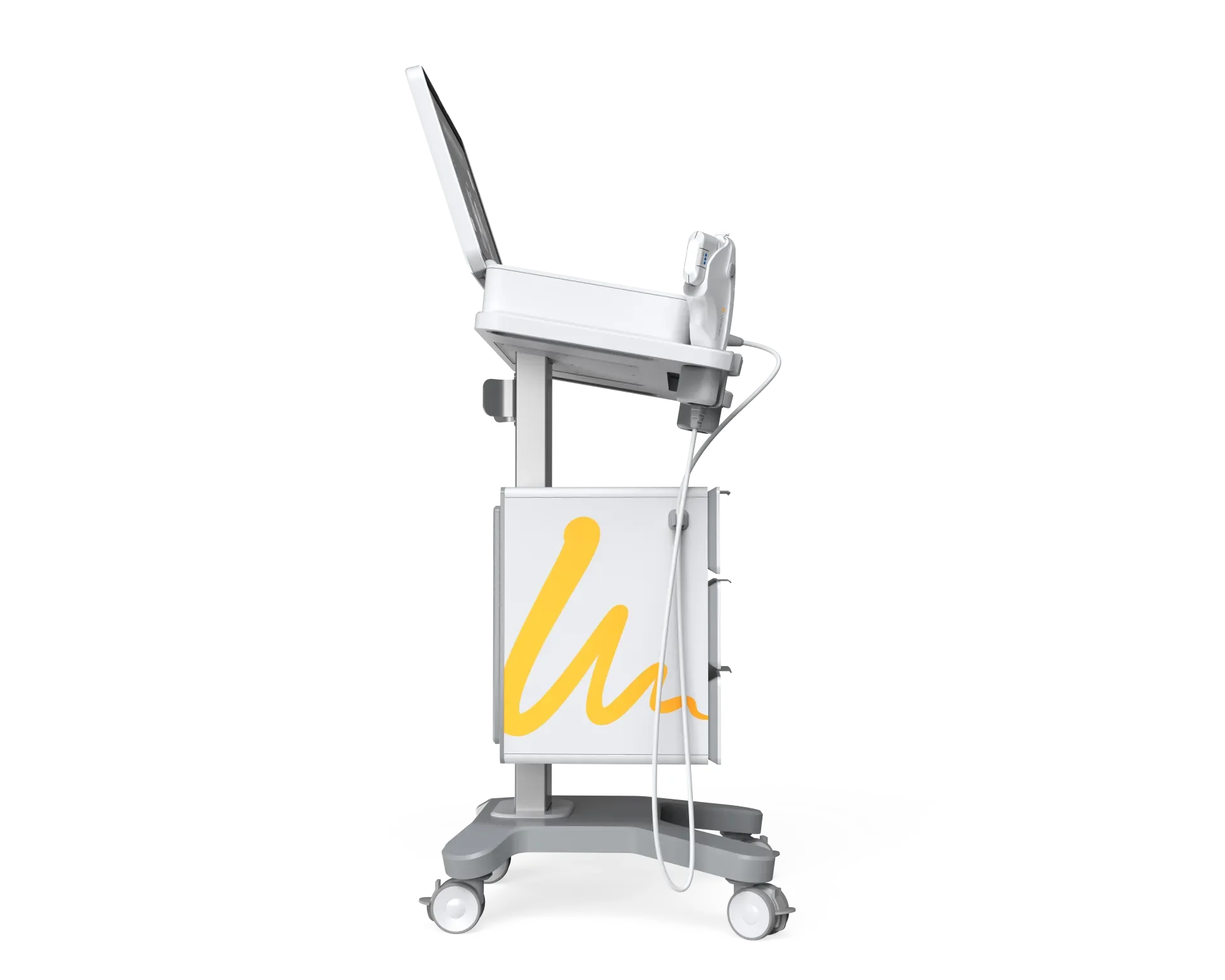
Ultherapy is a non-surgical skin-tightening procedure that uses focused ultrasound energy to heat specific layers under your skin so your body responds by making new collagen over the next three to six months. That's the whole thing. It's FDA-cleared in the United States for lifting the brow, the under-chin area, and the neck, and for improving lines on the décolletage — that's it, that's the official US label. Korean clinics use it on the same areas plus a few off-label zones like the jawline and the body, which I'll get to. Off-label doesn't mean unsafe in this context — it means the specific use hasn't gone through US clearance, but the underlying technology is the same. The word "Ultherapy" is a brand name, not a generic term. The technology underneath it is called MFU — microfocused ultrasound — and the device is made by a company called Merz Aesthetics. When a Korean clinic says "Ultherapy" they should mean the actual Merz Ulthera device. If they say "HIFU" or "Korean Ultherapy" they probably mean a different category of machine entirely, which I'll cover in a separate guide. The distinction matters more than the marketing makes it seem. One more framing thing before we go further. Ultherapy is not a wrinkle filler. It is not a Botox alternative. It is not a substitute for a surgical lift. It sits in its own category — energy-based collagen induction — and confusing it with any of those other categories is how patients end up disappointed. If you have deep nasolabial folds, Ultherapy isn't your answer; filler is. If you have dynamic forehead lines, Ultherapy isn't your answer; neuromodulator is. If you have significant jowls and skin redundancy, Ultherapy isn't your answer; a deep plane facelift is. Ultherapy treats one specific thing — early-to-moderate skin laxity — and treats it well when it's the right tool for the job.
How the ultrasound actually works under your skin
Here's the part that took me an embarrassing amount of time to understand. Regular diagnostic ultrasound — the kind they use in pregnancy scans — sends sound waves through tissue and bounces them back to make a picture. Ultherapy uses the same general technology but does two things differently: it focuses the sound waves into a tiny target point, and it cranks up the energy at that target until the tissue heats to roughly 60 to 70 degrees Celsius for a fraction of a second. That heat causes a controlled micro-injury at very specific depths under your skin. The controlled-injury part is the whole point. When you damage tissue in a precise, contained way, your body's wound-healing response kicks in — fibroblasts get activated, new collagen and elastin get laid down, and over three to six months the tissue contracts and tightens. A 2014 paper in the Journal of the American Academy of Dermatology (PubMed indexed, you can search it) reviewed the histological evidence and found measurable changes in dermal collagen density at the targeted depths. Studies suggest the effect is real, though the magnitude varies widely between patients. I'll come back to that variability — it's the most important thing on this page.
The three depths and why your provider talks about them
Ultherapy isn't one setting — it's three. The device has interchangeable transducers (basically the wand head), and each one delivers focused ultrasound at a different depth: 1.5mm, 3mm, and 4.5mm. The 1.5mm transducer hits the upper dermis, which affects fine surface texture and very superficial tightening. The 3mm hits the deep dermis, where most of the visible tightening happens for cheek, jaw, and neck areas. The 4.5mm transducer reaches the SMAS layer — the same fibrous-muscular layer that surgeons lift during a facelift — and that's where the structural lift effect comes from. The SMAS layer is the part that makes Ultherapy genuinely different from most other tightening devices. Radiofrequency treatments like Thermage work in the dermis and don't reach SMAS. Most laser-based tightening doesn't either. Ultherapy is, as far as I know, the only widely-available non-surgical device that can deposit focused energy at SMAS depth — which is why it gets called a "non-surgical lift" in marketing. That phrase is half true. It can produce a subtle lifting effect because of the SMAS depth, but it's not a substitute for a surgical lift. Patients report visible tightening, not a dramatic lift. I'll keep saying this because the marketing keeps blurring it.
Who Ultherapy is actually for (and who it isn't)
The honest answer is that Ultherapy works best on people with mild-to-moderate skin laxity who haven't lost a lot of facial volume yet. That tends to mean people in their mid-30s to mid-50s with reasonably good skin elasticity, mild jowling, mild brow descent, mild neck looseness — emphasis on mild. If you have a lot of fat redistribution, deep folds, or significant skin sagging, Ultherapy on its own probably won't get you what you're hoping for. Your provider may suggest combining it with filler, a thread lift, or just being honest that you're closer to a surgical candidate. It also works best on people who understand the timeline. Ultherapy results don't show up immediately. Day one, your face will look slightly puffy and maybe a little flushed. Weeks one through six, you'll mostly see nothing. Months three through six is where the gradual tightening becomes visible — and even then, it's subtle, and friends who don't know you had it usually don't notice. They just say you look rested. That's the whole brief. If you want a dramatic before-and-after, this isn't the procedure. If you want a slow, natural-looking tightening that nobody can pinpoint, this is exactly the procedure. A word on candidacy I think gets underplayed. Ultherapy works best on patients with healthy skin barrier function, decent baseline collagen, and a history of reasonable sun discipline. Patients with significantly photoaged skin, heavy smokers, and patients with autoimmune conditions affecting collagen synthesis often respond more slowly or less dramatically. None of that automatically disqualifies you, but it should shape your expectations. A 60-year-old with a lifetime of sunscreen use and good skincare often gets better Ultherapy results than a 45-year-old who lived in the sun without protection. Skin biology cares about cumulative history. The procedure responds to what your tissue can still do, not what you wish it could do.
What a session actually feels like (the part nobody describes well)
I've now done full-face Ultherapy three times so I have a real-person reference for this. You arrive, sign consent, take photos, and they apply numbing cream for 30 to 45 minutes. In Korean clinics they often add a sedative or an oral anti-anxiety pill on request, and some clinics offer light IV sedation for full-face sessions. The numbing helps but doesn't eliminate the sensation. When the transducer fires at the deeper layers, especially over bone like the jaw or brow, the feeling is a sharp, hot, brief stab — kind of like a quick electric heat pulse — that lasts a fraction of a second per shot. Then it moves to the next spot. A full-face session is usually 200 to 600 "lines" — the unit a clinic uses to count individual ultrasound shots — and takes 45 to 90 minutes. It's not pleasant. I'd put my pain level around a 5 or 6 out of 10 over bone and a 2 or 3 over softer areas. Some patients tolerate it easily; some don't. The first time I cried twice. The third time I barely flinched, partly because I knew what was coming and partly because the new device generation is genuinely more comfortable. Patients report that the upgrade — Ultherapy Prime — feels noticeably easier than the original device, which I'll cover in detail elsewhere. A few practical things I've learned across three sessions. Ask for a stress ball or a hand to squeeze — having something to grip during the deeper-bone shots genuinely helps. Eat a real meal before you arrive; sedatives on an empty stomach made me lightheaded my first session. Bring a podcast or playlist downloaded to your phone, because the rhythm of waiting for the next shot is mentally easier when you have something else to focus on. Tell your provider before each new area starts so you can take a breath. Korean clinics tend to push through faster than American ones, which is mostly fine but occasionally too fast — speak up if you need a pause. The session is a collaboration, not a thing being done to you.
Recovery, sun rules, and what to skip after
Ultherapy has almost no formal downtime, which is one of its actual selling points. The day of the procedure you'll look slightly puffy and a little pink, especially under the chin. Most people are presentable for dinner the same evening. Some patients see mild bruising or small linear redness along the transducer path — those usually resolve within five to ten days. Tenderness over treated bone areas (jaw and brow) can last up to a week. I always plan two quiet recovery days after the session, mostly because of the tenderness and because I prefer to baby my skin barrier for the first 72 hours. The non-negotiable post-procedure rule is sun protection. The treated tissue is healing for at least two weeks, and UV exposure during that window is genuinely the thing most likely to compromise your result. Broad-spectrum SPF 50, reapplied every two to three hours when outdoors, plus a hat with a 4-inch brim. Avoid heat exposure — saunas, jjimjilbangs, hot yoga, intense cardio — for at least seven days. Skip retinoids, vitamin C serums, and acid exfoliants for at least five to seven days, or whatever specific timeline your provider gives you. The recovery is more about discipline than discomfort.
Risks, side effects, and what to ask before you book
Ultherapy is generally well-tolerated, but it's not risk-free, and any provider who tells you otherwise isn't being straight with you. The most common side effects are temporary: redness, swelling, tenderness, mild bruising, small welt-like marks along the treatment lines that resolve within a week or two. Less common but documented side effects include temporary numbness in patches of the treated area, small pockets of fat loss in patients treated with certain settings on thinner-fat zones, and very rare reports of nerve irritation that usually resolves on its own but occasionally lingers for several months. A 2018 review on the .gov-indexed StatPearls dermatology resource discusses adverse events in non-invasive skin tightening — worth reading before your consult. Contraindications are worth understanding too. Active acne in the treatment zone, open lesions, recent fillers in the immediate target area, certain implanted electrical devices, current pregnancy, and a few specific autoimmune conditions are all reasons to delay or avoid Ultherapy. Recent fillers are the one I see most often missed — most providers will tell you to wait at least two weeks after fillers before MFU, and some say four weeks, because the focused energy can affect the integrity of recently placed filler. If you're combining treatments in a Korea trip, sequence matters. I usually do Ultherapy first, then any filler or skin-booster injections two weeks later, never the reverse. The questions I now ask every provider before booking: How many lines are you planning, and what areas? What transducers will you use, in what order? Have you treated patients with my specific skin laxity profile before? What's your protocol if I report unusual numbness or tenderness post-procedure? What's the realistic result you're expecting at three months and six months? If a clinic can't answer those concretely, I keep shopping. The procedure is too expensive and too consequential for vague answers.
Ultherapy vs the alternatives — quick orientation
There are a lot of energy-based tightening devices on the market, and the categories are confusing because the marketing deliberately blurs them. Here's the orientation table I'd give you on a napkin. The point of this table isn't to rank — it's to show you that these are different tools with different jobs, and the right answer depends on your face, your goals, and your provider's training. None of them is universally "best." Anyone who tells you a specific device is the best for everyone is selling that device.
| Category | Energy type | Target depth | Sessions | Downtime | Best for |
|---|---|---|---|---|---|
| Ultherapy / MFU | Microfocused ultrasound | 1.5 / 3 / 4.5mm (incl. SMAS) | 1, repeat 12-18mo | 1-3 days social | Mild-mod laxity, lift bias |
| Sofwave / SUVB | Synchronous ultrasound | 1.5mm only | 1, repeat 12mo | 1-2 days social | Surface tightening, less pain |
| Thermage / monopolar RF | Radiofrequency | Dermal | 1, repeat 12-18mo | 0-2 days social | Skin texture, mild contour |
| Korean HIFU (Shurink/Doublo) | High-intensity focused ultrasound | Variable | 1, often repeat 6-12mo | 1-3 days social | Budget tightening, regional brands |
| Thread lift | PDO/PLLA threads | SMAS-adjacent | 1, redo 12-24mo | 5-14 days | Visible lift, more invasive |
| Surgical facelift | Surgical | SMAS | 1, redo 7-15 years | 2-4 weeks | Significant laxity |
Frequently asked questions
Is Ultherapy the same thing as HIFU?
No, though the names get used interchangeably and that confusion is one of the most common things I correct in friend conversations. Ultherapy uses microfocused ultrasound (MFU) at very specific depths and is the brand name for the Merz Ulthera device. HIFU — high-intensity focused ultrasound — is a broader category that includes Korean and Chinese-manufactured devices like Shurink and Doublo. They share underlying physics but the safety profile, depth control, and clinical evidence base aren't equivalent. Ask your clinic which exact device they're using.
How long do Ultherapy results last?
Studies suggest the collagen-building effect peaks around three to six months post-procedure and then gradually softens over the following 12 to 18 months. Most patients report visible tightening for roughly a year to a year and a half, with significant individual variation based on skin quality, age, lifestyle, and sun exposure. Many patients schedule a maintenance session every 12 to 18 months to keep results stable. Your provider should give you a personalized timeline at consult.
Does Ultherapy work for everyone?
No, and this is where realistic expectations matter most. Ultherapy works best on patients with mild-to-moderate skin laxity who still have decent collagen reserves and elasticity. Patients with significant volume loss, heavy jowling, or substantial skin sagging often see disappointing results — they're closer to surgical candidates or candidates for combination treatments. A good provider will tell you honestly if you're not a strong candidate, even if it means turning away the booking.
Will I look different right after the procedure?
Mildly, yes. Day one you'll typically have some swelling, a slight pink flush, and tenderness over the treated areas. Most people are socially presentable the same evening, especially with light mineral makeup. Visible tightening doesn't appear immediately — that's the three-to-six-month timeline I keep emphasizing. If a friend has Ultherapy on Friday and looks dramatically lifted on Monday, what they're showing you is swelling, not the actual treatment effect. The real result is slow.
How many sessions of Ultherapy do I need?
Most patients have one full session and reassess at the six-month mark. Some patients benefit from a second session at six to twelve months, particularly for harder-to-treat areas like the lower face. After the initial result settles, maintenance sessions every 12 to 18 months are common for patients who want to sustain the effect. Stacking multiple sessions back-to-back isn't recommended — your tissue needs time to remodel between treatments.
Is Ultherapy worth the cost?
That depends on what you're comparing it to and what you actually want. It's more expensive than most Korean HIFU alternatives, less expensive than a surgical facelift, and pricier than Thermage in most markets. The clinical evidence base for the specific Ulthera device is broader than for many regional alternatives, which is part of what you're paying for. Patients report it's worth it when they have realistic expectations and a provider they trust; patients who expected a dramatic transformation often feel let down. Set the expectation correctly and the cost-value question gets clearer.